Australian Electric Vehicle Policy Reviews - 2026
It’s replacing $40 bn of annual oil imports stupid
There are lots of sound reasons for Australia to go hard on EVs, much harder than it currently does. But the number one reason that should appeal to Treasury is we get the equivalent of a new export industry. Replacing oil imports is pretty much the same as increasing exports. Why go through all the pain of having new LNG facilities and new coal mines when we can just kill oil imports and get a lot of votes in the process? Of the three main policy reviews this year—(i) safeguards, (ii) EV FBT concession and (iii) EV strategy—it’s the third that provides the biggest opportunity to improve Australia, to win votes, to increase the average Australian’s wealth via a stronger $, to decarbonise a significant sector, to reduce strategic risk and to increase public health.
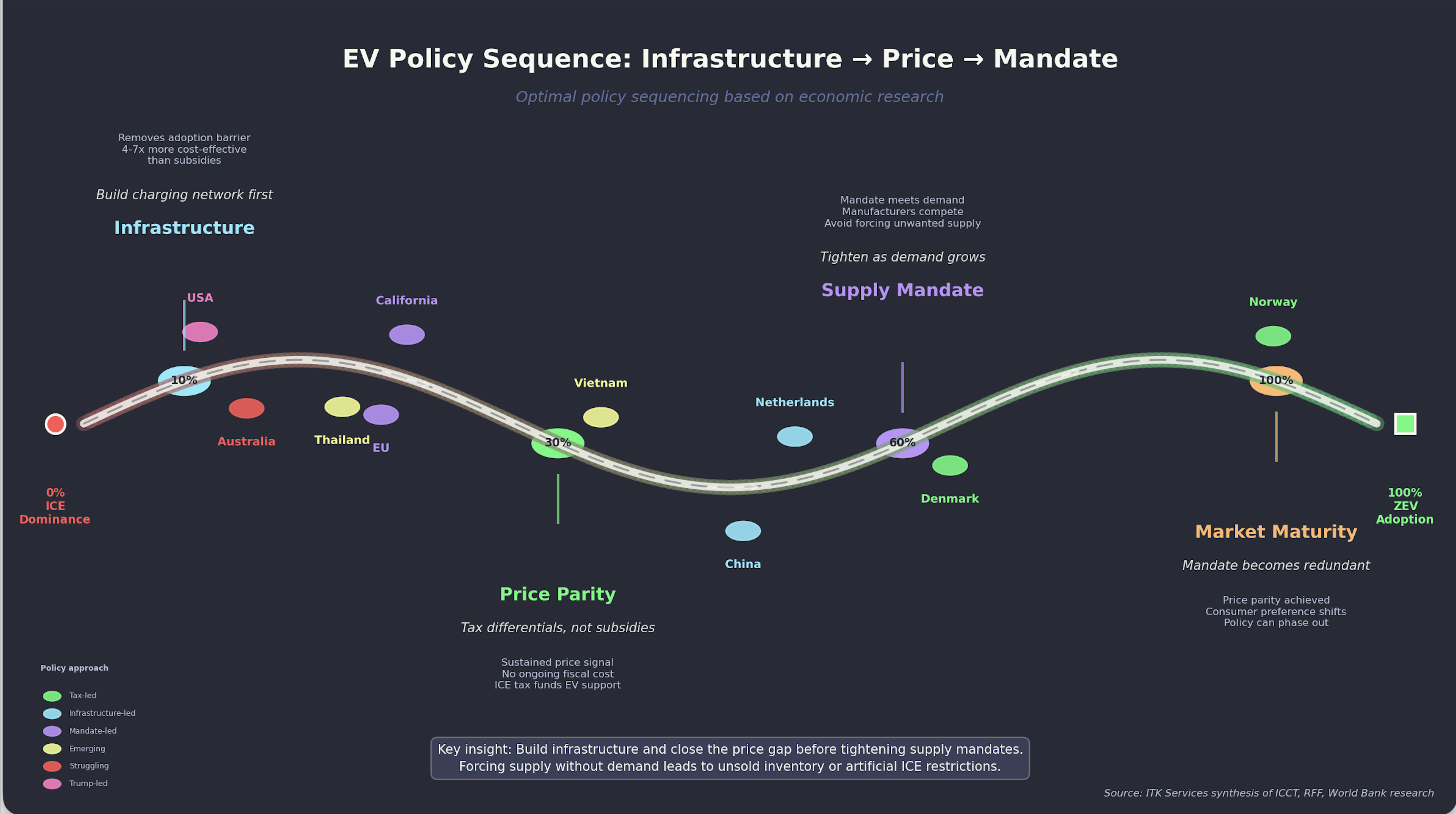
In this note we cover what policy works and the sequencing that Australia’s EV strategy review of the 2023 policy should implement. It requires going much harder on charging infrastructure, and building future proof infrastructure, ie over powering, then providing consumer incentives, like the FBT but available to all, to close the price gap. Home batteries showed how this can take off. State driven cheap incentive like bus lanes and rego can further drive consumer demand but provide sunset clauses. As consumer demand grows force a supply response via a mandate. In Asia, countries have seen it as in their national interest to promote EV manufacturing as a way to grow a new industry at the expense of traditional manufacturers like Japan. China, Vietnam and via partnerships Thailand have gone this way.
China has provided arguably between US$200 bn and US$300 bn of subsidies to its EV car manufacturers. The ethics of this are one thing but Australia should take advantage of those subsidies to accelerate EV adoption in Australia. Effectively, China pays for our cars. We shouldn’t look this gift horse in the mouth—just use Australian policy to accelerate adoption.
No carbon price but lots of Federal Policy
In 2026 there are three known official Federal Government policy reviews for which the outcome is uncertain. One, the EV FBT exemption review is “live” whereas the Safeguard Mechanism and the National EV strategy reviews are yet to formally commence. I expect there are also ongoing informal reviews, particularly of the effectiveness of the CIS in actually inducing new supply, then there is the Tomago-Snowy “back channel” policy.
On top of what the Federal Government is officially and even unofficially, there are also significant AEMC reviews and of course all the States have a bunch of policies and reviews.
Overview of Federal Review
Summary of Federal Energy Policy Reviews
| Review | Status | Submissions | Published | Agency | Key Focus |
|---|---|---|---|---|---|
| Gas Market | Implementation | Not open | ✗ | DCCEEW/DISR/ACCC | Domestic reservation scheme (15-25%); LNG netback methodology |
| DMO Framework | Implementation | Closed | ✓ | AER | Electricity price caps; tariff caps; embedded networks; Solar Sharer Offer |
| NEM Wholesale Market | Implementation | Closed | ✓ | Energy Ministers | Market liquidity; Market-Making Obligation; ESEM |
| Cheaper Home Batteries | Active | N/A | — | DCCEEW | ~200k installations; $7.2B program; 2M batteries by 2030 |
| Electric Car Discount | Review | Open | ✗ | Treasury/DCCEEW | FBT exemption effectiveness; $1.35B cost; PHEV eligibility |
| National EV Strategy | Pending | Not open | ✗ | DCCEEW | Uptake progress; charging infrastructure; regional equity |
| Safeguard Mechanism | Pending | Not open | ✗ | DCCEEW | Post-2030 decline rates; offset limits; 2035 NDC alignment |
Source: Author compilation from government announcements
Much of this policy could have been minimised if Australia had stuck with the carbon tax. Abolishing the tax has in the end achieved little, coal generators are still going to close, EVs are still slowly gaining market share, renewable generation has grown steadily and it’s likely the seeds for further growth, in the form of FID for several GW of renewables, will be planted this year. The required transmission upgrades are mostly proceeding.
If we had done some of this work back when the carbon tax was in place and stayed ahead of the rest of the world it would have been a lot cheaper but to be fair the delay has enabled technology solutions like inverter based grids to move out of the lab into the actual grid.
Carbon scoreboard
Although you can make excuses about carbon by relating emissions to population and/or GDP, in the end the physics of carbon are driven entirely by the longer wave infrared absorption and rejection of the carbon in the atmosphere. More carbon more global warming, population and GDP be damned.
Equally I have excluded land use and forestry from the Australian scorecard because I think they are used to make it seem that Australia is making more progress than it actually is.
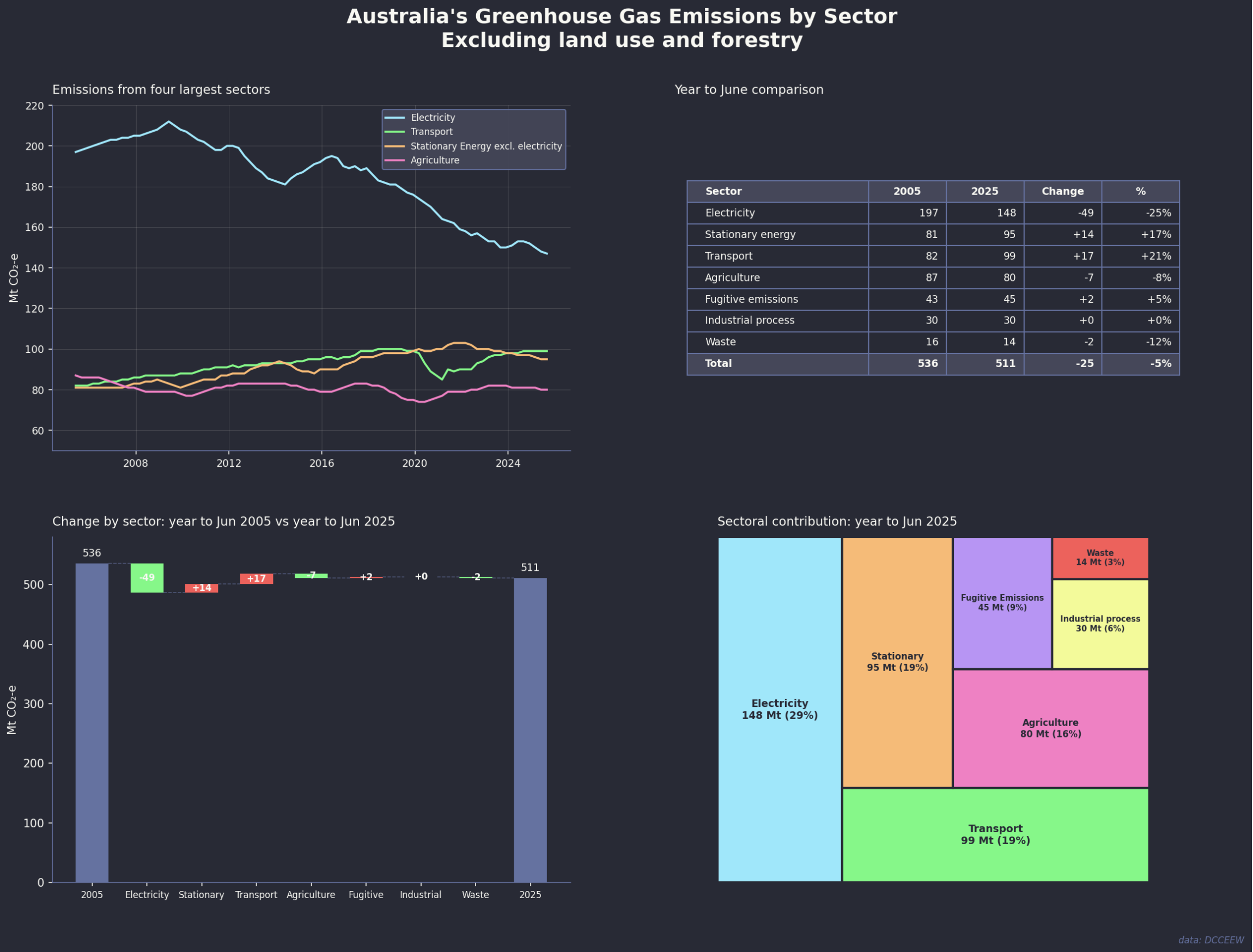
Essentially there is progress in electricity but almost nowhere else. As electricity emissions come down the relative importance of Transport, stationary energy and agriculture will increase.
In general the accepted policy for decarbonisation in Australia is the same as for every other country. Decarbonise electricity, then electrify everything. National EV strategy is the economic opportunity.
This note focuses on the EV-related reviews. There are two separate reviews. In essence the FBT is a subset of the EV strategy. I write from the point of view of a household with two EVs and regular long distance trips, not just to capital cities but to regional NSW and Victoria, over 80,000 EV km so far.
In my view over and beyond pollution a higher EV share should be on the priority list for Australia because: (1) Our climate, generally temperate, and terrain, mostly flat, are ideal for EVs. (2) We have no domestic car industry so there is no manufacturing industry to protect, (3) Australia has lots of oil imports which are both a strategic risk in the time of conflict and hurt our trade balance, (4) China has a surplus of EVs and wants to sell them to us, we should strike while the iron is hot.
Like everyone else who looks at decarbonisation seriously you would conclude that from an economics and efficiency point of view a carbon price or carbon tax is clearly the correct choice. But as ever politics have degraded us to the point where second best policies are the tools available.
Oil imports are a net $40bn say 6% of all imports
Let’s forget about climate and look at Australia’s trade balance. As everyone knows our main exports are iron ore, coal, LNG and tourism. We are the world’s top 3 thermal energy exporters, maybe 4 these days. It’s proving difficult to find industries that can replace thermal energy exports but another alternative is to reduce imports and oil is the main target. Importing EVs doesn’t do anything to the trade balance because we already import all the cars we sell. So we get to reduce imports by around $40 bn per year, let’s say $500 bn of net present value at zero cost. Our trade surplus would increase substantially.
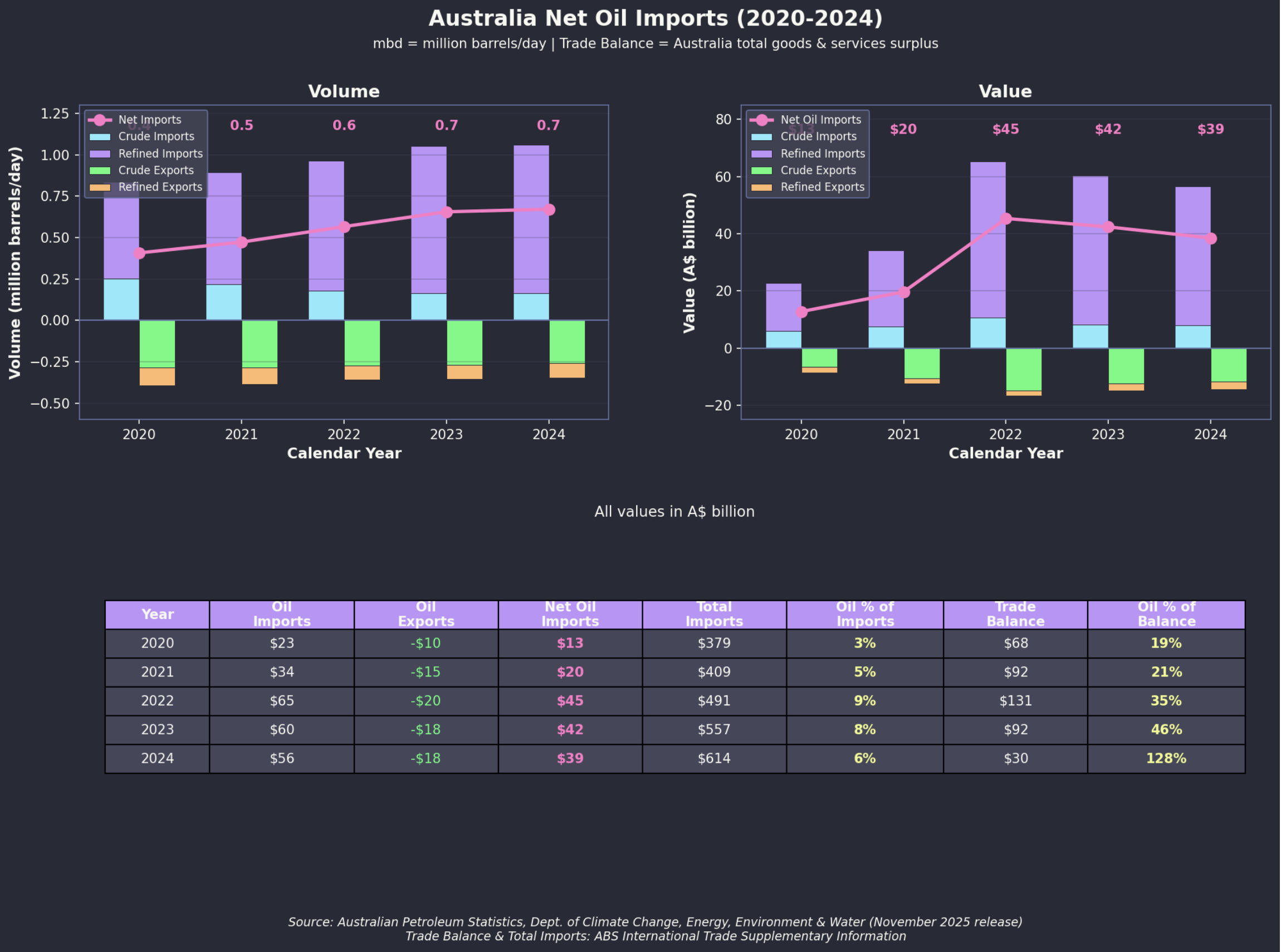
You almost can’t say this enough: reducing imports is just as beneficial to Australia as increasing exports.
We are falling behind Asia! Never mind Europe
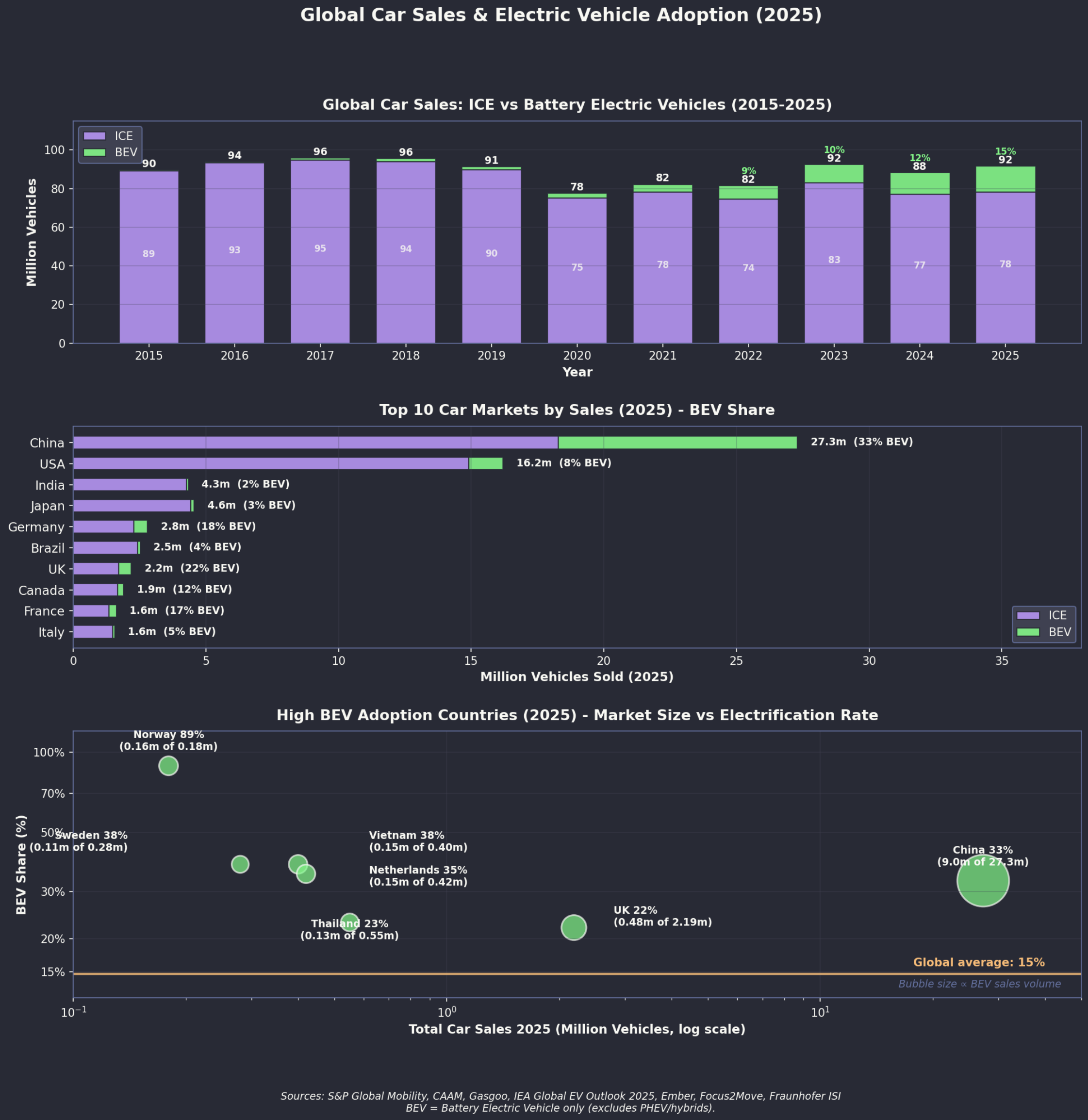
It’s easy to look at the global car market and think we are doing OK on EV adoption. Even so look at the hit the ICE car industry has already taken over the past decade. In 2018 sales were 94 million, now down to 78 million, that’s a really big drop. But looking at the global market completely misses the point. We aren’t competing with the USA or Japan. Japan is stuck in incumbent mode and the USA is run by a cognitively challenged leader.
We need to compare ourselves with the EV leaders, not the incumbents. France, Italy, Germany, Japan, USA all have to protect their domestic industries, just like we subsidise outdated smelters. We don’t need to subsidise Japanese and German carmakers in Australia.
Policy in high uptake markets
EV Market Share and Policy Configuration
| Market | EV Share | Supply Mandate | Tax Differential | Infrastructure | Driving Privileges |
|---|---|---|---|---|---|
| Norway | 92% | No (incentives-led) | 70%+ ICE premium | High | Bus lanes, tolls, parking |
| China | 51% | Yes (NEV credits) | Moderate | Very high | License plates, driving bans |
| Netherlands | 55% | EU CO₂ std | High (BPM tax) | Highest in EU | LEZ/ZEZ, parking priority |
| Denmark | 67% | EU CO₂ std | Very high (150%+ tax) | High | — |
| Thailand | 20% | Production requirement | Excise differential | Growing | None |
| Vietnam | 40% | No (VinFast-led) | Consumption tax diff | VinFast network | Planned |
| Australia | 12.6% | NVES (CO₂ only) | None | Lagging | None |
| USA | 9% | CA ZEV (some states) | Federal credit (uncertain) | Growing | HOV (some states) |
Source: IEA Global EV Outlook 2025; ICCT; author compilation
Key Research Conclusions
Infrastructure investment is 4-7x more cost-effective than purchase subsidies - redirecting subsidy spending to charging networks yields higher adoption rates (Michalek et al., 2025; World Bank, 2022)
ZEV mandates provide certainty that subsidies cannot - manufacturers respond to binding requirements; subsidy-only approaches require unsustainably high levels ($40,000/vehicle) to achieve equivalent outcomes (American Chemical Society, 2025)
Policy complementarity matters - subsidies and infrastructure reinforce each other; weakening one policy reduces effectiveness of others (Resources for the Future, 2025)
Tax differentials outperform direct subsidies - Norway’s tax exemptions (worth 70% of ICE price) and Denmark’s registration tax system create sustained price signals without ongoing fiscal cost (Norwegian EV Association, 2025; OECD, 2021)
Driving privileges provide additional adoption incentive - license plate priority (China), bus lane access (Norway), and LEZ exemptions (EU) reduce ownership friction, with measurable adoption effects (International Council on Clean Transportation, 2023; myeva-hov-2024?)
Australia’s policy mix is suboptimal - demand-side only (FBT exemption benefiting high earners), no binding supply mandate, no ICE tax differential, no driving privileges, lagging infrastructure. This configuration is least cost-effective among comparable markets.
Thailand: From 1% to 20% (2019-2024)
Thailand has emerged as Southeast Asia’s largest EV market, with market share rising from 1% in 2019 to 20% in 2024 (roland-berger-thailand-2025?). This rapid growth reflects a comprehensive policy package combining consumer incentives with manufacturing requirements.
The 30@30 National Target
The Thai government set a goal for BEV production to reach 30% of total vehicle production by 2030 (~700,000 units/year), signalling long-term commitment to manufacturers and attracting significant foreign investment (boi-thailand-ev-2024?).
BEV 3.5 Policy (2024-2027)
The comprehensive incentive package announced in December 2023 includes:
Thailand BEV 3.5 Policy Incentives
| Incentive | Details |
|---|---|
| Consumer subsidy | THB 100,000 (~$4,000 AUD) in 2024, declining to THB 50,000 by 2027 |
| Excise tax cut | Reduced from 8% to 2% for passenger EVs |
| Import duty reduction | Up to 40% reduction for CBU imports (2024-2025) |
| Pickup trucks | Excise tax 0% (2024-25), rising to 2% (2026-27) |
| Electric motorcycles | THB 10,000 subsidy + 1% excise tax |
Source: EY; Tilleke & Gibbins
Local Production Requirements
Companies using the incentive package must offset imported vehicles with local production at a 1:2 ratio by 2026 and 1:3 by 2027. This requirement has attracted Chinese manufacturers to build factories in Thailand rather than simply export to the market (asean-briefing-boi-2024?).
Norway
Norway has achieved near-complete electrification of new car sales through sustained policy commitment over 30 years (Norwegian EV Association, 2025).
Norway Key Policy Elements
| Incentive | Description |
|---|---|
| Purchase tax exemption | BEVs exempt from registration tax (70% of ICE pre-tax price) |
| VAT exemption | 25% VAT waived on first NOK 500,000 (~$70,000 AUD)1 |
| Road tax exemption | Annual road tax waived for BEVs |
| Toll exemptions | Free or reduced toll road access |
| Parking | Free municipal parking in many areas |
| Bus lane access | BEVs permitted in bus lanes (some restrictions apply) |
Source: Norwegian EV Association; OECD
Why Norway succeeded:
- No domestic car industry - No automotive lobby opposing ICE taxation
- Policy consistency - Cross-party consensus maintained over multiple governments since 1990s
- Fiscal capacity - Oil revenues fund incentive programs
- Clean grid - 98% renewable electricity (hydropower) maximises emissions benefit
- High ICE taxation - Making EVs cost-competitive, not just cheaper at margin
Estimated impact: Removing tax exemptions would reduce EV market share from 66% to 25% (sciencedirect-norway-2025?).
Netherlands/Denmark
Both countries have achieved >50% EV market share through tax-based incentives rather than direct subsidies. The key mechanism is making ICE vehicles expensive through taxation, rather than making EVs cheap through subsidies.
China: Scale and Industrial Policy
China is the world’s largest EV market by a substantial margin. In October 2025, NEVs exceeded 50% of all new vehicle sales for the first time (cnevpost-2025?). China accounts for approximately 65% of global EV sales (iea-gevo-2025?). Consumer unit subsidy falls with scale and penetration.
Subsidy evolution: Per-vehicle subsidies have declined from ~$13,860 (2018) to under $4,600 (2023) as the market has matured. The ratio of support to sales dropped from >40% (pre-2017) to ~11% (2023).
The Dual Credit System
China’s policy combines demand-side incentives (for consumers) with supply-side mandates (for manufacturers) through the “Dual Credit” system (International Council on Clean Transportation, 2022).
Component 1: Corporate Average Fuel Consumption (CAFC) Credits
Manufacturers must meet fleet-average fuel consumption targets:
China CAFC Targets
| Year | Target (L/100km) |
|---|---|
| 2020 | 5.0 |
| 2025 | 4.0 |
Source: ICCT
NEVs count as zero fuel consumption, helping manufacturers meet CAFC targets. Surplus CAFC credits can be banked or transferred to affiliates.
Component 2: NEV Credit Mandate
Manufacturers must earn NEV credits as a percentage of conventional vehicle production:
China NEV Credit Requirements by Year
| Year | NEV Credit Requirement |
|---|---|
| 2021 | 14% |
| 2022 | 16% |
| 2023 | 18% |
| 2024 | 28% |
| 2025 | 38% |
| 2026 | 48% |
| 2027 | 58% |
Source: ICCT; Ministry of Industry and Information Technology
Each NEV sold generates credits based on electric range, energy efficiency, and battery characteristics. Credits can be traded between manufacturers - creating a market mechanism where EV-focused companies (like BYD) can sell credits to laggards.
Why the dual system works:
- Manufacturers cannot simply pay a fine - they must either produce NEVs or buy credits from competitors
- Links fuel economy compliance to NEV production (surplus NEV credits can offset CAFC deficits)
- Creates technology competition (credits tied to performance metrics, not just sales)
- Ratchets up annually, forcing continuous improvement
Consumer Incentives
China Consumer EV Incentives - 2025
| Incentive | Description |
|---|---|
| Purchase tax exemption | 100% exemption through 2025 (max ¥30,000/~$6,000 AUD) |
| Purchase tax reduction | 50% exemption 2026-2027 (max ¥15,000) |
| License plate priority | NEVs receive plates immediately in restricted cities |
| No traffic restrictions | NEVs exempt from driving bans in many cities |
| Local subsidies | Municipal incentives vary (e.g., Chengdu: ¥8,000 per vehicle) |
Source: China Briefing; Ministry of Finance
License plate restrictions are particularly powerful in major cities:
- Beijing, Shanghai, Guangzhou, Hangzhou operate license plate lotteries or auctions for ICE vehicles
- In Shanghai, an ICE license plate costs ~¥100,000 (~$20,000 AUD) at auction
- NEV plates are free and issued immediately
- Six of China’s top ten cities for NEV ownership have license plate restrictions
Government Investment
China Government Support for NEV Industry
| Period | Estimated Support |
|---|---|
| 2009-2022 (subsidies + tax breaks) | ¥200-300 billion ($40-60 billion AUD) |
| 2009-2023 (all support types)2 | $230 billion USD |
| 2024-2027 (tax incentive package) | ¥520 billion ($105 billion AUD) |
Source: CSIS; Ministry of Industry and Information Technology