Diesel consumption shows the decline in coal. A specific symptom of a broader need for renewal.
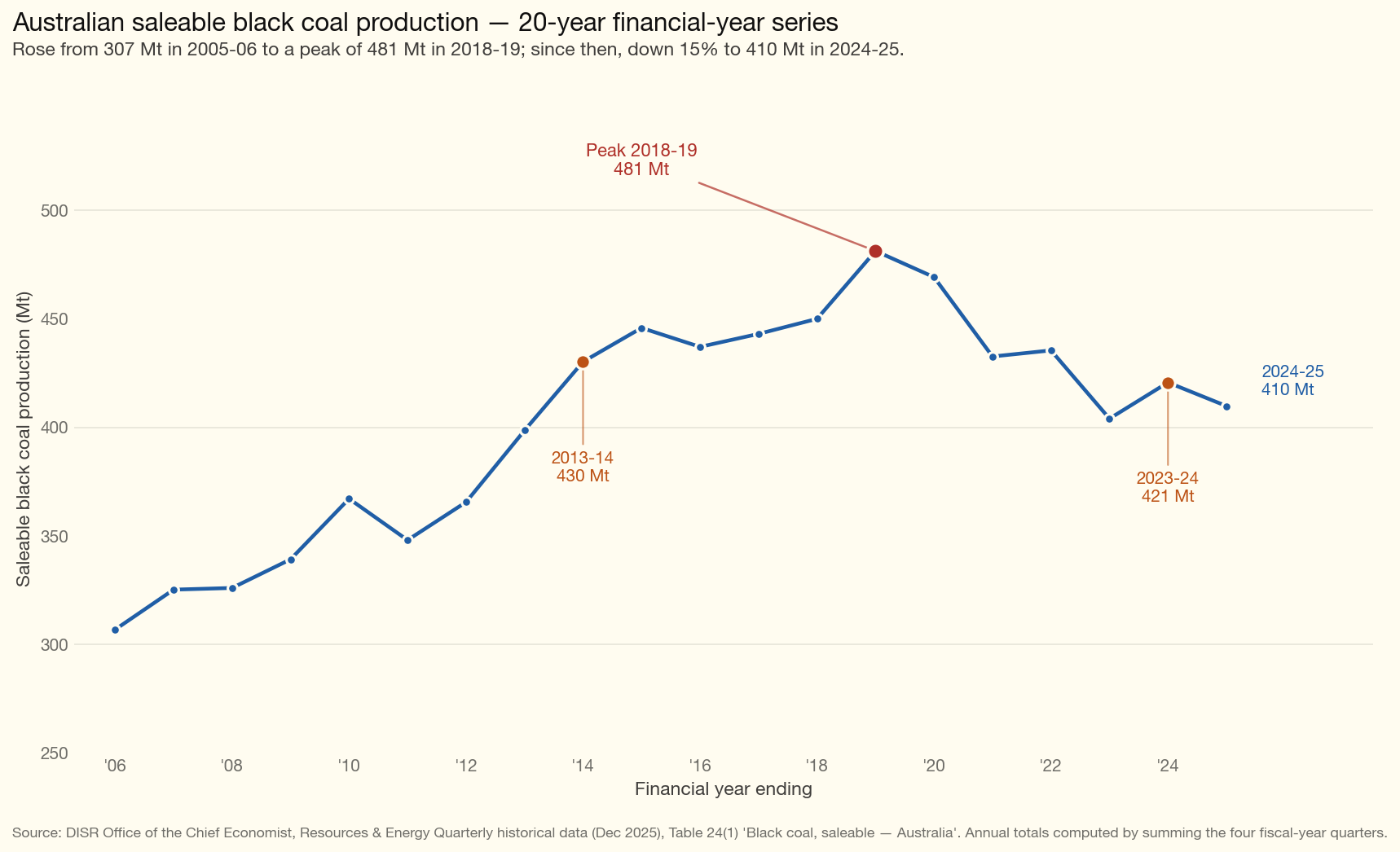
One of the most interesting points to emerge from the security, cost and decarbonisation issues with diesel is a realisation that Australia’s coal production has likely passed its peak.
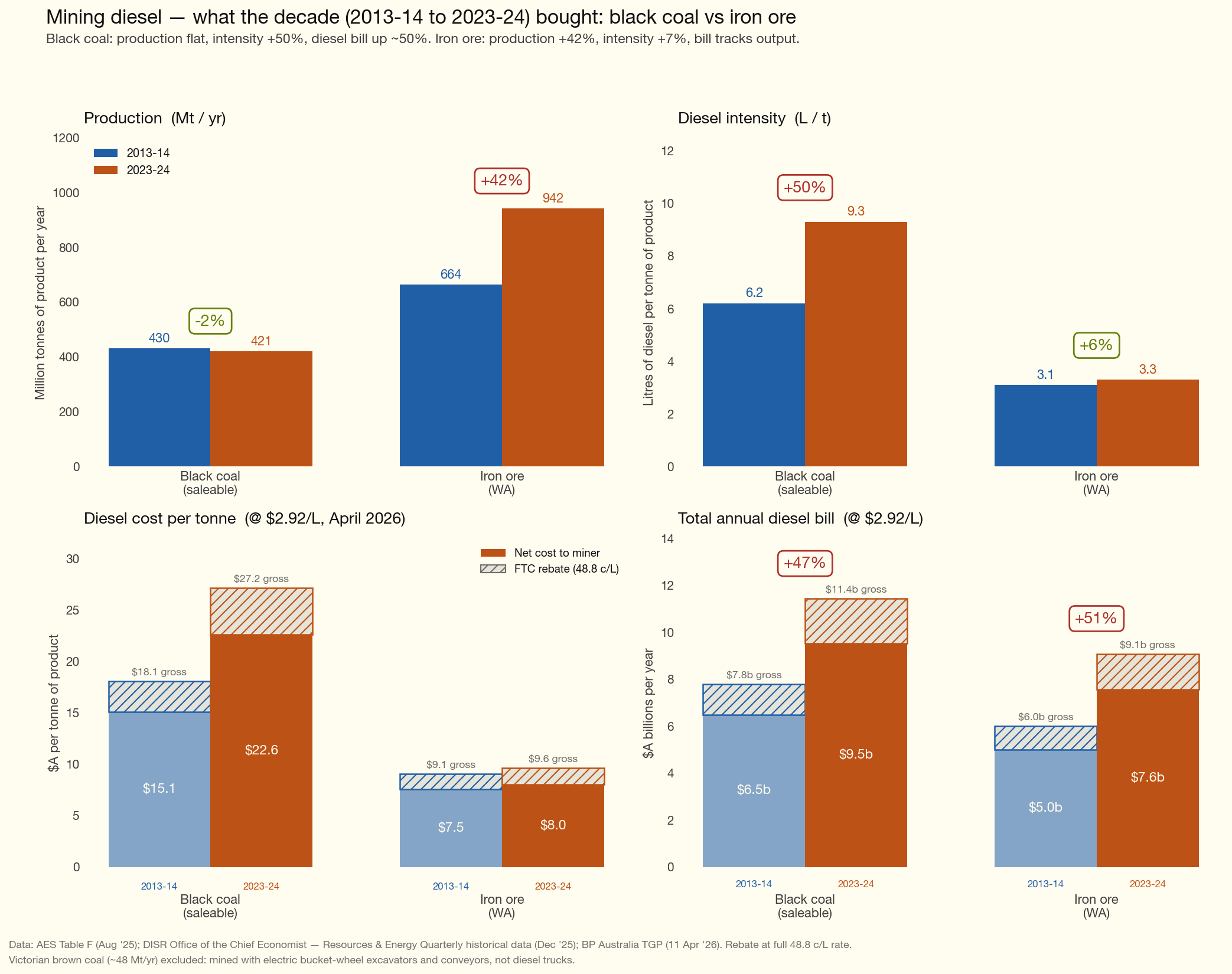
The plot below shows diesel consumption per tonne of coal produced is up 50%, while for iron ore the rise is just 6%.
Secondly, cost increases look set to be a feature of coal production, at least as measured by diesel intensity. The rising fuel use suggests miners are moving more overburden per tonne of coal — a sign the better seams are being worked out.
It’s not news that coal mining areas go into decline. Whether it’s Wales, Spain or Virginia in the USA, coal mines get worked out.
What’s surprising is to see it happening now in Australia. I had always assumed — and still expect — that China, which produces 10X as much coal as Australia, would run into rising cost issues much more quickly. I suspect the underlying issues in China have been disguised by the modernisation of mining technology: productivity rises even as the underlying seam quality falls.
In Australia we have always used modern technology, so there aren’t really any new levers to pull as the resource depletes.
Then of course there are new royalty rates, the far higher bars to be cleared for new mines (and even extensions to existing ones), and the clean-up liabilities.
Even in iron ore there are early but still very minor signs that more overburden is being moved per tonne of ore.
The visualisation below summarises the change.
The apparent flatness of national coal production hides the underlying rise and then decline.
The broader question
The current Federal Government has an “old smelter” subsidy program. The most egregious example, in my view, is the preliminary $600 m support for a copper smelter at Mt Isa — even though copper is no longer mined there, and it’s blindingly obvious Mt Isa is not where you would locate a smelter dependent on imports. One proposed and part-financed Northern Territory mine could have supplied it, but has allowed its HOA to lapse.
So putting $600 m in there places the workforce on a traditional work-for-nothing scheme, redolent of the worst of the pre-Hawke Govt Labor supports. This is so alien to the great boost to productivity that the Hawke Govt introduced when floating the dollar and reducing business subsidies was the order of the day.
I am not against subsidies at all. I am against paying businesses that have zero long-term future to stay open for no reason other than to provide jobs.
Whyalla steel works is another example — a facility propped up despite having had no future for 20 years. There is a longer list.
I can understand short-term support if there is a very clear, driven and achievable path to find a new source of growth for Australia.
In my view that path lies in a determined whole-of-economy electrification, with new industries built on top of it.
But subsidies just to kick the can down the road? Hopeless.
And if we are going to electrify, as we must, then don’t stuff around. Make it a national priority. Be open and go really hard. Half measures will get stuck halfway across the river and commentators will talk about “the road to hell is paved with good intentions”.