Freight Forwarding - still early enough to do it right
I attended the Smart Energy/Boundless Freight Forwarding conference in the great hall at Parliament House yesterday. The audience was about 80% male.
Parliament House puts a warm feeling in my heart driving up in the Xpeng G6 and parking was easy, well it’s a very nimble car, great turning circle, good self parking, big battery. Whoops… A quick stroll up the steps, efficient security and the hall is right there.
Out front on the lawn maybe 250 metres away is the Windrose semi, $475 k for you with the big smile, hardly more than a Kenworth T909 which Claude tells me is between $400k and $500k. You are kidding … don’t tell me that trucks are no different to cars in that diesel and electric prices are actually comparable.
Well I can work that out in 5 minutes but clearly no-one has told the Minister for Transport and Infrastructure, Catherine King. Both when speaking at the conference and later on the 7:30 report, she clearly had no idea what technology is available and seemed to assume she was speaking to an audience of junior school students.
In my experience Chris Bowen works very hard to be across his portfolio. Not all the policies are successful but there is a constant flow of ideas, like the home battery subsidy that comes with keeping up on innovations, talking to the industry, and generally being enthusiastic.
By contrast, King just didn’t seem that interested. Not opposed — prepared to speak at the conference — but not really across the specifics. She spoke like someone who read a report last year and can remember most of it.
I don’t mean to be critical of King specifically — this is where the industry is at right now. In a sense it’s full of opportunity because what works and what doesn’t work aren’t that clear yet. We seem to be as Patti Smith sang in an “infinite sea of possibilities”.
Equally you could read articles by mainstream media, also trying to come up to speed, and find angles talking about the need for harmonised State maximum weight regulations. I’m all in favour of harmonised regulations, provided they aren’t QLD originated ones LOL, but the fact is Windrose already meets the standards, as does another Chinese new entrant. Volvo could probably manage it as well now that their prices have dropped into the competitive range. Weight standards are a long way below charging infrastructure in the opportunity set.
But coming back to the main point, King stood up and basically said the technology for long distance trucking didn’t exist yet. Yet in China there were close to 200,000 electric semi trailers sold last year, and in recent months electric semis and trucks are 50% of new sales and growing.
Politicians rarely listen to anyone else at a presentation. They come in, pay respects to Elders past and present, deliver a few remarks and head out. Listening to someone that actually might know what they are talking about is not on the agenda. Especially not when there is a fuel crisis. And why is there a crisis? Because no-one listened last year, or the year before, or the year before that.
At the risk of being boring, this is how politicians often make bad decisions: they just don’t work hard enough or find the people who can brief them correctly. If you want to make policy you simply have to keep up and take a genuine interest. Not a half-hearted interest but a genuine curiosity.
The road to hell is paved with good intentions
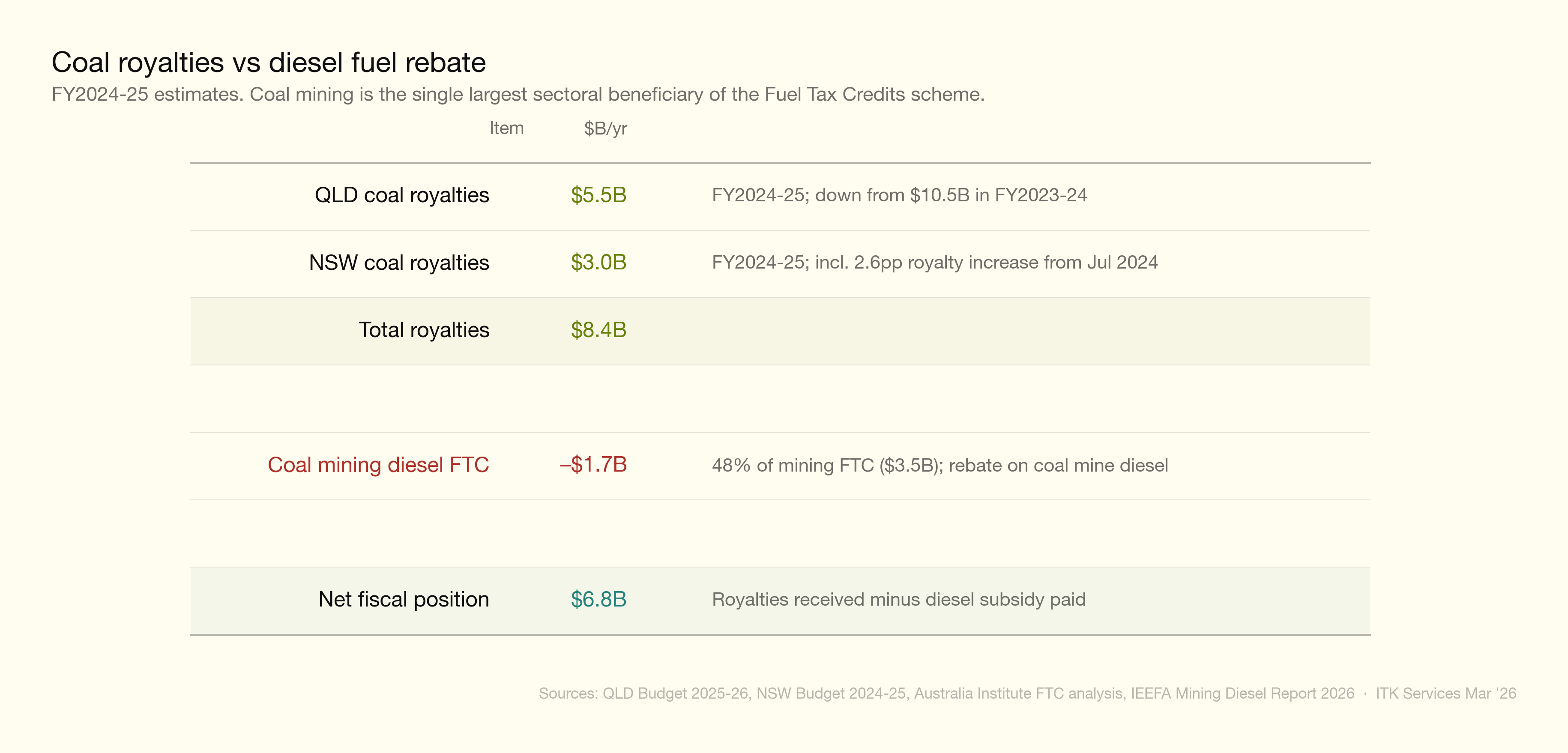
Most of the conference was focussed on energy security. That’s a very obvious and genuine reason for reducing dependence on diesel but it won’t pay for lunch from the industry’s point of view. The same goes for the climate. And may I take this opportunity to pay my respects to the future generations for whom we steward the lands. Australia doesn’t have a carbon price, there aren’t any emissions standards in the truck industry. The mining industry gets a dirty big fat diesel rebate (50%, $1.7 bn goes to coal).
The industry hard heads might like to have an electric truck in the fleet so they can talk it up at an event but they are never going to do anything seriously unless they are forced to or unless the economics stack up.
At the conference the TWU rep did a good job of talking about LOD (Lorry owner drivers) and how they aren’t jumping up and down to buy electrics even if they could charge them, which they can’t. Equally, the giant operators like Linfox (70 electrics ordered in a large fleet with CEFC assistance), Toll and Team Global Express ($2.9 bn revenue, but not much profit) have heaps of incumbent relationships including truck buying contracts that they would not hurry to disturb. So both ends of the spectrum, in my opinion, make haste very slowly. This opens up the classic opportunity for a disruptor, keen to seize on the opportunities that new technology brings and push on through to the other side.
For the industry to act it needs to get a return. For the Government, and considering national security, economics and the size of the target; it wants — or ought to want — to focus on sub-segments where there is lots of diesel consumption. Contrary to what I thought when I started looking at this, the big diesel consumers are mining and long haul trucking. It’s no coincidence that it’s those sectors where fuel consumption per vehicle is high and where therefore electrification potentially offers the largest annual saving to offset against the higher capital cost.
In the table below focus first on the size of the bubbles, that is the sub segments that actually consume a lot of fuel. Then look at the tradeoff between EV price premium and annual fuel savings.
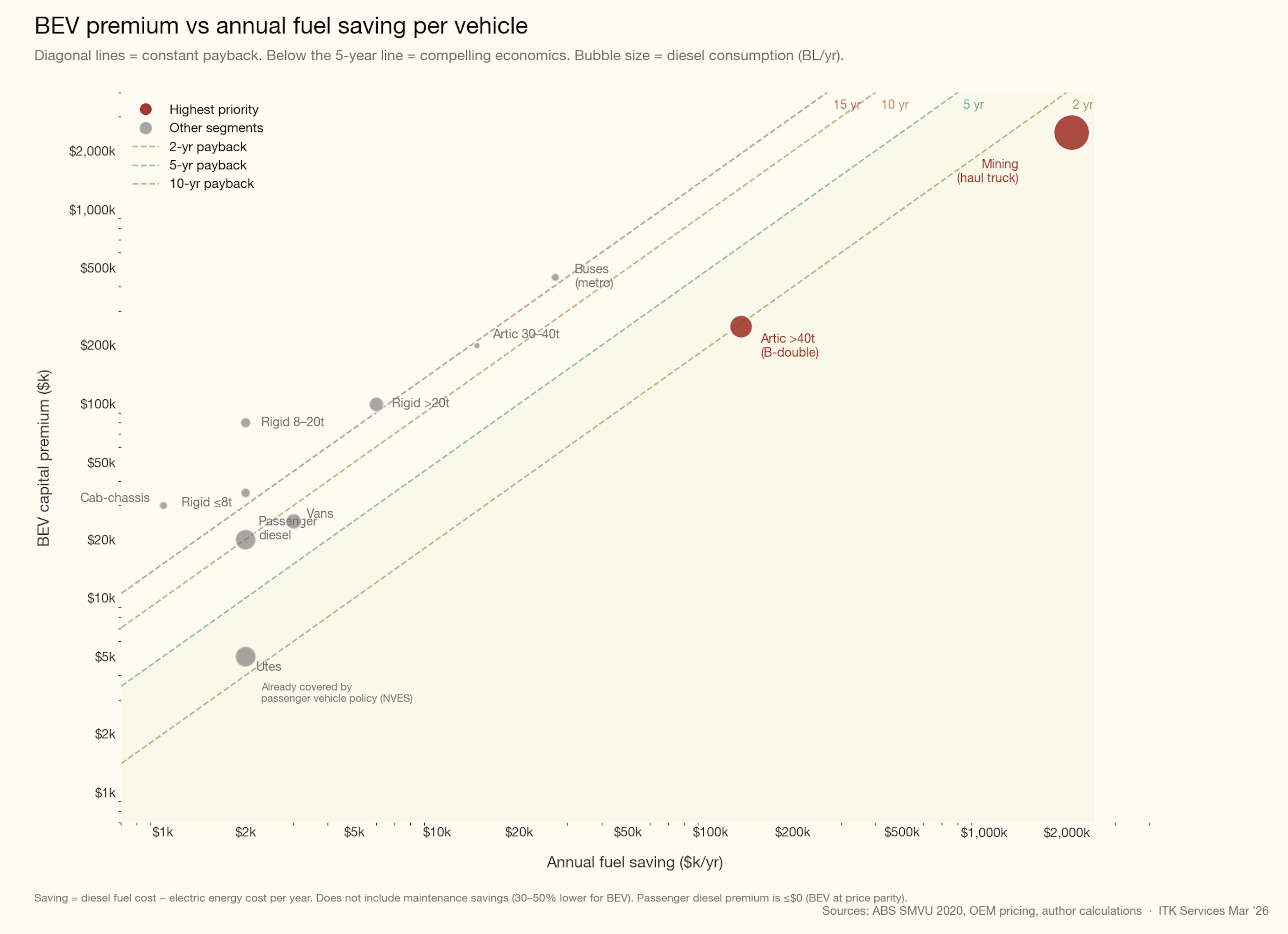
That plot is partly based on the following table. Whereas only so many people have any real knowledge of what a wind or solar farm or utility battery costs, nearly everyone has a view on what a car or truck is worth and so will be able to correct my estimates quickly.
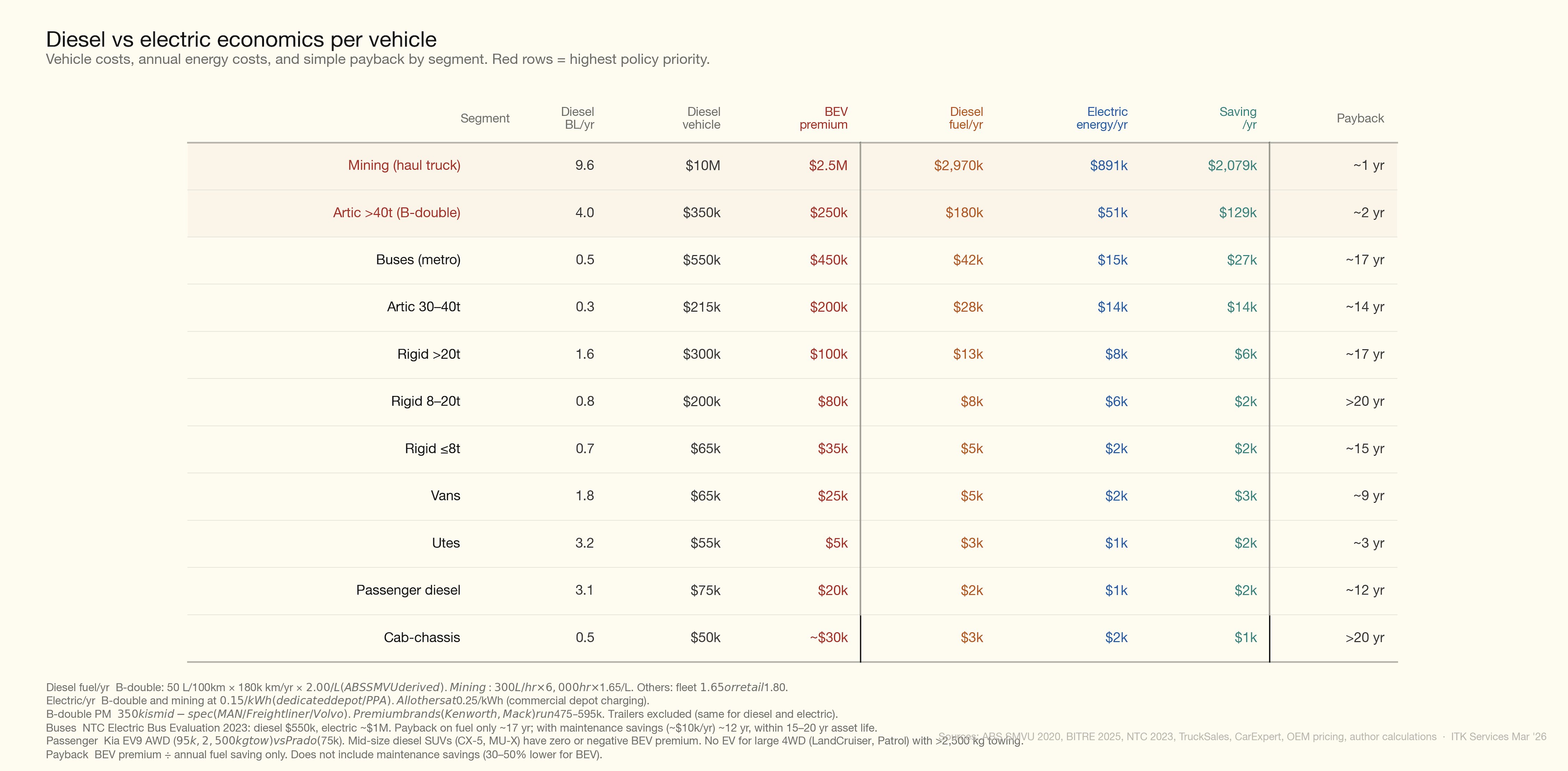
The event was very light on this kind of background. I’m sure there were lots of people at the conference who know the chapter and verse on this much more. But the presenters, with honourable exceptions, basically didn’t respect the audience. That was not intentional — the presenters just assumed the audience didn’t know much and therefore they didn’t have to try too hard.
Charging infrastructure - there isn’t any. No really there isn’t.
Virtually every person when asked what they wished for said more charging infrastructure. As one woman CEO noted , truck owners didn’t traditionally have to pay for the charging infrastructure. I guess oil companies funded petrol stations but I don’t see your Ausgrids building trucking depots. They might like to but it doesn’t work because of the geographic focus, well not unless there was a national standard and a plan.
Truck charging infrastructure though is not as simple as car infrastructure. The prime mover that wants to charge at 1 MW during the 30 minute lunch break doesn’t want to be sitting round waiting for some Ford van charging at 200 kW using a different plug.
Then you have to get the power supply. Imagine 20 prime movers all wanting 1 MW. That’s a 20 MW connection. So infrastructure provision will be important.
There are dots on maps representing charging hubs that someone might build sometime. Energy Futures’ Bruce Hardy presented at Freight Forwarders and showed a map similar to the one below on 7:30 report but none of it exists today.
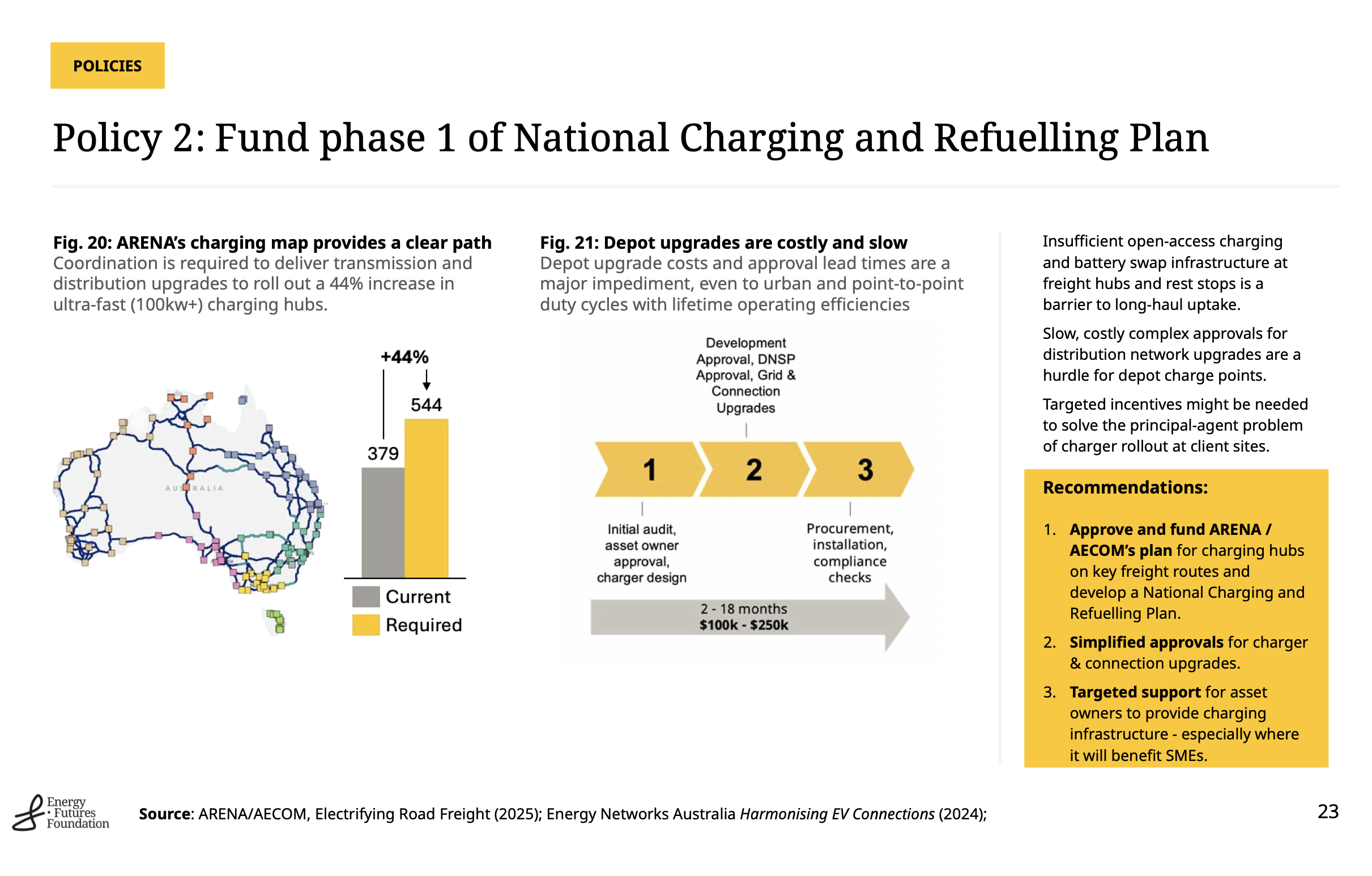
Nor is it clear to me that such a plan is really thought through and prioritised in the way I would expect a competent large business, Government or army to operationalise a plan.
Prioritise, plan and act
It’s clear to me that the Federal Government has a job to do. You can’t ask ARENA to keep funding experiments. We should already be well past the point of experiments.
Nor is it ARENA’s job to build a national network, if that is required.
We need to turn the very poor job done so far into an advantage. The advantage is that by having dicked around for so long, charging and vehicle technology have advanced.
If security is the priority, then electrify long distance transport — that will free up diesel for segments where paybacks are slower.
If reducing diesel usage is a priority, and it is, then get rid of the diesel fuel rebate.
Coal’s “Unelectrify everything policy”
In Australia the coal mining industry is abandoning efficient draglines and moving to diesel trucks . The coal industry is doing that because coal mines are getting older and the reserves more expensive to extract. As a result productivity goes way down. Diesel dependency goes up. Carbon emissions go up. The coal industry becomes less economic. Don’t believe me? Look at Indonesia’s’ growth in global coal shipments compared to Australia in recent years.
And a big part of the reason for Australia to “impoverish” itself is the diesel fuel rebate. The coal industry is Australia’s biggest beneficiary of the diesel fuel rebate.
I chased a rat up a drainpipe on coal because some of these numbers are not that obvious. Andrew Gorringe from IEEFA wrote a great report which was the starting point for this section.
Look at the overburden move in Australian coal every year.
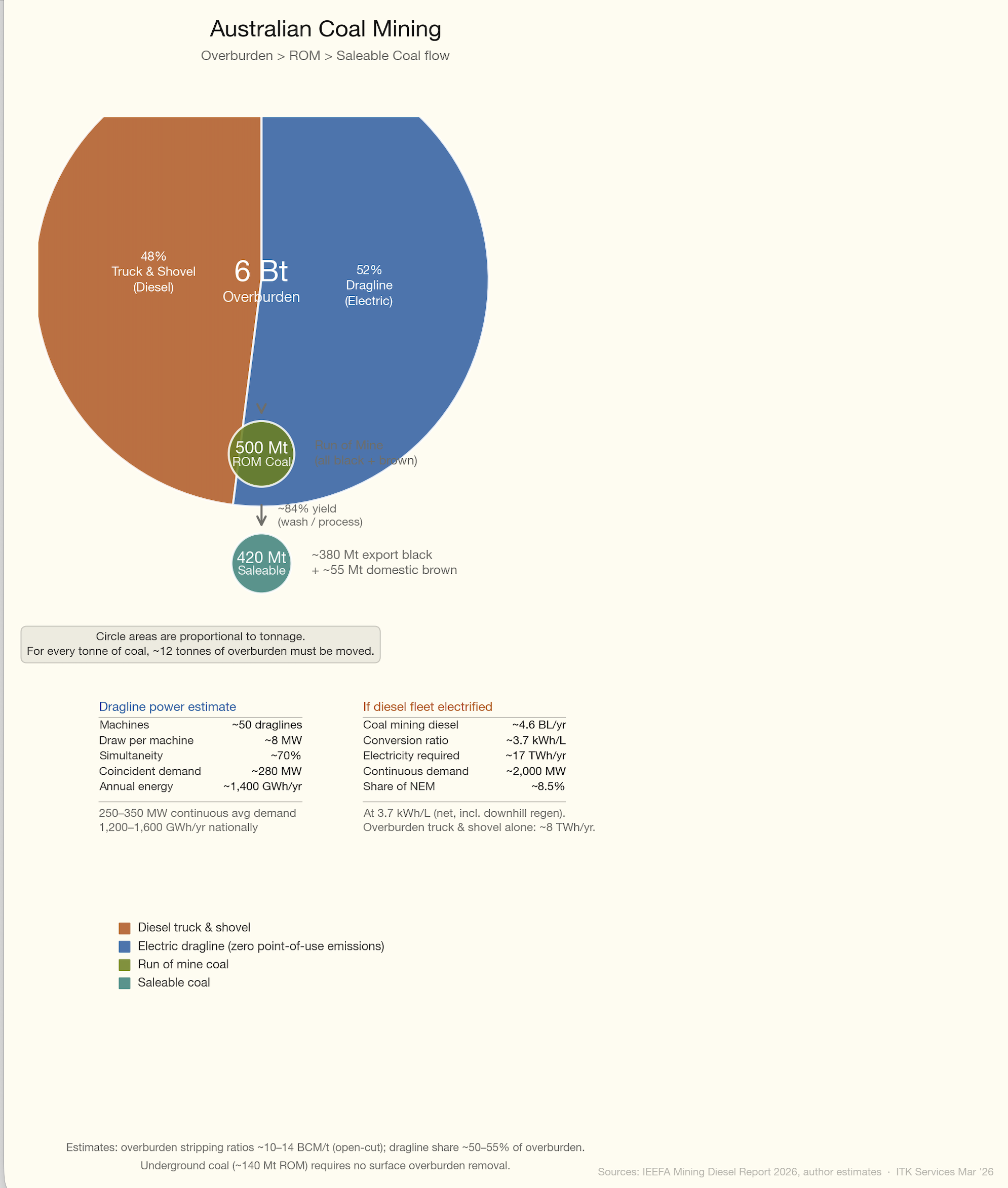
In Australia most of the energy consumed to produce coal is shifting about 6.0 BT of overburden out of the way so that 500 MT of run of the mine (ROM) coal can be produced which is then washed down to about 420 -460 MT of saleable coal. That includes Victoria’s brown coal.
Of the overburden in tonnes a fraction over 50% is moved by maybe 55 large walking draglines. These are electrically powered and the estimate is they consume maybe 200-250 MW of power. The draglines are very efficient, but because it’s getting harder to extract coal in Australia, and as Gorringe points out, we’re getting rid of the draglines and using diesel trucks.
Here’s the thing. It takes 7 times as much energy to move a tonne of overburden using diesel as it does by dragline. And it has all the other disadvantages of diesel over electric. Not only is the coal industry responsible for coal emissions, thanks to the diesel fuel rebate it’s making Australia less secure, more polluting and making the coal industry less economic. It’s completely and utterly dumb.
Federal Govt diesel rebate is effectively a subsidy to QLD and NSW Govts who collect it back as royalties
Irony abounds in Australian policy and business. But nowhere is it more pronounced than in the coal industry and how it’s taxed and subsidised. Effectively the Federal Govt pays about 20% of the coal industry’s royalties to the State Govt.
Best presentation - Dr Clare Walter
My award of best conference presentation goes to Dr Clare Walter who demonstrated with clear evidence the $6.2 bn annual health cost to the population of diesel combustion. After watching Dr Walter’s presentation you wouldn’t send your kids to a preschool or school located on a national route. Perhaps that explains what happens to all those private school kids on the Pacific Highway, although hopefully they are old enough to escape the worst of the damage.