Moving on from the REC target was correct, replacing it with the CIS an error
The CIS has not worked. But the capacity it was designed to procure is needed more than ever, and the cost of delay rises every year.
Two years is long enough to try the CIS. Do we want to continue to enact past mistakes? Do we want to be like WW1 generals continually sending the troops out as happened at Fromelles, or do we want to adjust like Monash did at Hamel and snatch victory from a difficult position? I argue that if we succeed the old mistaken course is quickly forgotten.
Reminder that we are becalmed
It is abundantly clear that not many utility scale renewable projects are reaching FID (final investment decision). Only two years ago 80% renewables by 2030 seemed like a just about achievable target. Today we can confidently say it has no chance.
The latest data, on my calculations, has the renewables share at about 45%. Of course it goes up in Spring and Summer and down in Winter. On the positive side each of Wind and Rooftop exceed Brown Coal and every State is over 35%.
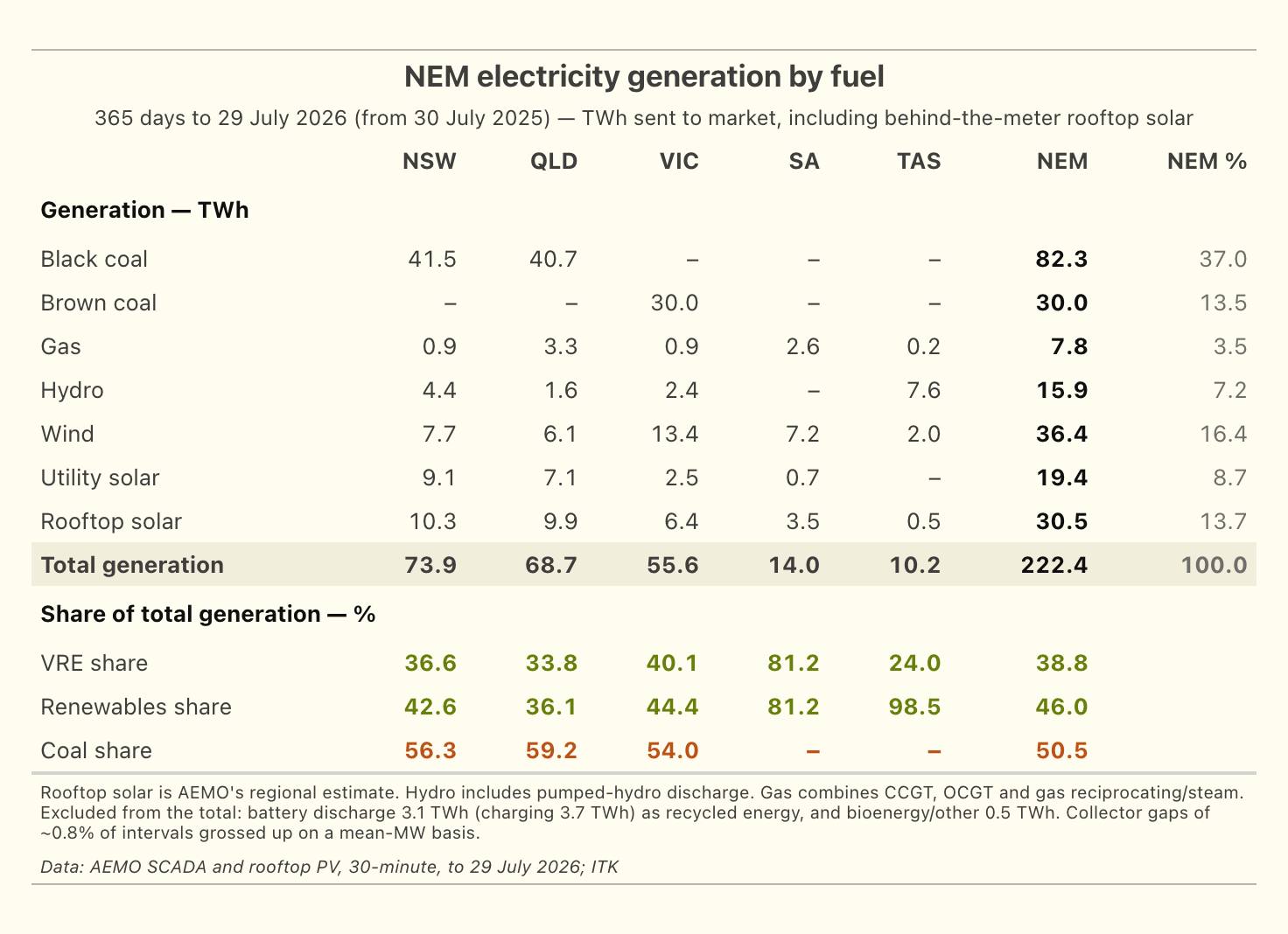
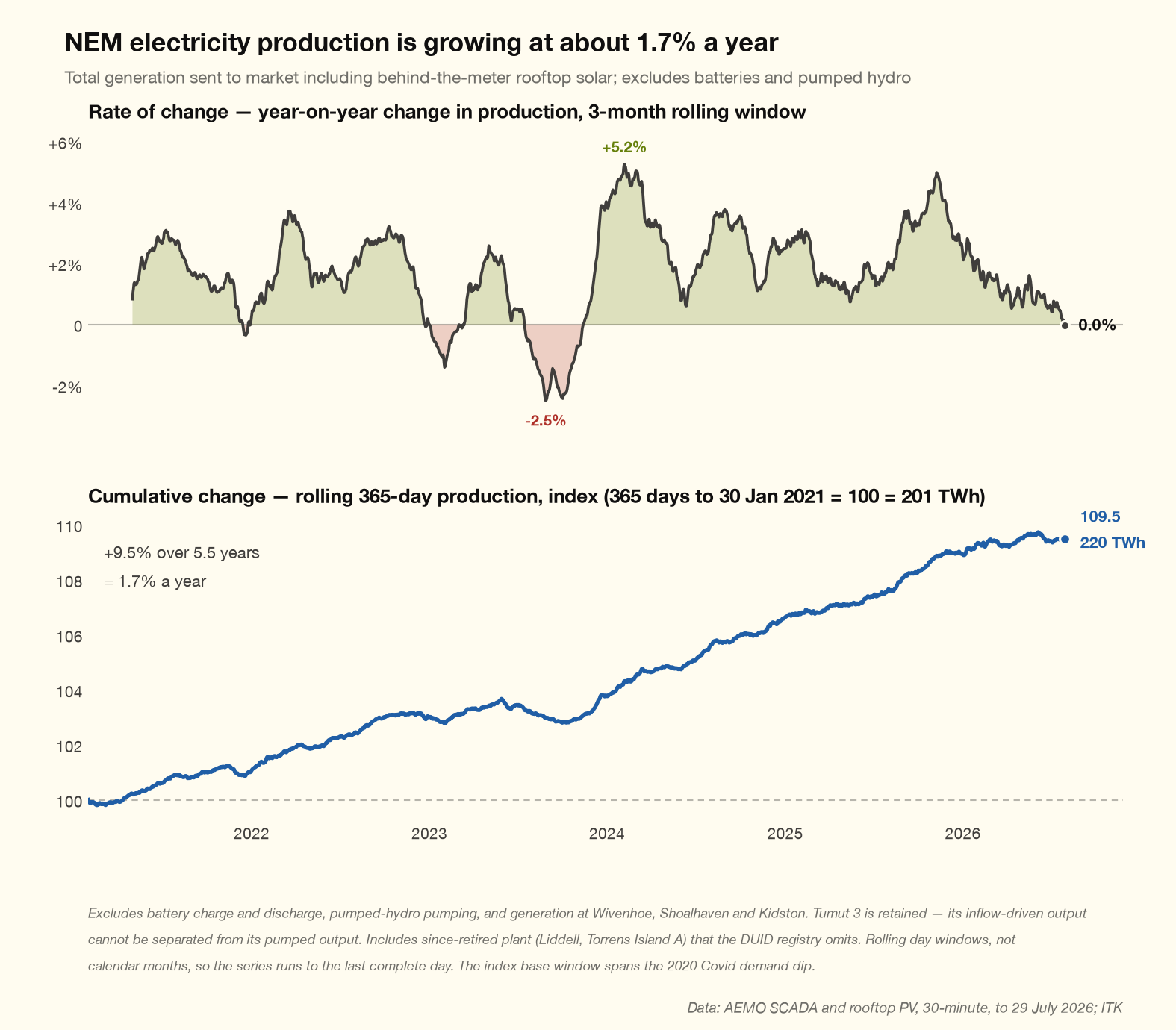
Broadly production has been growing about 1.7% per year and rather than accelerating is currently slowing, maybe reflecting a slowdown in population growth as much as anything.
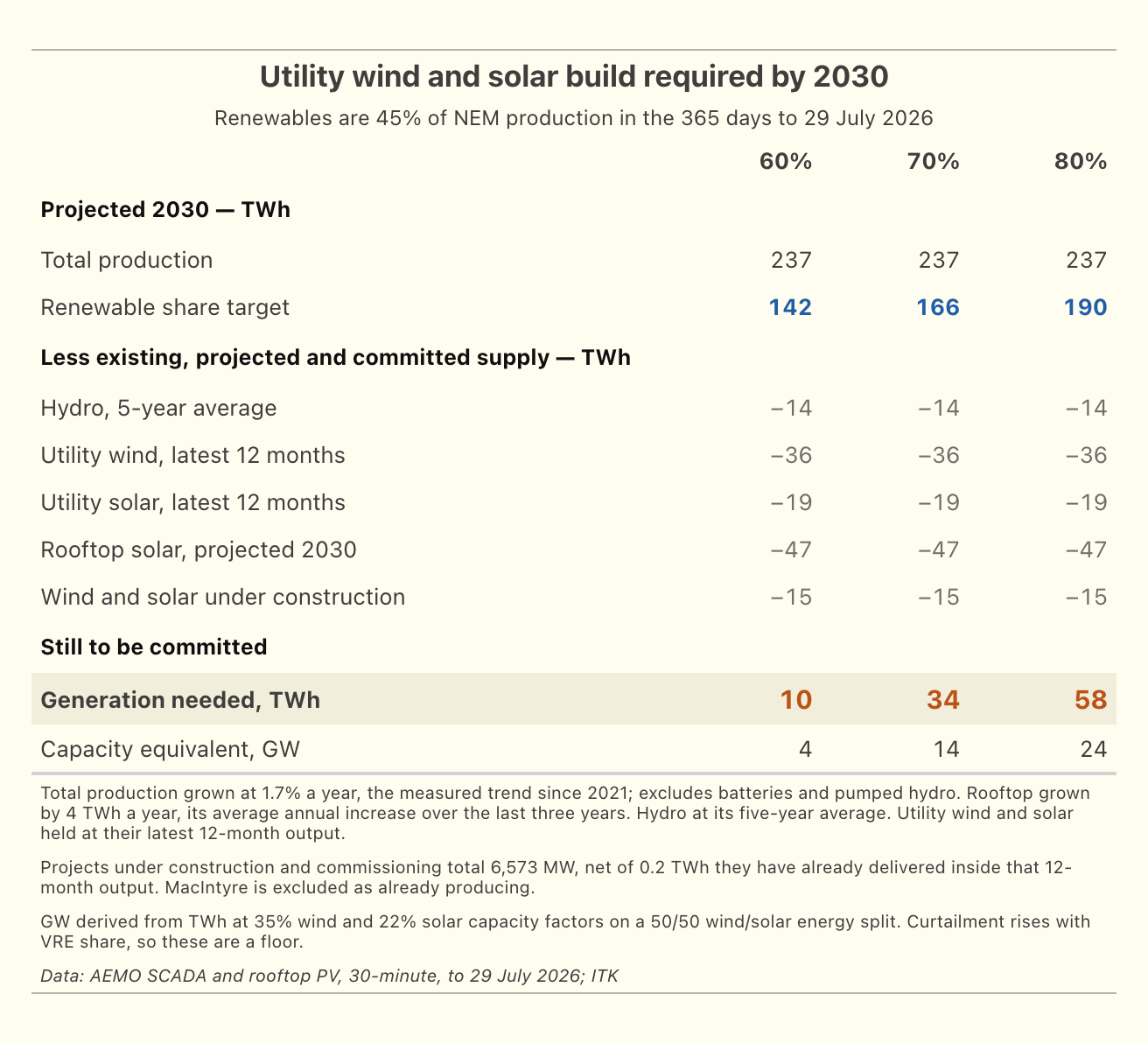
Normally I use a modified version of AEMO’s demand forecast but a naive projection forward at historic growth rate gets us to the following build rates for 60-70-80% targets
Lets use as usual Renewmap for what’s hit FID or under construction
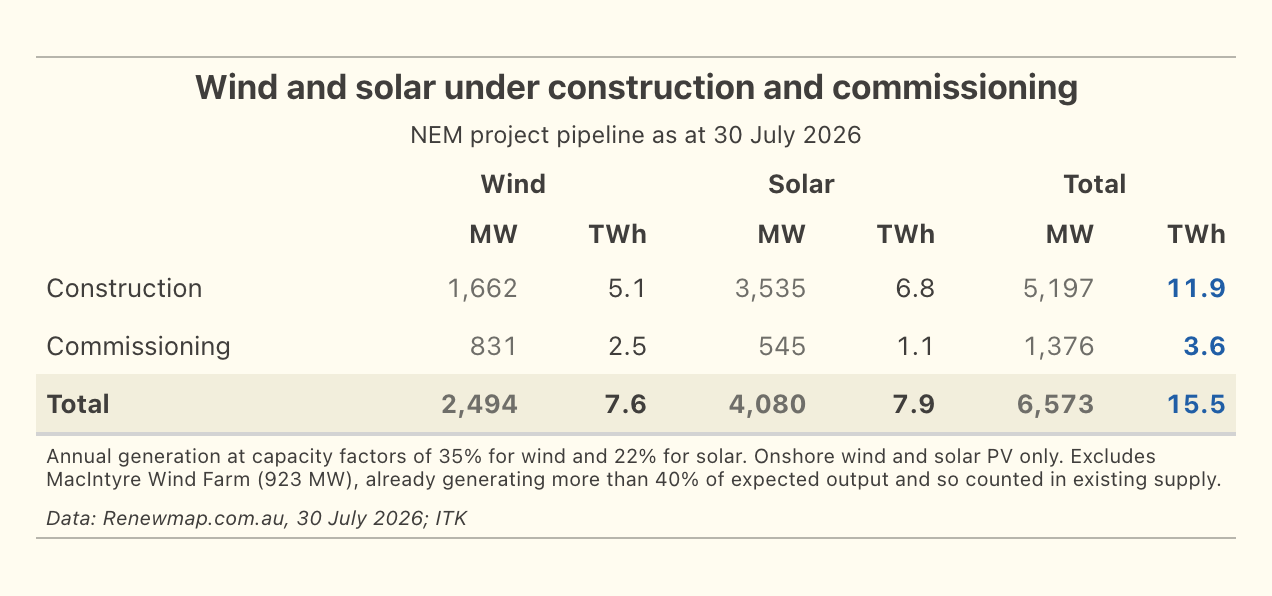
On this set of numbers, with a fully committed Govt, 70% might be achieved. 14 GW, still a huge amount by recent standards, is imaginable as a number if I ignored construction time. It takes probably 3 years to build a 1 GW wind farm and 2 years to build a 0.5 GW solar farm. That’s if things go well.
So to get to 70% 14 GW needs to hit FID over the next two years. I’ve been making similar statements for the last two years. It’s become dead boring.
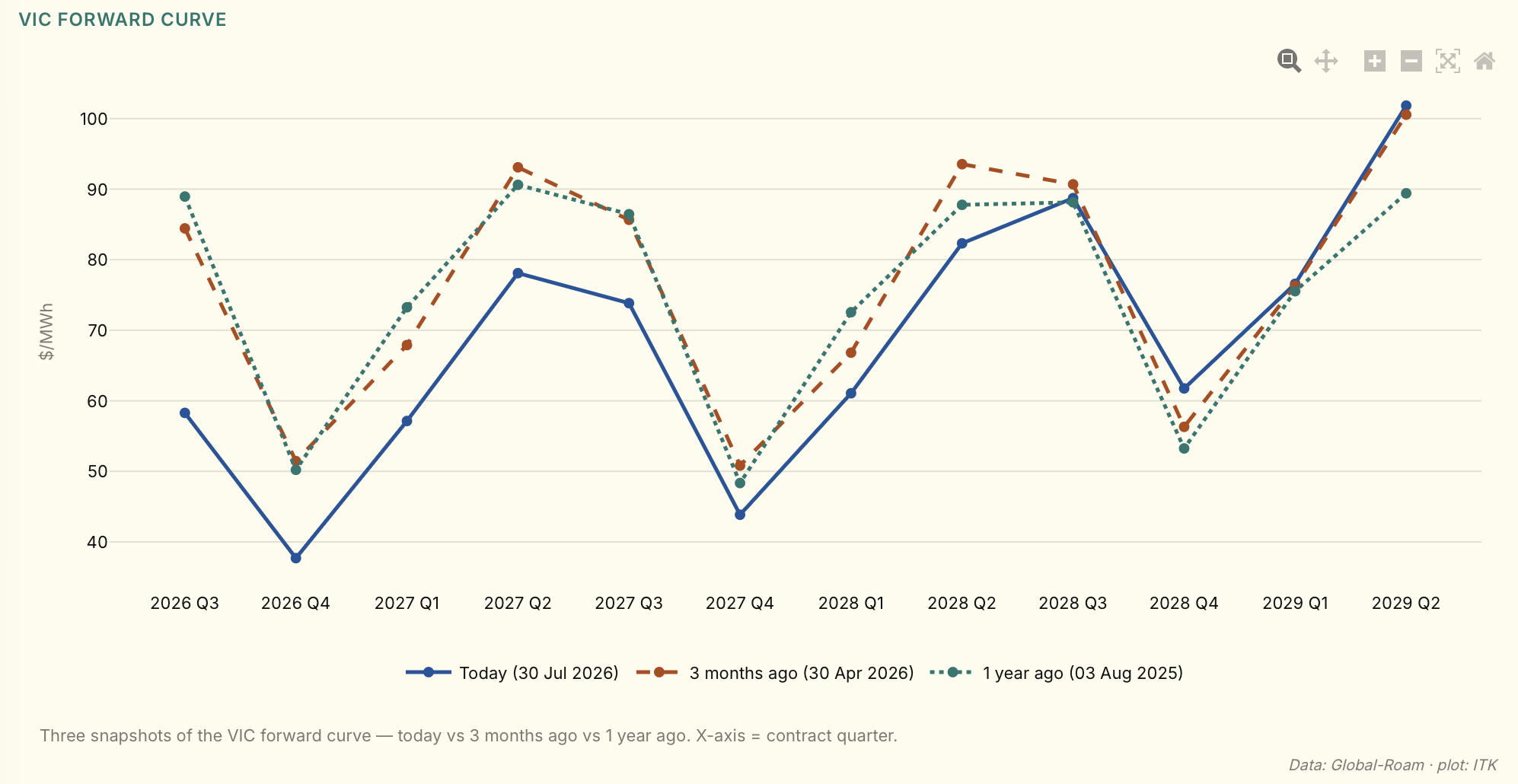
There are no near term price signals to prompt investment either.
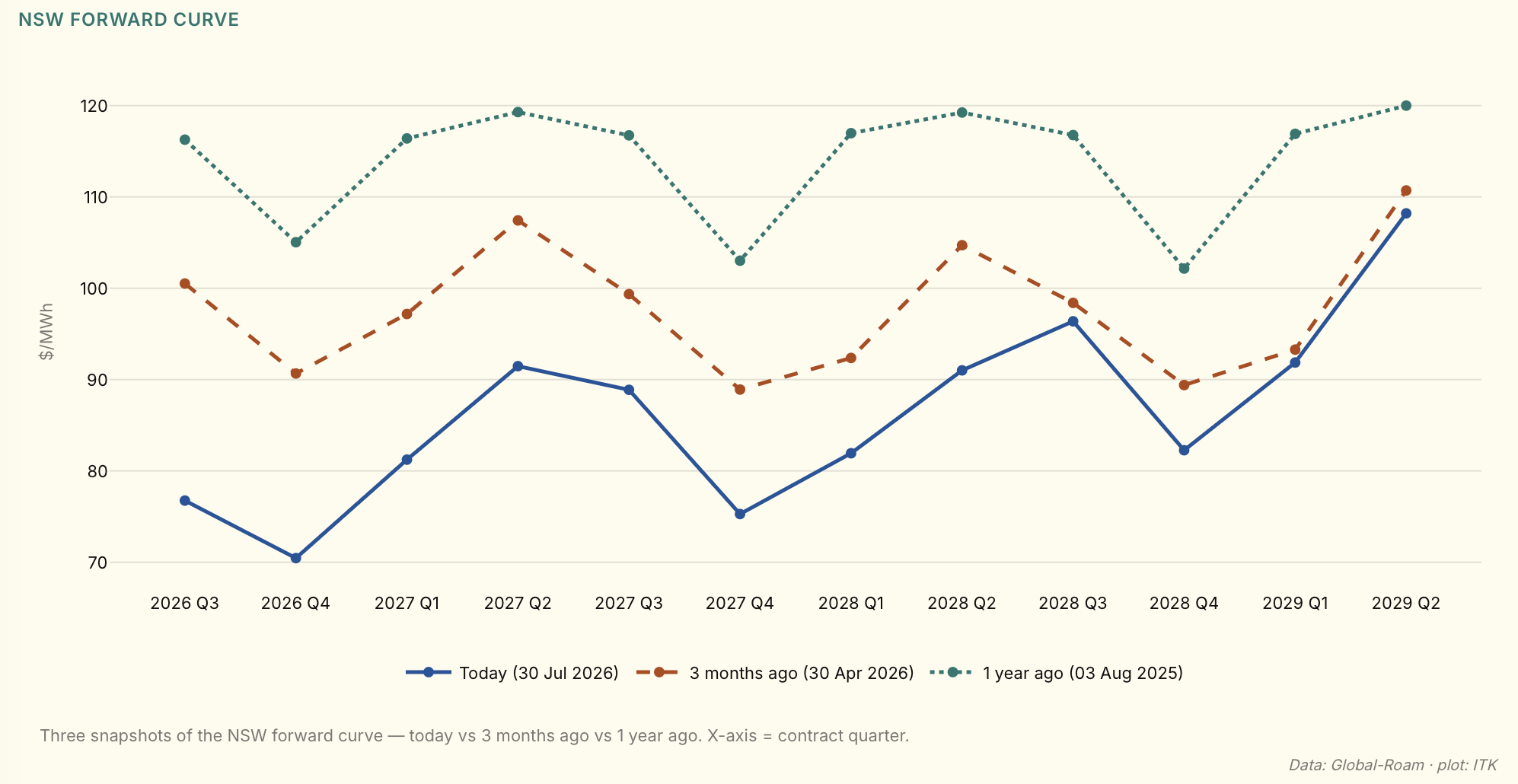
Futures expectations are for Victoria to get up towards NSW. That could change if Yallourn is preserved due to a change in Govt. QLD is not expected to be leading the charge unless its towards gas.
CIS issues (Penny wise, pound poor)
New utility scale renewables are not getting financed because:
- Nothing has replaced lost REC revenue;
- The CIS provides some “optional” downside protection that is useless to equity investors;
- Costs have increased even as near term spot prices have declined;
- Coal generation is being paid to stay online.
Lenders size debt on contracted revenue, and the CIS doesn’t supply any.
It is evident to me that during the transition old supply must stay online while new supply is being built and commissioned and this will result in prices below LRMC. As a result both existing and new supply must be supported during the transition. In any event as discussed below you justify the capex for new wind and solar just by taking into account the shadow carbon price the AER uses. Never mind all the actual benefits or safe, secure supply. The CIS is a perfect example of the old saw “Penny wise, pound poor”
The way forward is moving the CIS to a defacto CFD
The obvious ways to make progress are a carbon price or tax, or — politically far easier — a CfD PPA. A flat contract for differences PPA will get capacity built where the CIS, which only covers the downside for debt, has not. The ACT, South Australian and Victorian Governments have all used one successfully. Even a PPA can be treated as an option by tenderers — bid, then walk away if conditions change — so a winning tender bond is needed to make the commitment real.
The flat swap simply says the Govt pays (spot is below) or receives (spot is above) the difference between the spot price and the PPA over each and every quarter over the contract period. By making the contracts 20-25 years equity can commit with confidence, bearing basically only the construction and opex risk. A long duration PPA will lower the cost to consumers because lenders will lend lots and lend long.
The objection to a flat swap is that the Government wears the risk of some new technology or other event that drops long term prices. That fear is exactly why the CIS was written to cover only the downside for debt. But the downside risk is really small in the bigger picture. That’s a bigger picture than looks at carbon costs, energy security, import replacement, foreign investment attractiveness and community well being and belief.
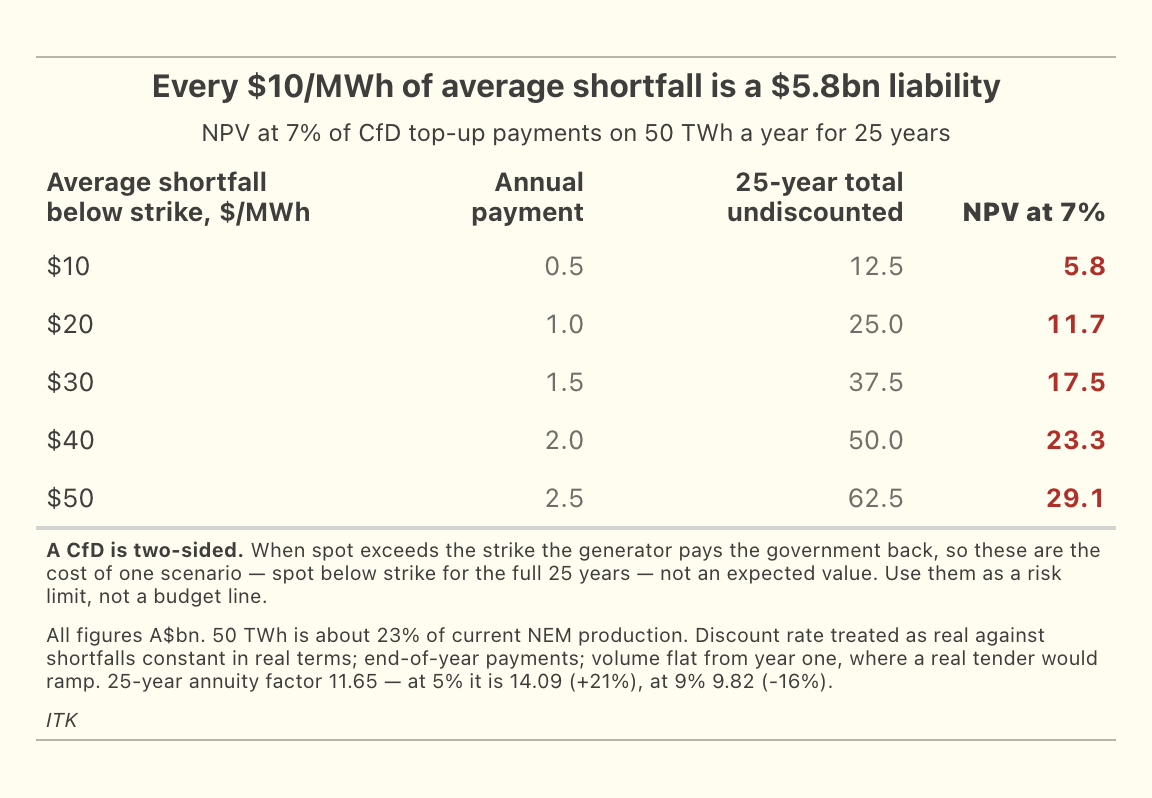
The main mitigation for the risk is PPA competition. The expectation is that project developers want to build their projects. Origin has for instance spent $300m on Yanco/Delta. Sunk costs are irrelevant but I think it would make them keen bidders.
Equally the risk is symmetrical. Ex post costs have gone up and earlier Govt PPAs probably looking quite good now.
Finally, looked at in annual terms, a $2.5 bn cost for being wildly wrong is pretty small by Federal Govt standards — $29 bn in present value over the full 25 years.
If the Federal Govt had adopted a simple approach instead of the CIS, projects would be under construction by now and the conversation would have moved on.
Carbon costs compared to wind and solar costs
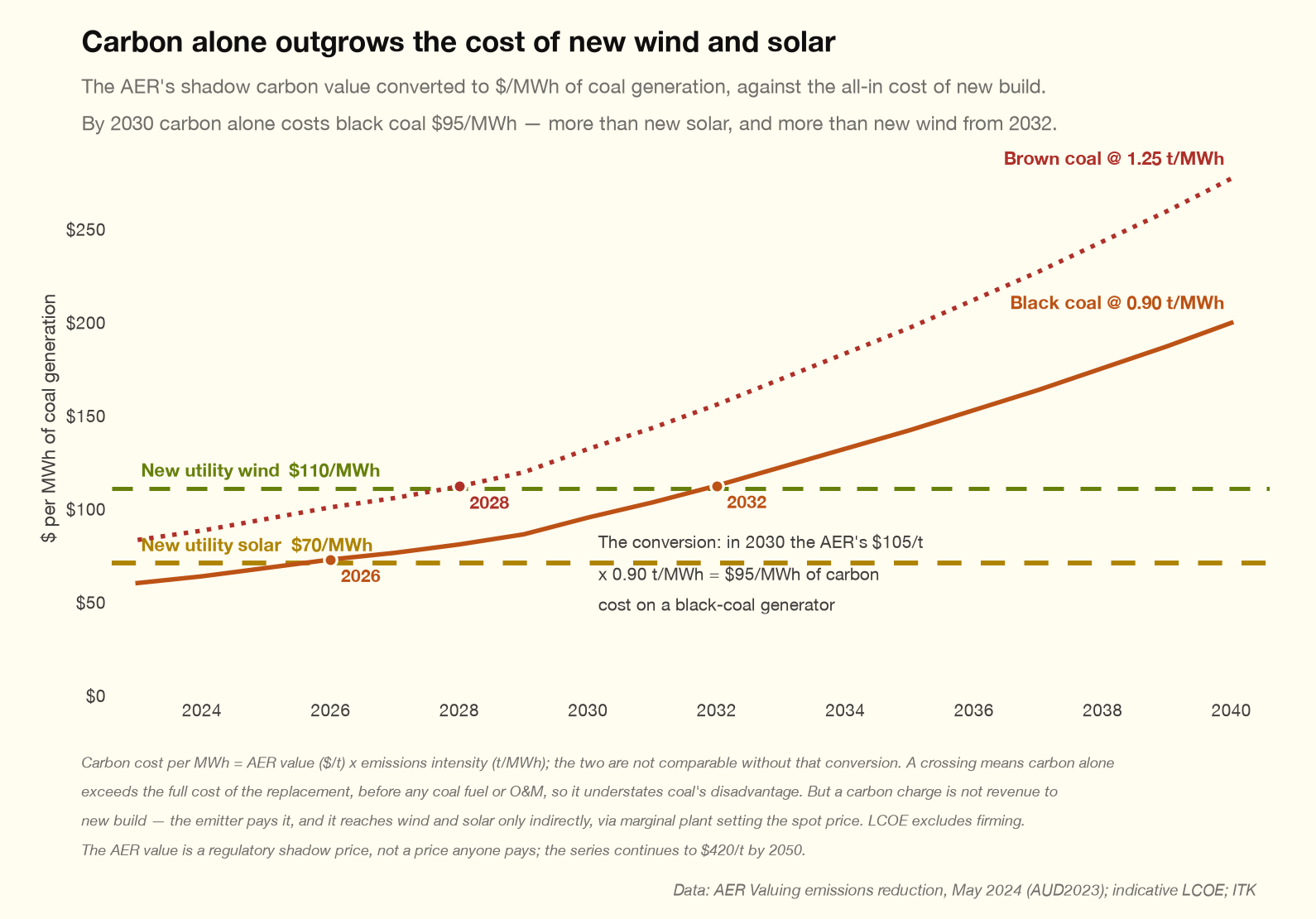
On the year to September 2025, the latest available, and at the AER’s 2030 carbon value of A$105/t, the cost of Australia’s emissions is about A$46 bn a year. That accepts the negative land use net benefit, which many would not.
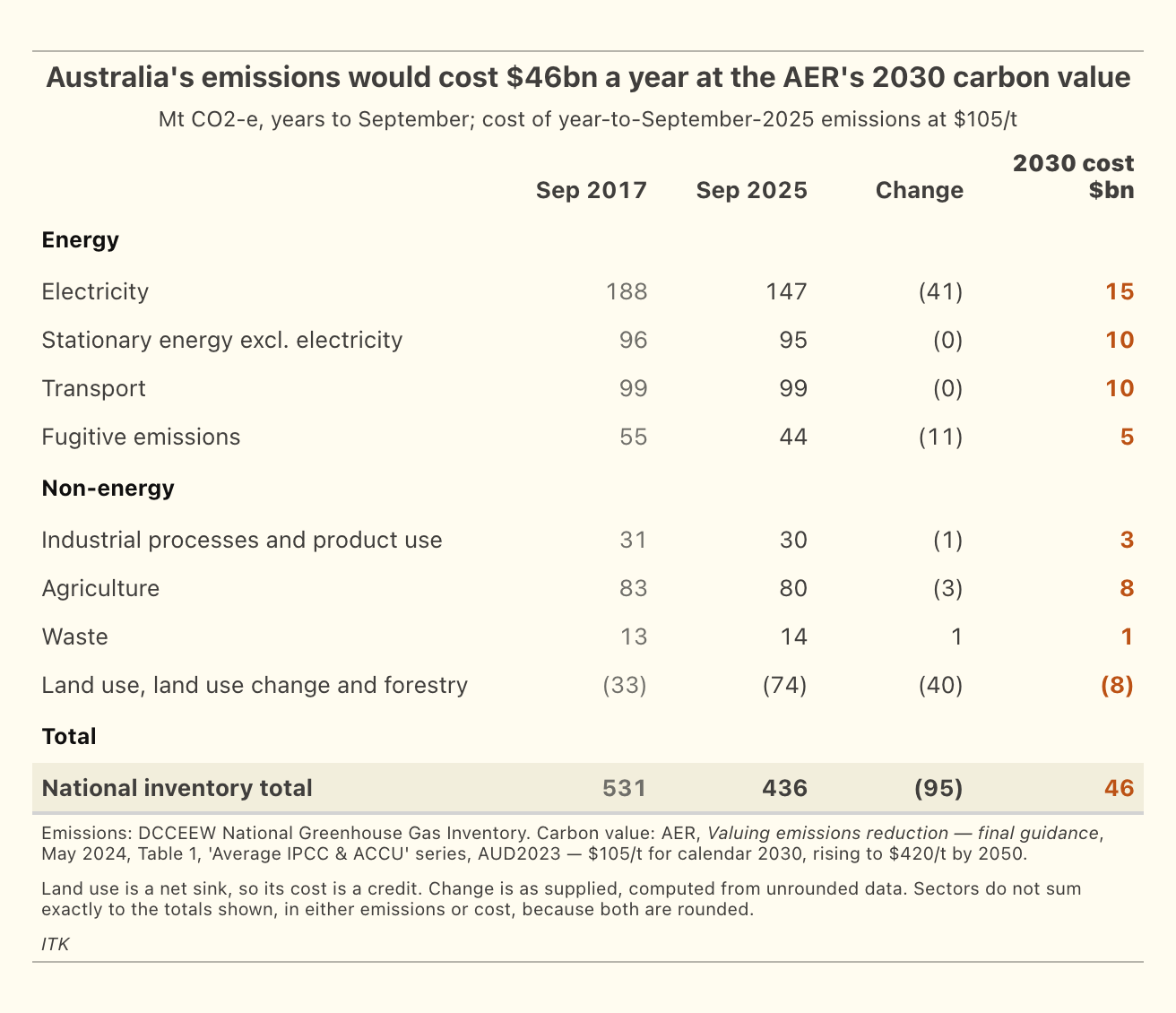
More than half that cost is in the easy to abate electricity and transport sectors.
Before getting to some different sums, it’s worth observing that at the AER carbon values, building wind and solar is fully justified even if 100% subsidised.
Replacing imported oil is the easiest win Australia will ever have
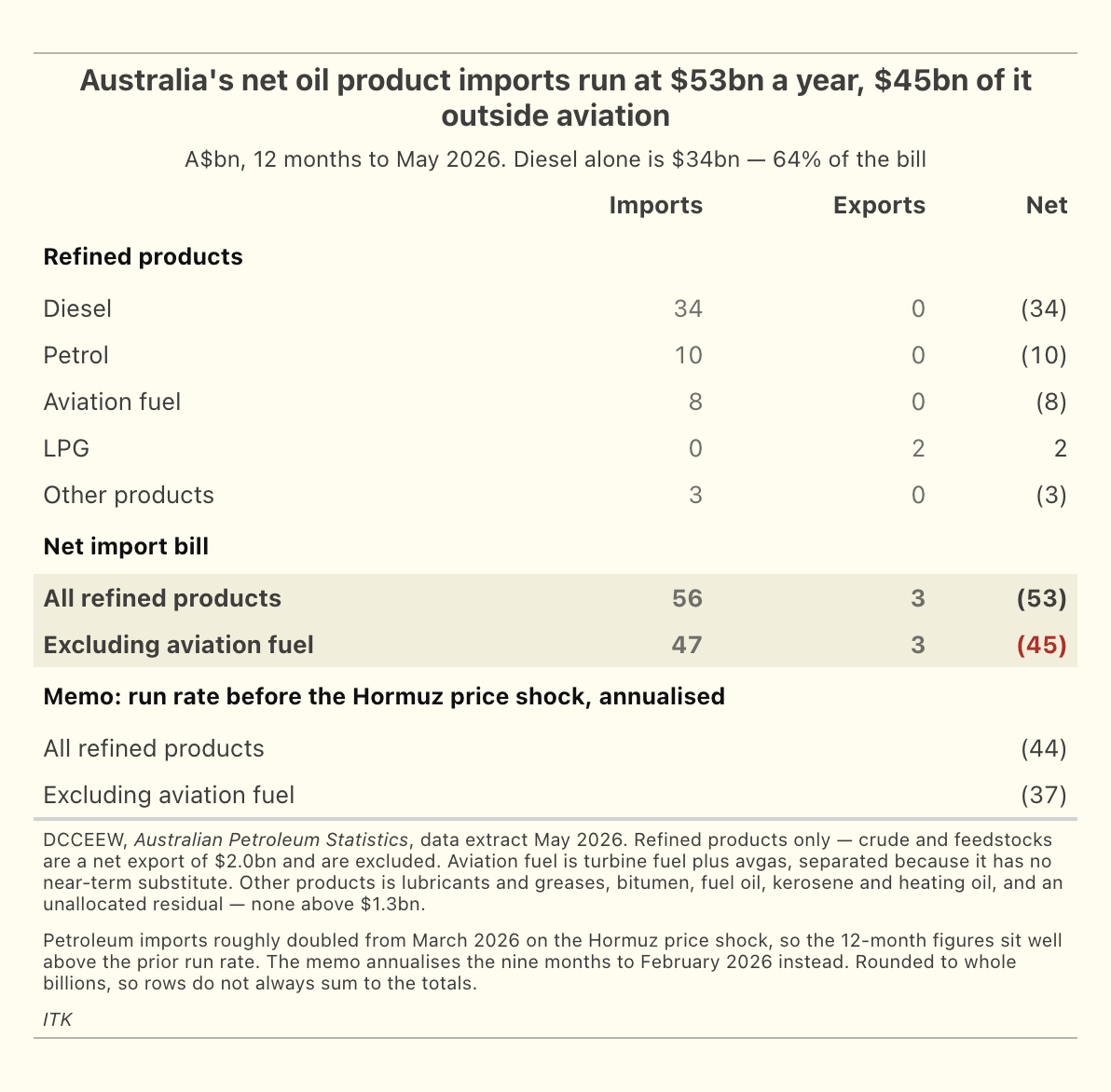
Our net oil bill as of May and excluding impossible to abate aviation fuels is around A$45 bn. Almost all of it is substitutable, which is the subject of the next section.
The benefits of taking advantage of the opportunity
Australia cannot continue to have an each way bet on its energy future and also expect to increase productivity and do the best by its citizens. To support coal, gas, hydrogen, wind, solar all at once is almost self evidently expensive and pointless.
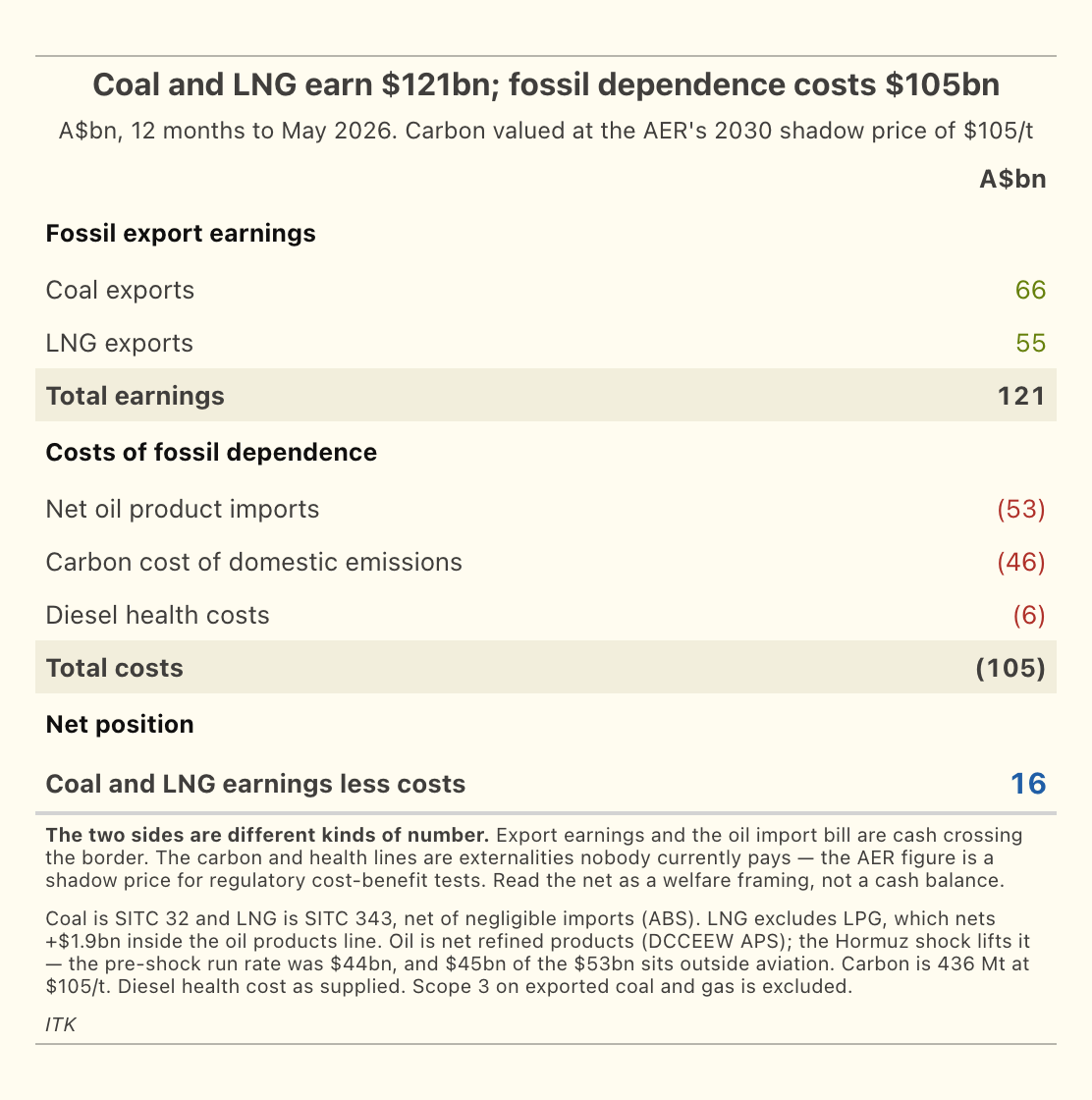
And as the ledger in Figure 11 shows, the bet is not even paying off. Coal and LNG exports are a big deal, but so are oil imports and carbon costs: the whole franchise nets about $16 bn once you count what fossil dependence costs us.
Net of the AER’s carbon cost, Australia could subsidise 100% of the cost of building wind and solar and still end up in front, because the avoided emissions are worth more than the entire build cost.
It’s trivially easy and trivially cheap by the standards of global problems to replace oil for road transport. Essentially there is no vehicle capex — you just import electric cars and trucks instead of oil fuelled ones, build some charging infrastructure and bingo you’ve won the lottery. You do have to spend capex on the electricity production of course. Road transport fuel is $29 bn roughly and that cost is avoided every year as is the diesel in mining equipment and probably agriculture. In total the vast majority of the $45 bn.
You are secure in a war. You have avoided $6 bn a year of health costs. Your drivers are happier. Consumers impacted for 50 years by the noise of diesel motors and air brakes get relief.
It’s a complete no-brainer.
Just doing electricity and transport would open up productivity gains, the very doing of things makes them more productive. It would make Australia an attractive destination, like China but a democracy. Let us build data centres, move into green iron ore and open up 30-40 years of investment and value add. I hesitate to use not politically correct language but the government really couldn’t get a more blatant or open invitation.
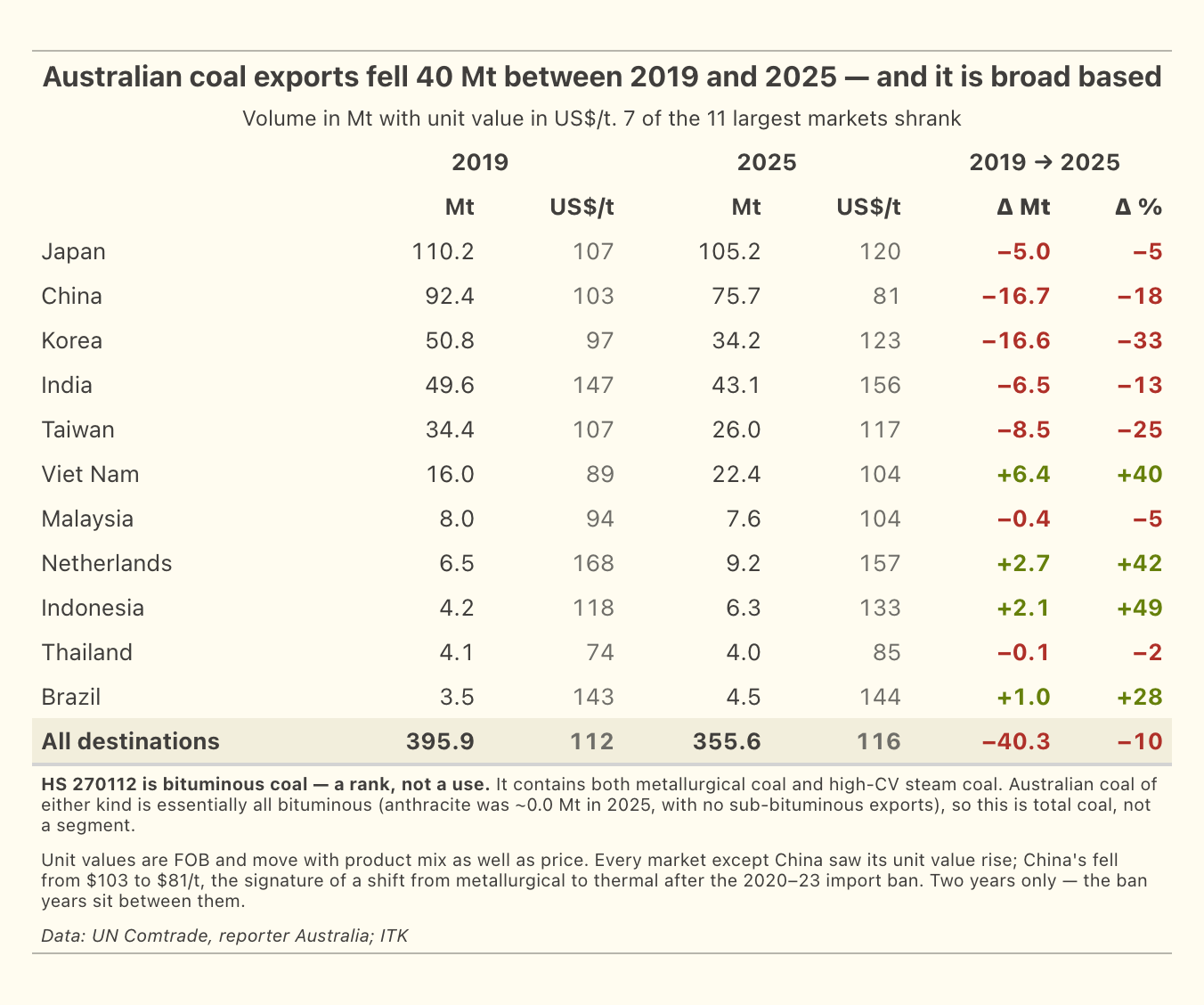
Our coal customers are decarbonising and buying less
The final point for any policy maker “should” note is that thermal coal is losing market share across the portfolio of countries we sell coal to. Surely our policy makers, our Govt Depts, our business lobby groups can see this? We need to go long and strong on decarbonisation. It’s just the right choice from almost any point of view.
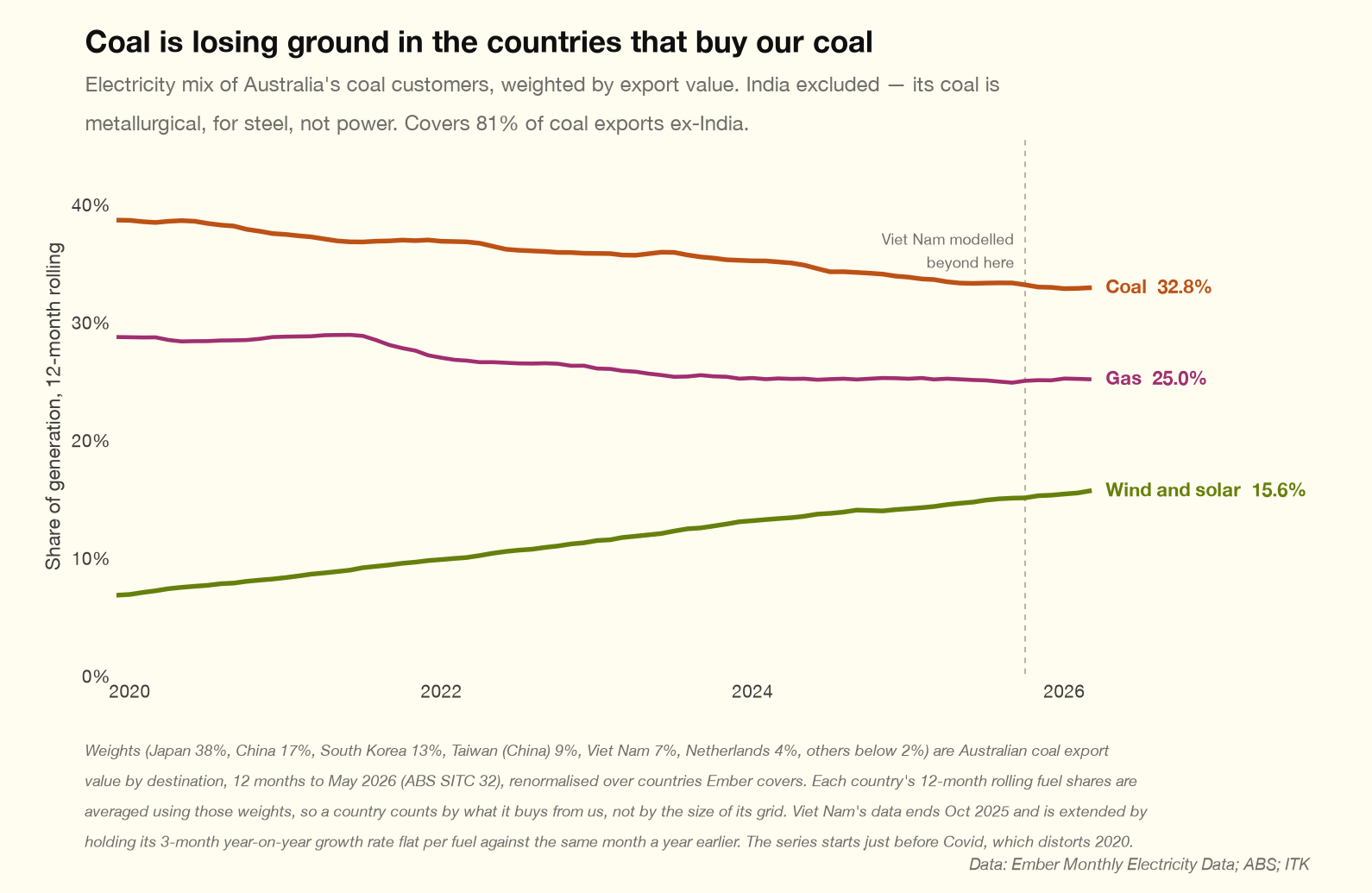
Coal is not only losing share. Australia is losing coal export volume outright. My data only goes to 2025. I think the last 12 months have been better, and China coal fuelled electricity demand is up this year, but the better view is that coal’s future is limited and Australia has only a narrow window of opportunity.
“Well, when events change, I change my mind. What do you do?” (Samuelson 1970)
What should be so simple becomes impossible. That is exactly when management has to step in. Management matters. The people in charge are in the jobs to make big decisions. If the decisions are wrong you also have to be big enough to admit it and correct course. Few senior people can ever admit they were wrong about anything. But some can… eventually.
Bob McNamara admitting an error, but 25 years too late:
“We of the Kennedy and Johnson administrations who participated in the decisions on Vietnam acted according to what we thought were the principles and traditions of this nation… Yet we were wrong, terribly wrong.”
(The fog of war is a great movie)
Warren Buffett, on buying ConocoPhillips near the oil price peak:
“The terrible timing of my purchase has cost Berkshire several billion dollars… sucking my thumb when new facts came in that should have caused me to re-examine my thinking.”