EVs are getting better, Bjørn Nyland’s real world tests show it
Dedicated to my grandfather Hilton Chenhall
My grandfather was a gentleman and a car enthusiast. He could have had any car he wanted and I think my mother said he’d once had a Bugatti. When I was a kid it was mostly Jaguars but I think as he grew older he was fondest of a Datsun 240Z.
Staying at my grandparents as a young teenager I was an avid reader. Perhaps the most read book was my grandmother’s copy of S.J. Simon’s Why You Lose at Bridge (1945), a brilliant piece of writing with a Mrs Guggenheim, an Unlucky Expert and a Mr Smug as three of the players. I have resembled each of them at various stages of my career.
But also on the shelves were books about Nuvolari, Juan Manuel Fangio, Stirling Moss and of course Jack Brabham. I read them all.
When I was 18 my grandfather gave me, as a Christmas present, an advanced driving course with Peter Wherrett (who lived the latter part of her life as Pip Wilson) out at Warwick Farm. What a great day. My father also came to the party by buying a second family car, a second hand Datsun 1600. It must already have been basically out of production by then but I neither knew nor cared. For at least the next 12 months I would spend weekends around Armidale on the dirt roads practising four wheel drifts, heel and toe shifts, handbrake turns and so on. Eventually one Sunday afternoon returning from a soccer trip to Glen Innes the head gasket blew, thanks to my poor maintenance, and after that there was no second car.
Moving to Sydney I rode a pushbike to work for many years, but cars remained of interest.
Eventually, as I moved up in investment banking, newer cars became possible. Our first Renault had so much rust that when I was driving my girlfriend, now my wife, around Alstonville a stick came through the floor. We thought it was a snake.
I was always envious of my more successful colleagues who had Mercedes long before me. Eventually I got one, then a better one, and finally an E-Class diesel wagon. If you had told me that within three years I’d sell it for a Hyundai I’d have laughed. But when Giles Parkinson let me drive the Hyundai Ioniq5 he was testing in Canberra there was no looking back. I might digress even further and note that years earlier on one of many business trips to LA I’d taken the time to visit the nascent Tesla shop where a memorably pretty girl with memorable attitude had shown me the Roadster. I wanted an electric from then but somehow not a Tesla.
This is an overlong introduction, but the point is that the family now has a 2021 72 kWh Ioniq 5 AWD and a 2024/25 Xpeng G6, 87.5 kWh. Between them about 100,000 km, with trips to Wentworth, Melbourne, Jerilderie, Horsham, Mt Coolum, Armidale and other spots. So I feel I have paid enough dues to write on the topic.
Bjørn Nyland runs a great YouTube channel
Tesla Bjørn as he is sometimes known is a “youtuber” whom I have recently discovered. He posts a video most days and has a new EV most weeks. More to the point, he runs a semi-standardised real-world test: how long it takes to drive 1,000 km through Norway and Sweden. He hasn’t always driven the same route but it seems more consistent now. He drives at night to minimise traffic and it’s cold in Norway. He has a variety of test equipment and Norway and Sweden being largely electric, there is an excellent fast charging network.
Bjørn being Bjørn he publishes a freely available spreadsheet of test results and car data and the remainder of this note is based on that spreadsheet.
The data supports tentative conclusions that:
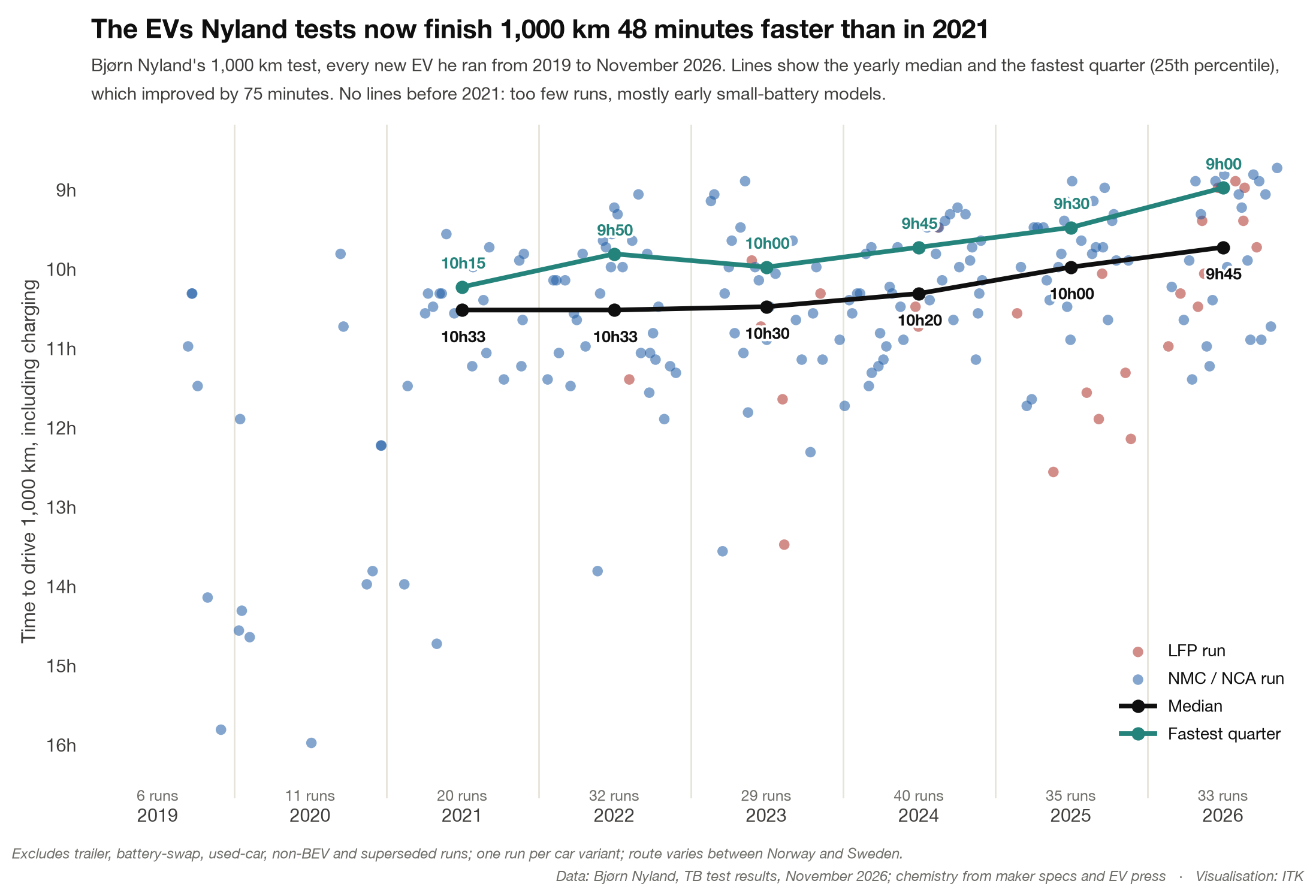
The best in class cars can do the 1,000 km in something like an hour less than a few years ago. The best are now within 10–15 minutes of a fossil-fuel car, and the fastest quarter within about 25 minutes.
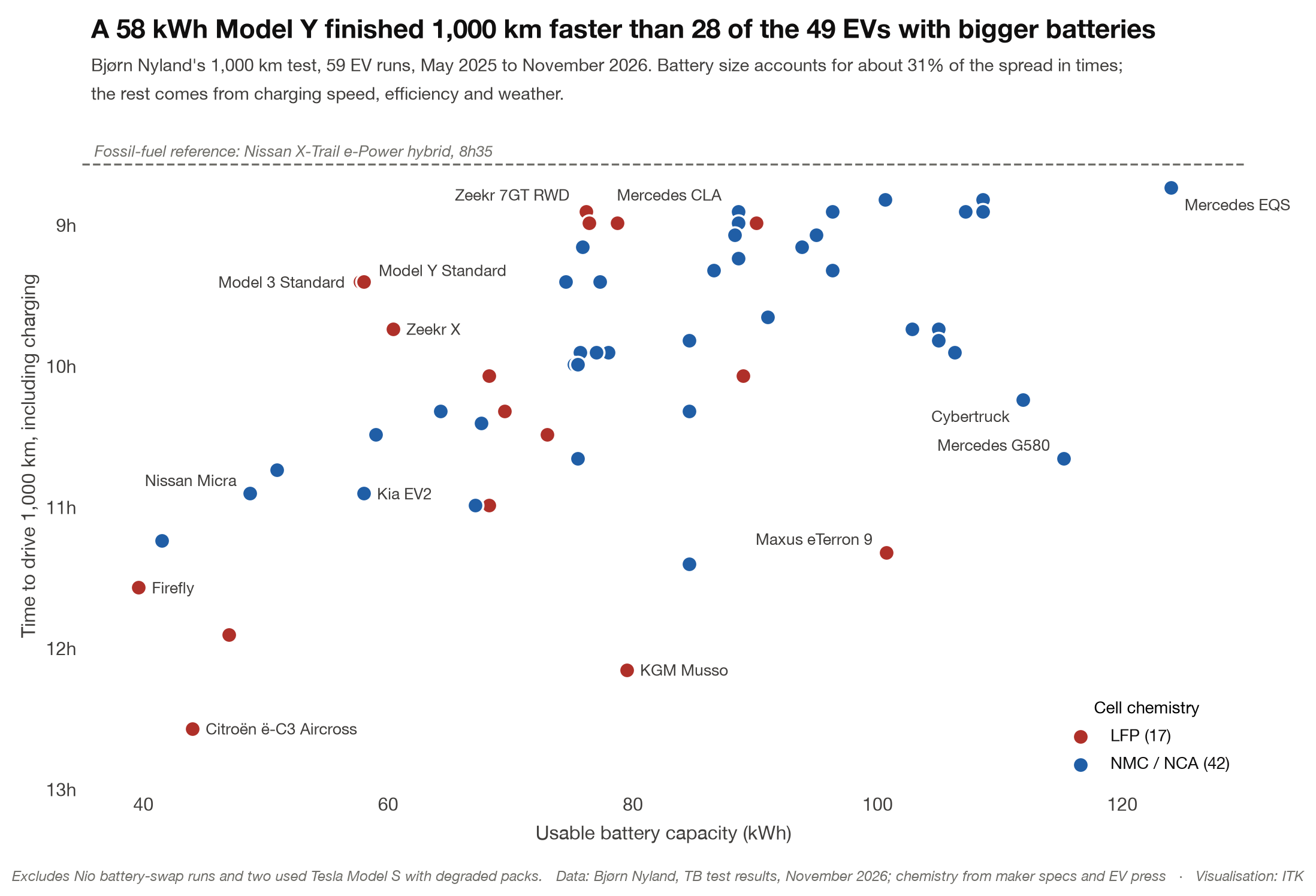
Smaller battery fast charging cars can do the trip to within 10 minutes of much bigger battery cars.
Chinese cars have improved out of sight, and in Bjørn’s 2026 tests they are faster on median times than everyone else, and in my view far better value. This is at the top end which is where I have focussed.
There is a huge variety in performance. I have paid no attention to middle of the road cars, they don’t interest me. However Mr Nyland is as happy in a Mazda 6e or a VW ID. Polo as he is in a Mercedes or a Zeekr so if you are interested in a car it may well be there.
A smaller battery that can charge very fast can compete with much bigger batteries on virtually equal terms but only when there is a charging network that supports it. Australia does not have such a network.
I did a late night back of the envelope, that doesn’t even take the value of time into account and leaves out running costs, that very much suggests Australia would be more productive if we build on the main highways say 300 sites, with very fast charging capabilities and spaced every 100 km. Smaller batteries then could save buyers about $5,000 a car. I think its a NPV positive decision from Australia’s point of vie but requires more formal work.
Bjørn Nyland’s results in charts
Let’s look at the time progression first:
Then I have two charts on battery size, first with every car Bjørn has tested since May 2025. Note the Y axis shows shorter times at the top. In this and the next chart you want to be in the top left.
Then a focus on cars with 75 kWh or more, highlighting the best performers. Even in this group plenty of cars are not great performers, at least not for a long-distance traveller keen to arrive.
The fastest cars now give up only 10–15 minutes over 1,000 km to a fossil-fuel car in Norway and Sweden. I suppose it is fairly flat and in Italy it might be different.
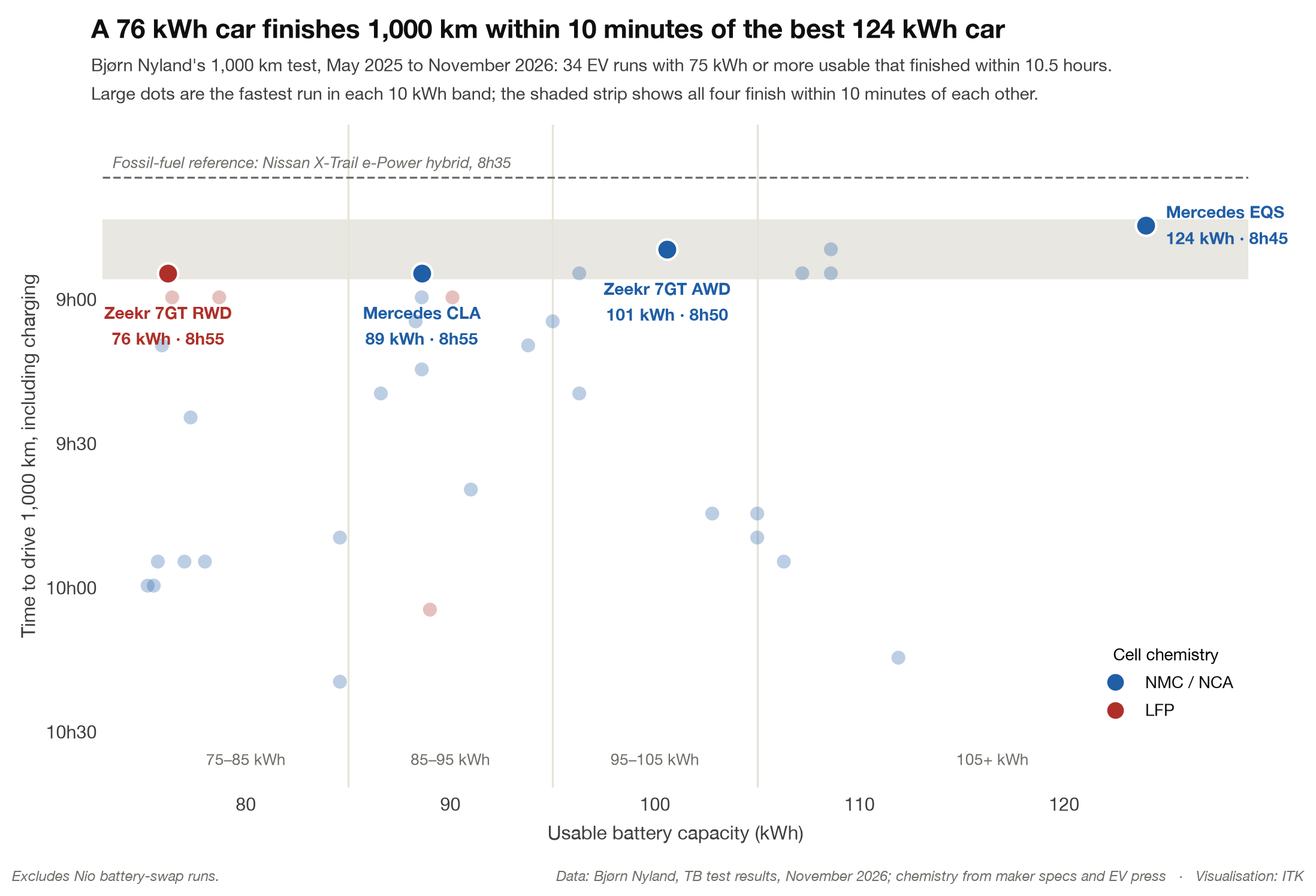
The 76 kWh LFP Zeekr 7GT finished 1,000 km 10 minutes behind a 124 kWh Mercedes EQS: two-thirds of the battery for almost the same trip.
Note the great performance of very modern LFP (lithium iron phosphate, the cheaper chemistry) batteries coming out of China. They are so new that the impact of 5C charging (a full charge in about 12 minutes) on battery life has yet to be seen. But the rate of actual progress is incredibly clear.
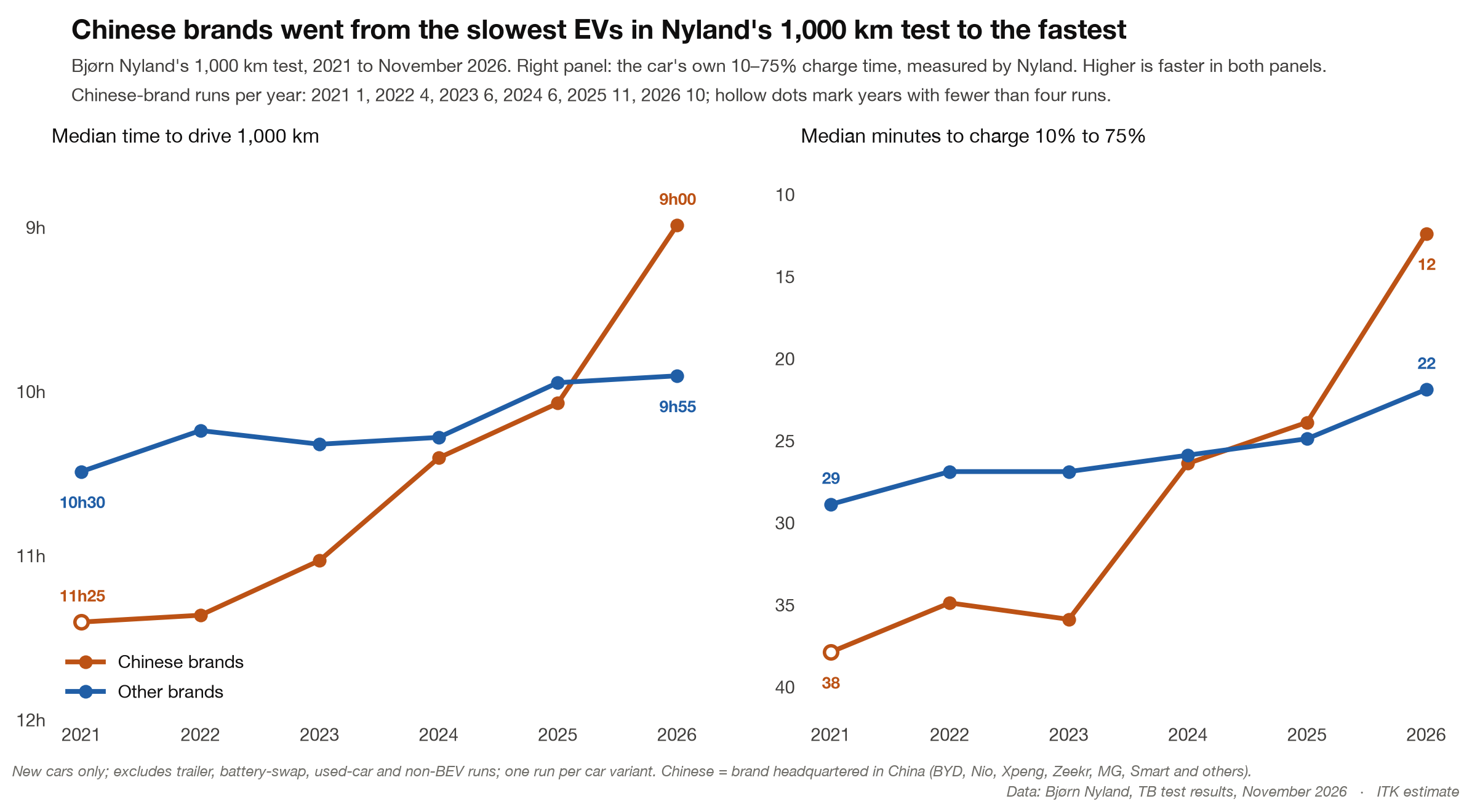
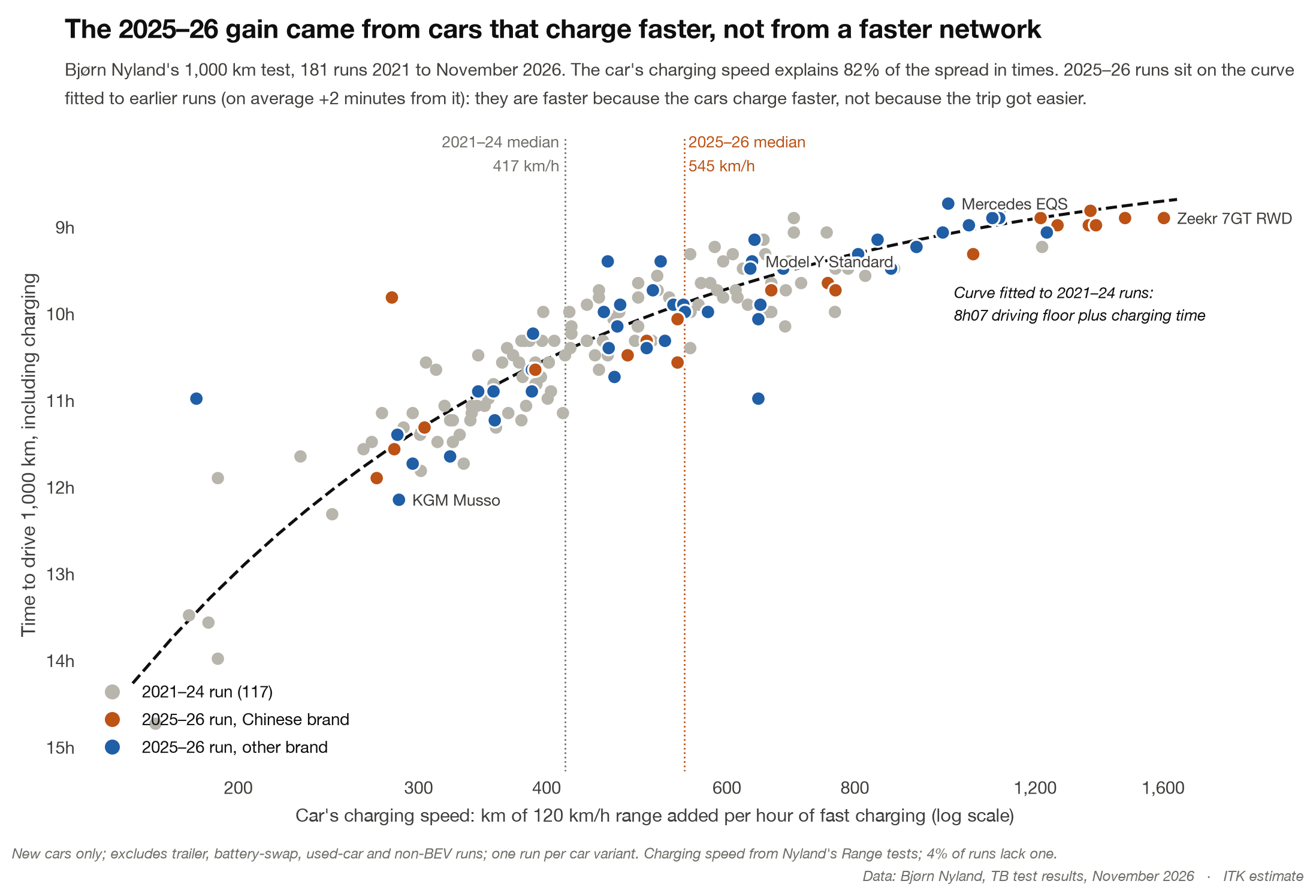
But my favourite chart of the lot shows that faster charging in the car itself, given a network that can deliver it, explains most of the improvement. It also shows China’s impact in the recent data.
Why the network matters
There is now only a small time penalty in choosing electric over petrol for long distance driving provided there are enough fast chargers. If you were towing a caravan results might be different but towing a caravan is fairly expensive just now, or so I understand.
The improvement has come from the cars and car battery technology but it requires the network to be there.
As you might expect in productivity shy Australia there is no national database of chargers showing power, number of stalls or anything else. It’s possible Carloop provides the data but that’s commercial and I can’t say how up to date it is.
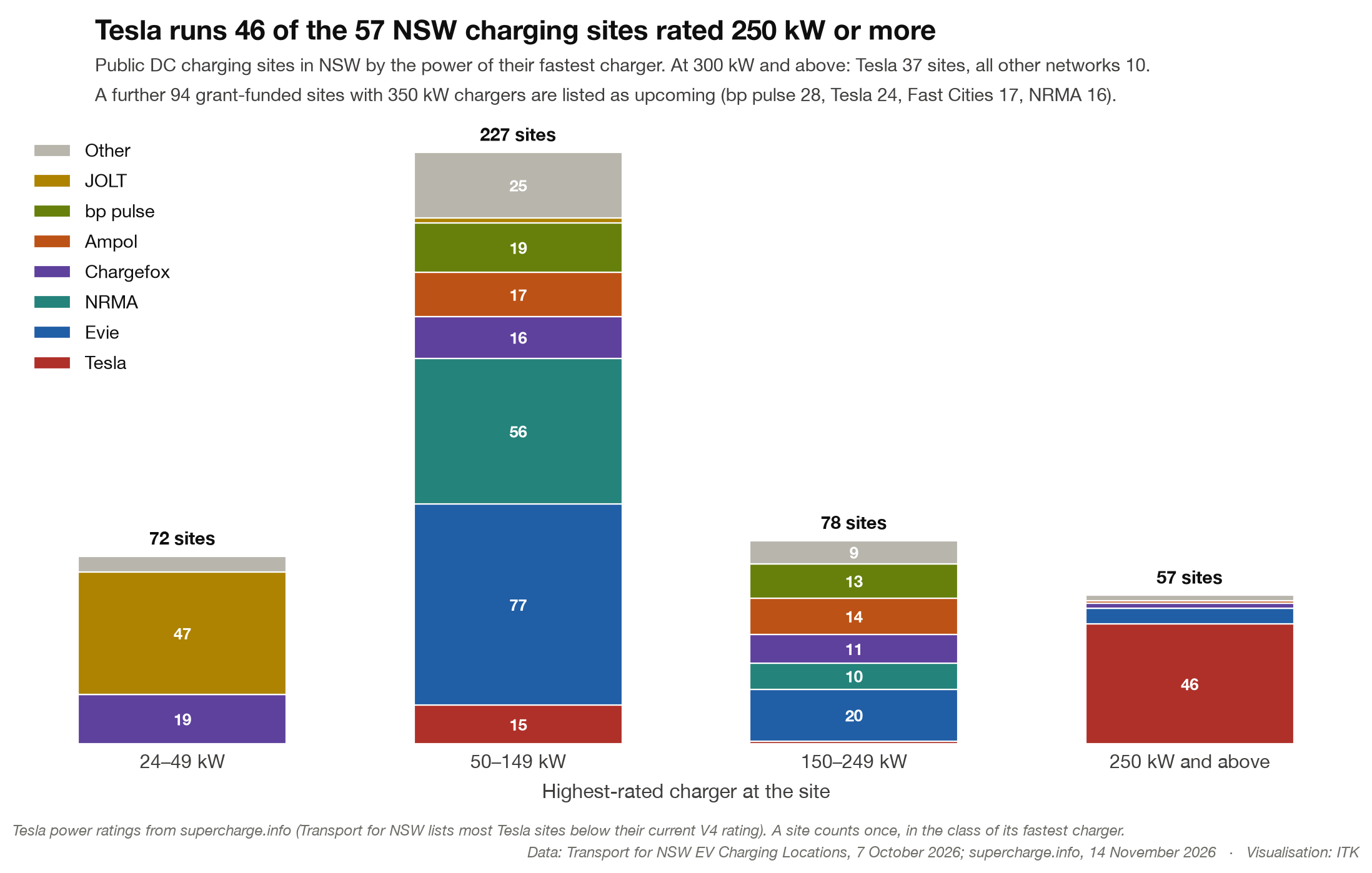
The NSW Govt maintains a database for NSW but it doesn’t appear to be up to date, at least as regards Tesla V4. Tesla data comes from supercharge.info, which tracks every Supercharger; everything else in the next chart is from the NSW data. Given my own experience, the chart looks surprisingly optimistic.
The good news is more fast chargers are coming.
Sadly my experience is it’s rare to get charging over 100 kW. If I owned a Tesla it would be different.
- 400 V chargers can’t typically supply their rated power to 800 V cars. Even among Tesla’s NSW sites, only 37 have the V4 cabinets that 800 V cars need. So I personally have in recent years tended to use Tesla networks. They work, I can generally get onto one, although increasingly in the past year Tesla charging stations are full on peak days (Sapphire Beach, Wagga, Albury at the Commercial Club, Raymond Terrace, Kew) but I only get 100 KW. At my age I suppose I don’t mind the delay.
- Most bays share their available power with neighbouring bays, so typically a second car can halve the power. A charger station was recently installed in Gloucester NSW. It’s great but if a second car is there the output is 22 kW. Ask me how I know. And probably another car will be waiting to get on. Charging operators are well aware of this and recent tenders require dynamic load management. That is, more power from the grid connection (kVA) is available, except when it’s not.
- And that’s the other point, there just aren’t enough stalls. Watch one of Bjørn’s videos. Look at all the empty stalls. To be sure, he is often driving at night, but the experience is not even remotely similar to Australia.
- Lots of stalls are needed because many cars in Australia cannot charge that fast, so fast chargers are wasted on them, and they cost more for consumers. From the charging companies’ point of view having slow charging cars on fast chargers is better than no throughput but you sell less electricity than if you had a constant stream of fast charging cars.
What carmakers compete on now
To my way of thinking EVs need to be able to do long journeys in roughly the same time as fossil fuel cars. The average car might only do 15,000 km a year or less but many of us do long trips, and definitionally the roads will be crowded on peak days, Easter, Boxing Day and so on. It’s on those days where people form their emotional relationship with the charging network. A bad experience tends to stick in the memory far longer than ten routine charges where there is nothing to remember.
Beyond charging there is the weight of cars. It is going up, and not just because of the batteries. It’s partly that having solved all the other problems car manufacturers are now competing on comfort.
A good electric car doesn’t drive itself but neither does it require much effort. You have endless power and acceleration, adaptive cruise control and one pedal driving. There is no motor noise but neither is there a spare tyre. Very few people really care about going round corners fast so what do manufacturers compete on?
The very best, e.g. the Mercedes EQS, have things I value like outstanding headlights that change with the steering wheel movement, electronically controlled air suspension that adjusts as cameras scan the road ahead and of course safety.
It’s partly comfort, so called zero gravity seats, acoustic glass, fridges in cars, tv screens and gaming controllers for the back seat. I recently drove a late-model fossil-fuel Mercedes for 1,000 km in Western Australia when on holiday because no electric cars could be hired. The roads were good but I was struck by how much noise there was in the car. Tyres I think, and the engine and wind noise around the pillars. It was a good car, but it reminded me why I like electrics.
It’s partly software. Few manufacturers, if any, have yet got their software to a standard which keeps every user happy. As Apple users know it takes a rare engineer to build a great user interface.
Finally here EV manufacturers need to find a way to build a small car that performs to the same standard as a big car. The EQS Mercedes is 5.3 metres long and weighs about 2.8 metric tonnes. Many new EVs are approaching 2.5 tonnes. LFP batteries are heavier than nickel-based NCM per kWh and even 80 kWh will push you well into two tonne range. Perhaps solid state batteries could be the answer here potentially around 60% of the weight of an LFP pack of the same capacity.
In closing
This note was inspired by watching several Bjørn Nyland videos on YouTube. The state of the art in electric cars is of interest but beyond that Mr Nyland somehow makes a basically boring topic, driving a car, quite watchable. He is so far the only car reviewer whose new videos I look forward to.
Here’s to another year of progress in 2027.