There is a lot of news flow this week:
- AGL results: execution, reliability and cost control good, and the market likes that. Forward investment outlook poor. Now gas plants are showing up on the future investments list.
- ORG results (execution, reliability and cost control good). Yanco Delta “challenging”. Capex forecast low. Octopus nearly earned a positive EBITDA. APLNG underlying cost position likely to gradually struggle in my view.
- Tomago. RIO gets the subsidy it wants just like every other time. In a game as old as the NEM itself, RIO threatens to close the smelter, whichever government is in office at the time initially refuses to help, then prostrates itself. The twist this time is that Snowy is going to provide the electricity rather than AGL. Snowy doesn’t have enough power to supply so it’s going to have to buy some. Initially it will, in my opinion, have to buy from AGL, ORG, or EA until it can get renewables built. The Federal and NSW Govt each contribute over $1.2 bn over 10 years. That is about $240 m a year, or something like $30-$40/MWh. RIO has said it’s going to spend $1.1 bn but on what we don’t know. The pot technology is reasonably modern. About $100 m is to improve the ability of the plant to throttle back. But my understanding is that so far there is little evidence that throttling the power damages the pot life although of course it results in less production.
Tomago comments
A couple of points about Tomago need to be cleared up — actually, now the deal is done, only one really does:
Tomago is connected to the grid. The electrons used to run it will come from the grid and will notionally reflect whatever renewable percentage the grid has.
So Tomago will NOT be renewable powered in a technical sense unless the “grid” — whether you think of that as NSW or the NEM — is itself renewable powered.
What Snowy can do is procure renewable energy equal to the roughly 8.5 TWh that Tomago consumes every year.
In no way will or should Tomago’s load be firmed on its own. What has to be firmed is the “grid”. You don’t firm the grid on a MW-for-MW basis. There is always something running: wind, solar, Tasmanian, NSW and Victorian hydro, as well as — for the time being — coal and gas generation.
If there is one thing the ISP demonstrates it’s that you can run the NEM without coal or nuclear and not all that much gas. The ISP has been through multiple versions over quite a few years now and if there were any real technical doubts they would have surfaced.
If every load had to firm 100% of its power and energy it would indeed be ridiculously expensive. That’s exactly why Tomago is connected to the grid. There is more to say, including what this means for data centres, but I write too much as it is.
Damien Nicks was on the money but also deeply depressing
It’s incredible to me how little ambition the big gentailers show to decarbonise. It’s almost like the people that work there don’t have kids or grandkids and all they care about is this year’s profit. I’m sure that’s not true but I doubt their descendants will thank them much for their lack of ambition.
It’s perhaps most incredible when I look at AGL. AGL’s Chair used to be the CEO of the biggest or second-biggest owner of renewable generation in Australia. Before it became the biggest coal generator, AGL was itself either the number one or number two wind farm builder. But now ….
Where this matters is in AGL’s strategy, which in concept is no different to ORG’s or EA’s. Except EA’s strategy is about as meaningful as my strategy given its balance sheet. ORG and AGL have reasonably good balance sheets.
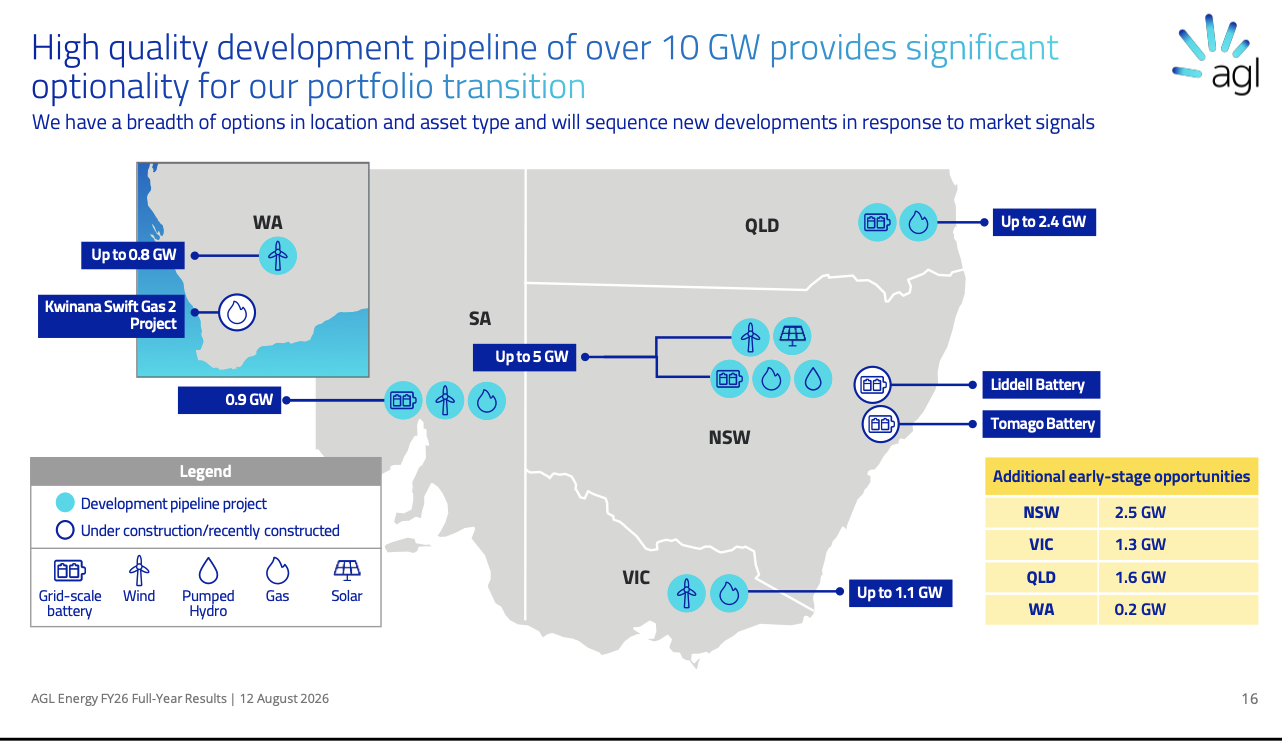
Gas plants now on the map in every state. Solar plant only in NSW. It’s true there is wind on the map in three States.
But the commentary was what interested me.
Our strategy is premised on building a firming portfolio diversified by technology and asset type.
As I say, although that’s Nicks from AGL, it could have been spoken by any of the majors.
A slide or two earlier Nicks stated:
Continuing the discussion on market conditions - the divergence we are seeing between FY27 and FY30 forward curves largely reflects recent cyclical factors, whilst the medium-term outlook points to a progressively tighter system and returning to pricing levels which will ultimately be required to underpin investment requirements.
The forward market is increasingly recognising numerous structural changes underway across the NEM. Planned coal-fired retirements in both New South Wales and Victoria from FY29 will remove significant baseload capacity from the system.
Importantly, if those retirements are delayed, reliance on ageing and less reliable baseload generation is likely to increase volatility, further reinforcing the value of portfolio flexibility.
At the same time, demand forecasts continue to strengthen, underpinned by the growth of data centres and broader electrification across the economy.
Of course the businesses best placed to dampen that volatility are AGL and ORG, and arguably EA. In fact they are actively encouraging it.
ORG closes Eraring in 2029. To be sure, management have twice delayed the closure and now they can get insurance payments to keep it open.
EA closes Yallourn in 2028. They have been receiving undisclosed capacity payments for years.
So ORG and AGL have been busy building and contracting firming capacity because they can see this extra volatility coming. They know — as I have been writing for months, and if I can see it so can anyone — that the low prices and the low volatility of today are only possible because coal still provides 50% of the energy in the NEM.
There is oversupply in the evening right now, and batteries compete hydro and gas out of the market, keeping prices down. That is only possible because of the coal generation sitting lower down the stack.
Once the coal goes, volatility will return, as Nicks says.
And that’s why I’m depressed. This has all been clear for two years and yet still we see no new bulk energy projects.
More to the point AGL and ORG are now incentivised to increase volatility. They are incentivised to reduce coal generation but they are even more strongly incentivised not to write wind PPAs or solar PPAs.
Snowy will have to act against its own portfolio
Snowy is still the largest provider of firming generation in the NEM although it’s losing share. Its profits benefit from volatility. Nevertheless, were it acting commercially — and assuming it had a balance sheet — it would probably be incentivised to pick up market share by writing wind and solar bulk energy PPAs. Maybe.
The good news for Snowy and the Govt is that the implied lease doesn’t end up on the balance sheet. But that’s accounting which not too many people care about and comes after tax which no-one pays.
Victoria is the biggest loser followed by NSW
Unfortunately after being the leader for so long Victoria has lost its way. There is no replacement for Yallourn in sight. Offshore wind is prohibitively expensive and years away. Onshore projects capable of replacing Yallourn are not yet ready to go.
In looking at the following chart bear in mind that futures prices are arguably an upwards-biased representation of future spot expectations. We can argue the toss — there are competing theories — but my view is that retailers are incentivised to hedge forward and to pay for the privilege, which shows up as a futures premium. Just not a premium anything like the size the curve implies.
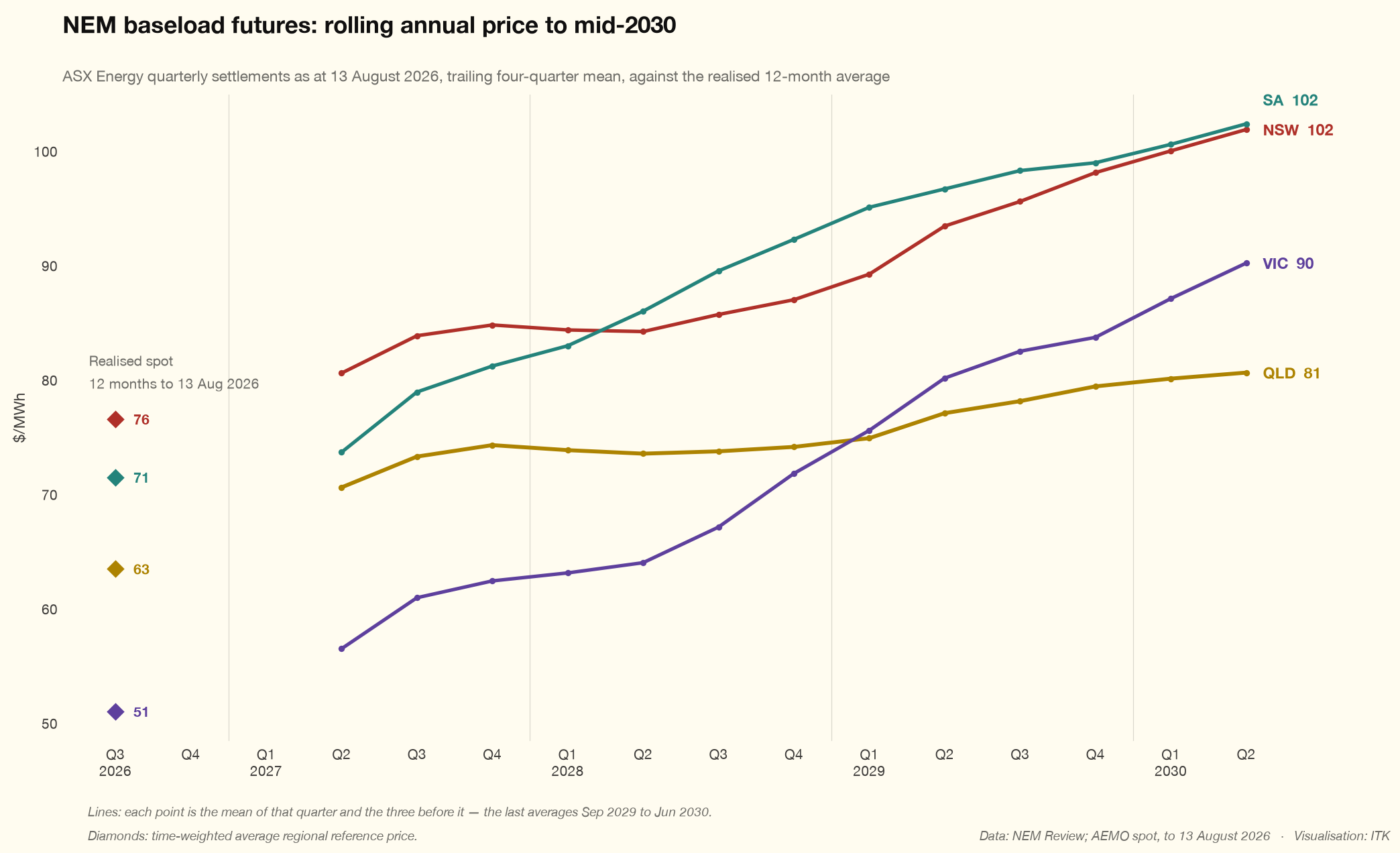
QLD will undoubtedly see this as justification for its coal policy.
I am tempted to ignore South Australia because in my opinion it’s not a very competitive market.
But the price in Victoria is up very steeply. It is still below NSW, though by much less than it used to be. And in any case the rise in NSW arguably reflects a view that Eraring is going to close and that not enough new capacity is available.
As is obvious, if we close old capacity and don’t build enough new stuff, prices will rise. If the supply/demand balance is too tight volatility will extract a consumer cost.
Every hour at $23,000/MWh adds nearly $3 to the average price for a year, and that average price feeds into the AER forward DMO so it affects next year’s price as well.