Linking electricity and safeguards
In this note I set out a case and the implications of linking electricity and safeguards. In my view the linkage would:
Bring the largest source of emissions into the scheme and would result in over half of Australia’s emissions being brought under a formal scheme;
Provide price support for new renewables. At an NREC price of $30, a little below the ceiling the exchange rate implies, I’d argue it’s the difference between a viable and a less viable wind project. In some ways this is to me the predominant driver.
Provide an indirect incentive for gentailers, who are the owners of coal generation, to purchase so-called NRECs. It would be better if they had a compliance obligation but that ship has maybe sailed;
Increase the costs of coal generation;
Be achievable with only a minor impact on the electricity price;
Expose land-based ACCUs to new competition from renewable electricity, though the exchange rate may leave them a competitive edge.
Under a binding cap it’s the decline rate that sets the quantity of emissions. If you want lower emissions you tighten the baseline. Linkage may change where abatement money goes. I personally hope it goes to new renewable generation because in my view we need to decarbonise the economy more than we need to sequester emissions. Sequestering is good for the climate. Decarbonising is also good for the climate and has other benefits in reducing transport costs, in freeing up gas for other uses, in reducing electricity fuel price risk and in reducing supplier market power.
I showed versions of this note to various people with an ear to the ground and the general opinion was that “might be a good idea, but the Government has zero interest”. So much so that people dont try. I also think the Government worries about anything that even smells like an electricity price increase. But that’s silly to be honest. If wind needs $100 or even $110/MWh and the spot and futures price don’t offer that then the wind wont get built. Or the Government will have to subsidise it through its budget. If the wind doesn’t get built we kick the coal can down the road, reliability falls away steadily and the problem just gets worse. Probably costs will increase further. A stitch in time and all that. If the Government isn’t interested in good ideas because they don’t suit the agenda, well that will surprise no-one. It has always been that we live in three worlds. The climate world, the world of economics and the world of politics. I’d have thought that ticking the climate and economics boxes was enough…..
Bring electricity in, allow new renewables to satisfy safeguards compliance
Grid-connected electricity generation is brought inside the scheme. Electricity has emissions of about 150 mt but there is presently no safeguard or other carbon-reducing policy. The closure of Eraring, Yallourn and Gladstone should reduce electricity sector emissions to about 114 mt. In this proposal electricity is brought into safeguards with a 2029 baseline of 114 mt declining 6% a year. Individual generators don’t get a baseline, it’s sector-wide.
(New) Renewable electricity certificates become eligible compliance units. Certificates may be surrendered against a Safeguard obligation alongside ACCUs and Safeguard Mechanism credits. Eligibility is restricted to certificates from projects reaching final investment decision after the announcement date. RECs are in MWh, Safeguards and ACCUs are in tCO2.
Preferred conversion rate is fixed at 0.90 tonnes CO2-e per megawatt hour. That figure is the emissions intensity of black coal. It sits above gas plant, which sector-wide averages about 0.6 tonnes CO2/MWh.
The 2029 commencement allows certificates of that vintage to be contracted forward from announcement, so projects reaching investment decision in 2027 and 2028 can be financed against them.
Including electricity strongly increases abatement demand
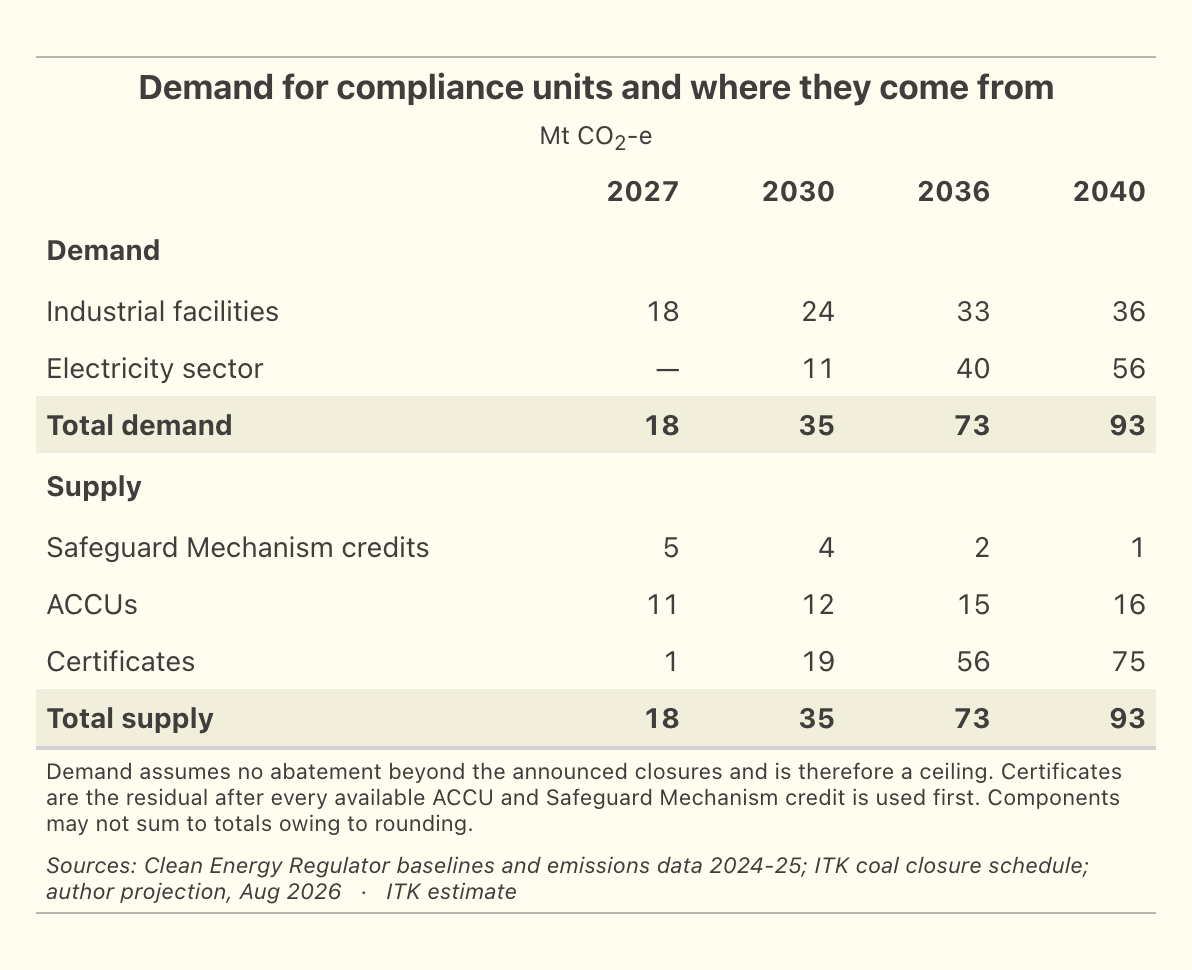
It’s worth separating how much of that demand comes from bringing electricity in and how much from the certificates themselves. Allow NRECs to acquit safeguard obligations but leave electricity outside the scheme and residual demand for them is about 1 mt in 2027 and still under 19 mt by 2040, because ACCUs and safeguard credits between them already cover most of what industrial facilities need. With electricity inside, it’s 75 mt. The electricity limb is what creates the demand. Certificate eligibility only decides who gets to supply it.
NREC demand converts to 15 GW of supply by 2036
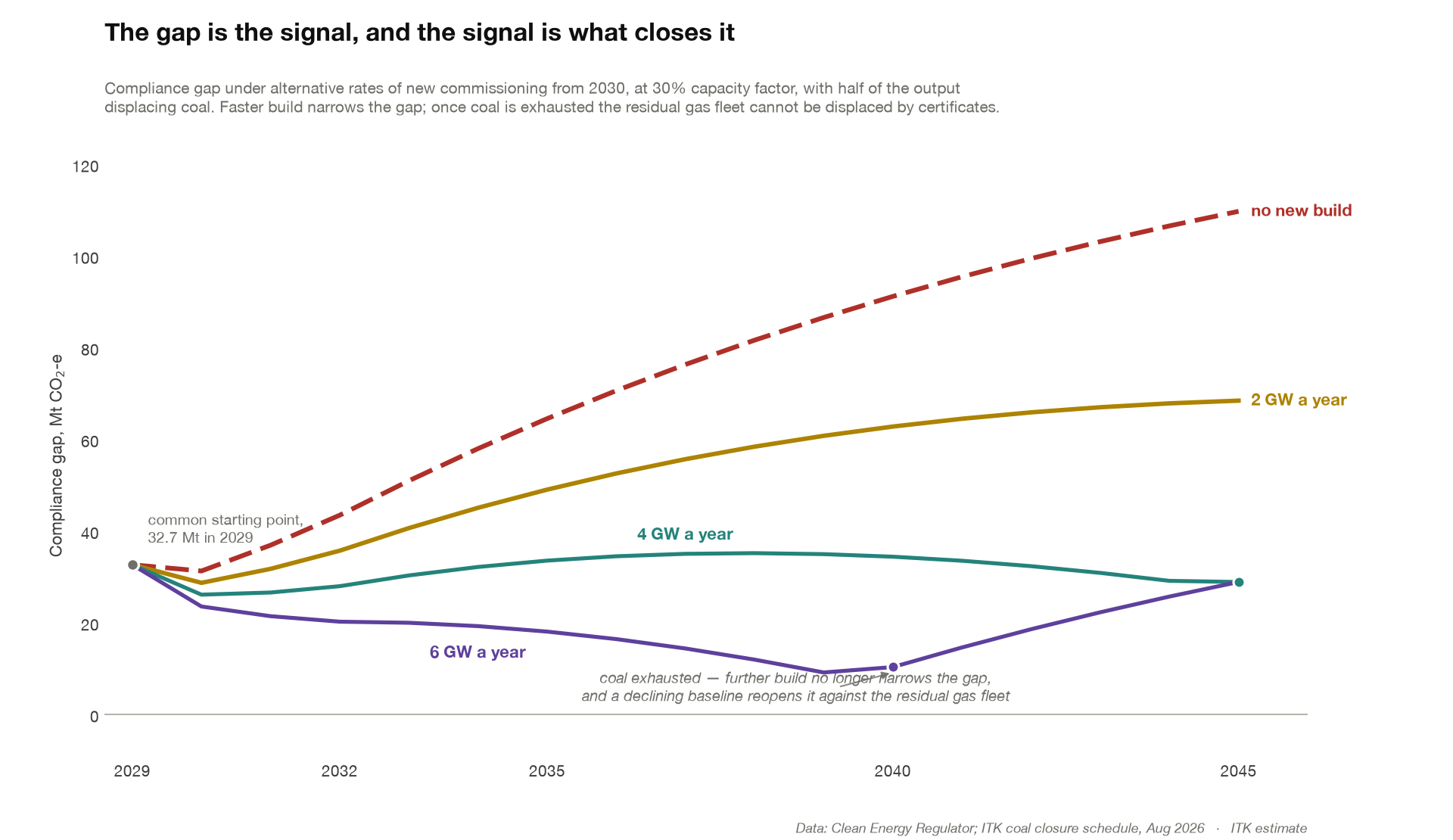
The certificate obligation converts to generation at the exchange rate. The extent to which coal generation is reduced by new generation depends on how much underlying demand growth there is.
Generation and capacity corresponding to the certificate obligation
| 2030 | 2036 | 2040 | |
|---|---|---|---|
| Certificates required (TWh) | 13.8 | 40.4 | 53.8 |
| Capacity at 30% capacity factor (GW) | 5.2 | 15.4 | 20.5 |
Source: Author calculation at 0.90 t CO2-e per megawatt hour, assuming half of new generation displaces coal. · ITK estimate
On this basis about 15 GW of new renewables gets additional price support by 2036, rising to 20 GW by 2040.
Price expectations
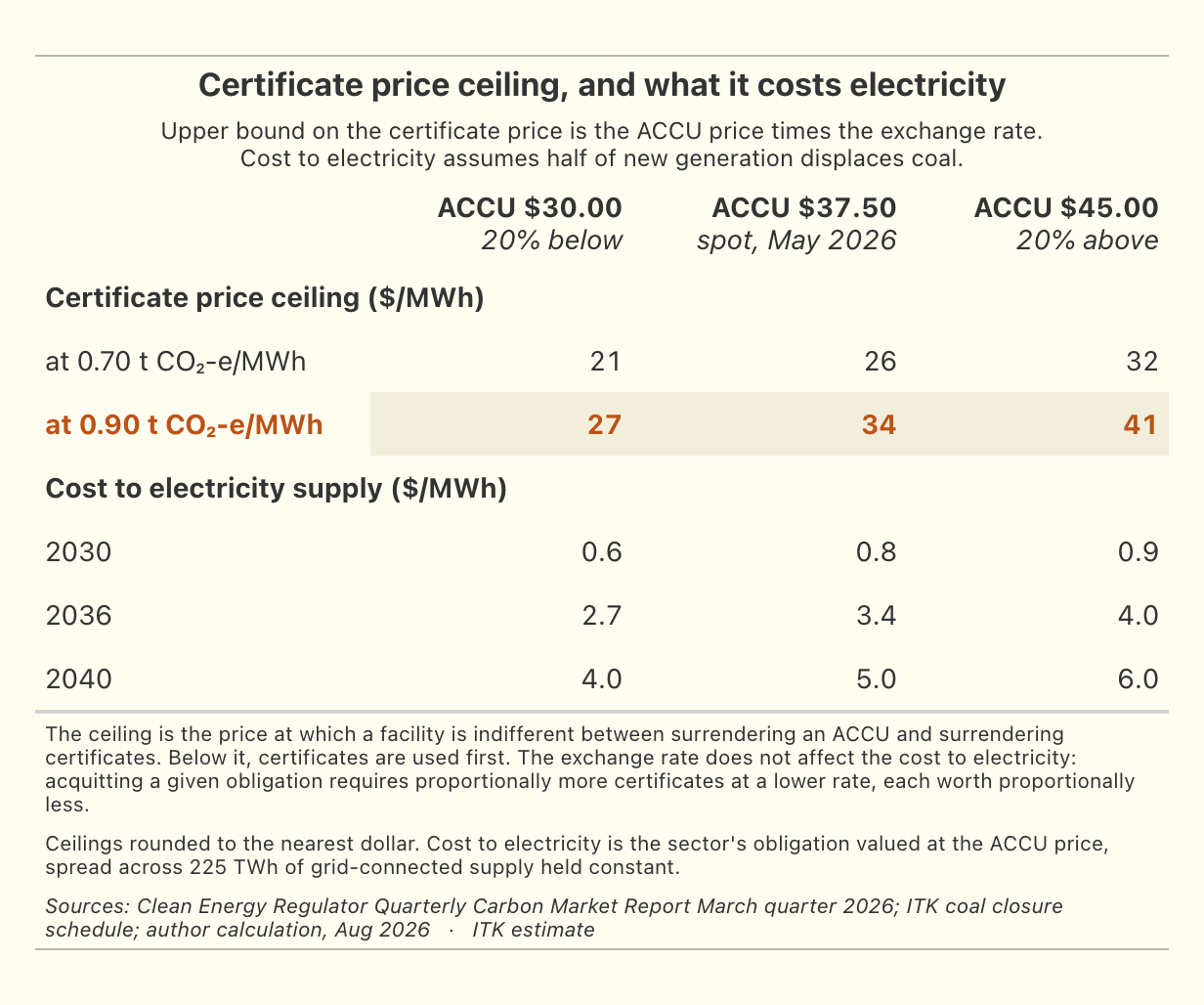
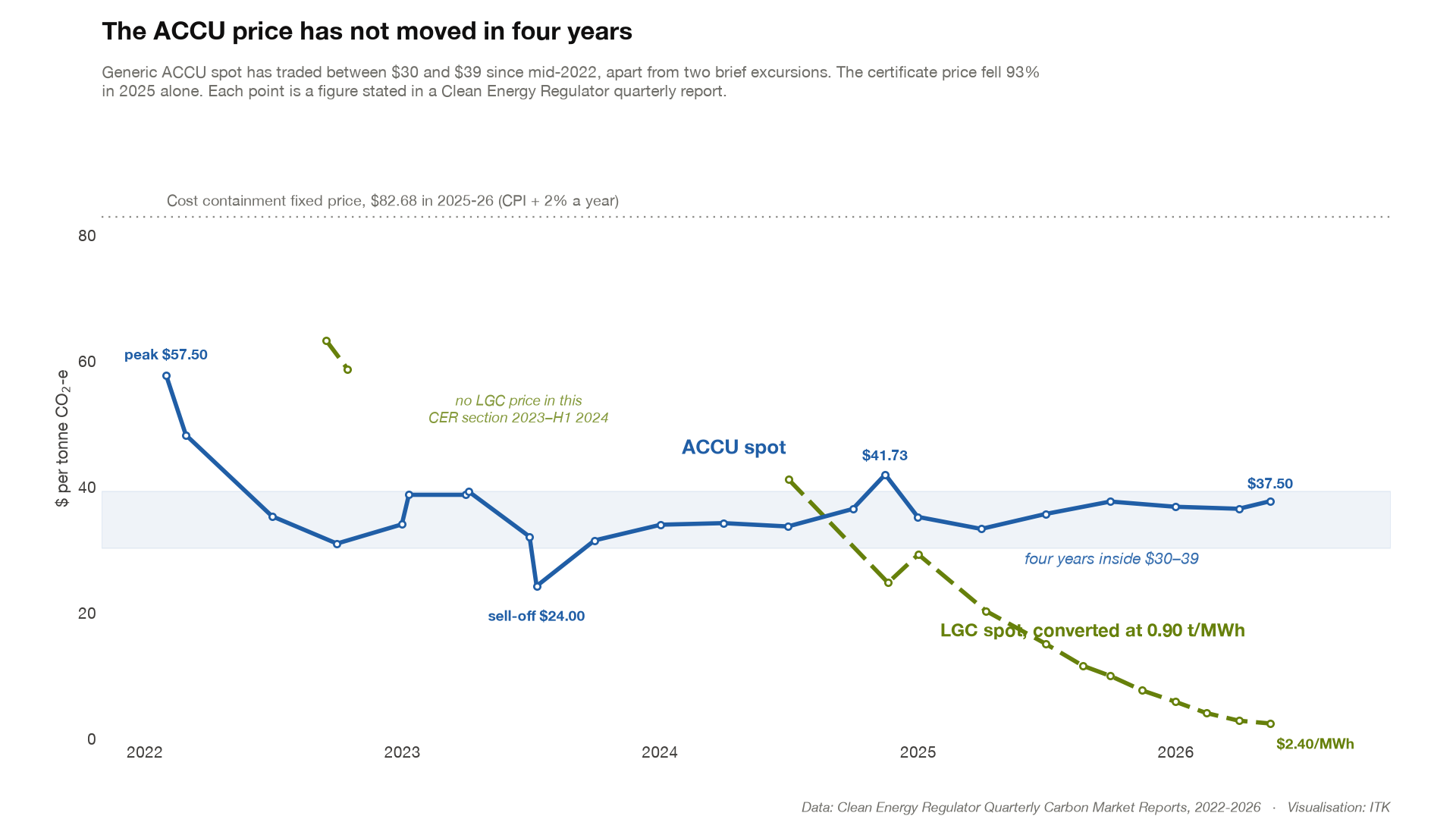
Current ACCU prices are around $37.50, so with the NREC price capped at ACCU × 0.9 the ceiling is about $34. Eligible supply will be zero at announcement since it has to be new renewable generation. So the NREC price will likely sit up around its ceiling.
In the short term ACCUs are unaffected since there are no NRECs.
The gap without convergence
As things stand with no coal retirements formally announced beyond Yallourn, Eraring and Gladstone and with little announced abatement from currently covered facilities then we get emissions and baselines as follows.
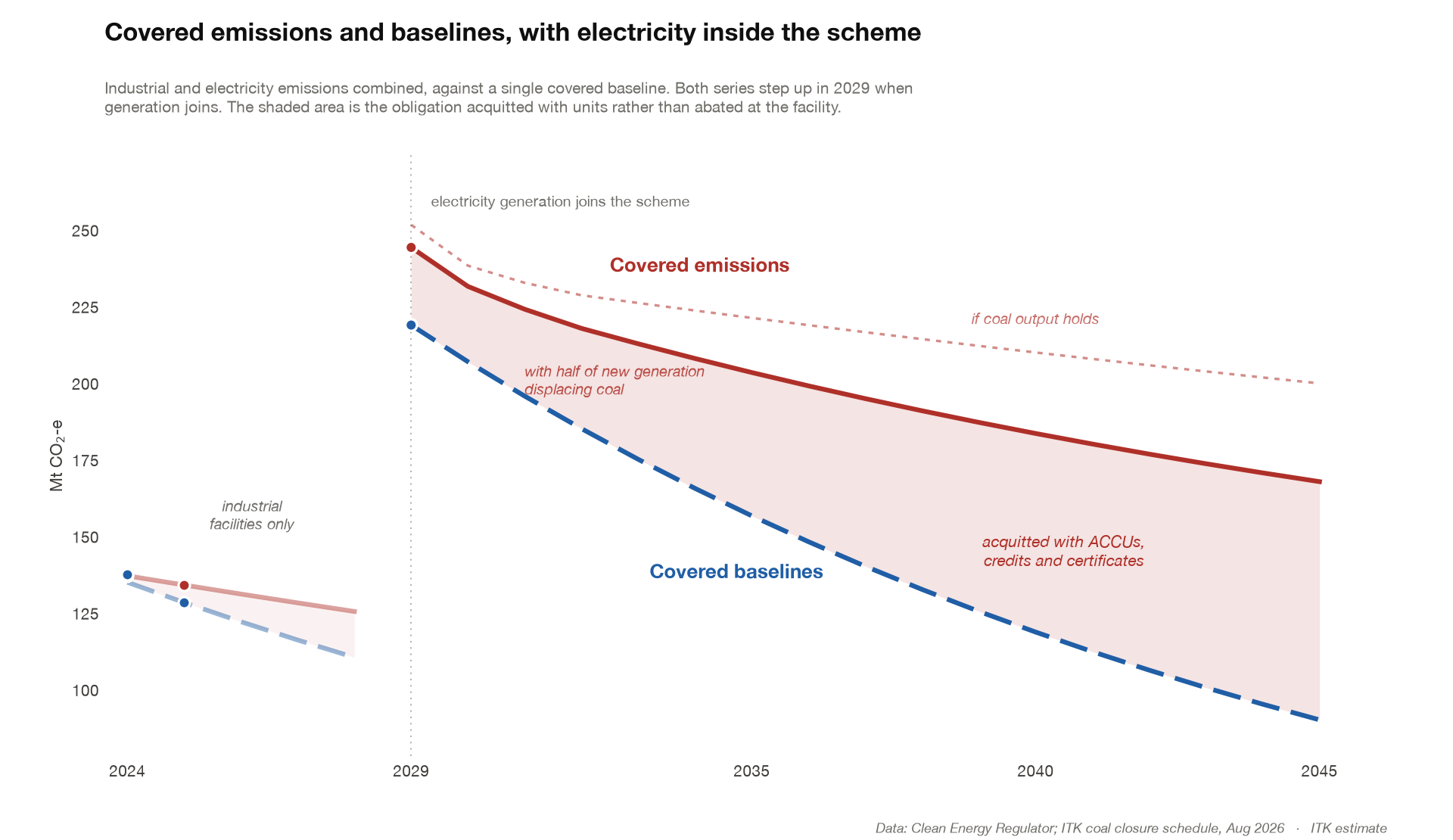
However this growing gap will produce higher prices and induce more supply. Available evidence shows that ACCU supply is reasonably elastic with a modest price increase producing a strong supply response.
So depending on the exact and unknowable at this stage supply response to an increase in price then various abatement outcomes are possible.