After the blizzard, Snowy post Snowy2
Summary
In this note the focus has not particularly been on Snowy 2.0. With the benefit of hindsight the investment won’t earn its cost of capital but that is far from unusual in the business world even if the totality here is large. Everyone from BHP and Rio to AGL and Origin has made dud investments at one time or another. Snowy was valued at about 3.5X book (book $2 bn, price paid $7.1 bn net) in 2018 when the NSW and Victorian Governments sold to the Federal Government. Probably worth more today. That excess supports Snowy’s new balance sheet…. well not really but accountants are clever. But as discussed below book value is not the point. Never has been.
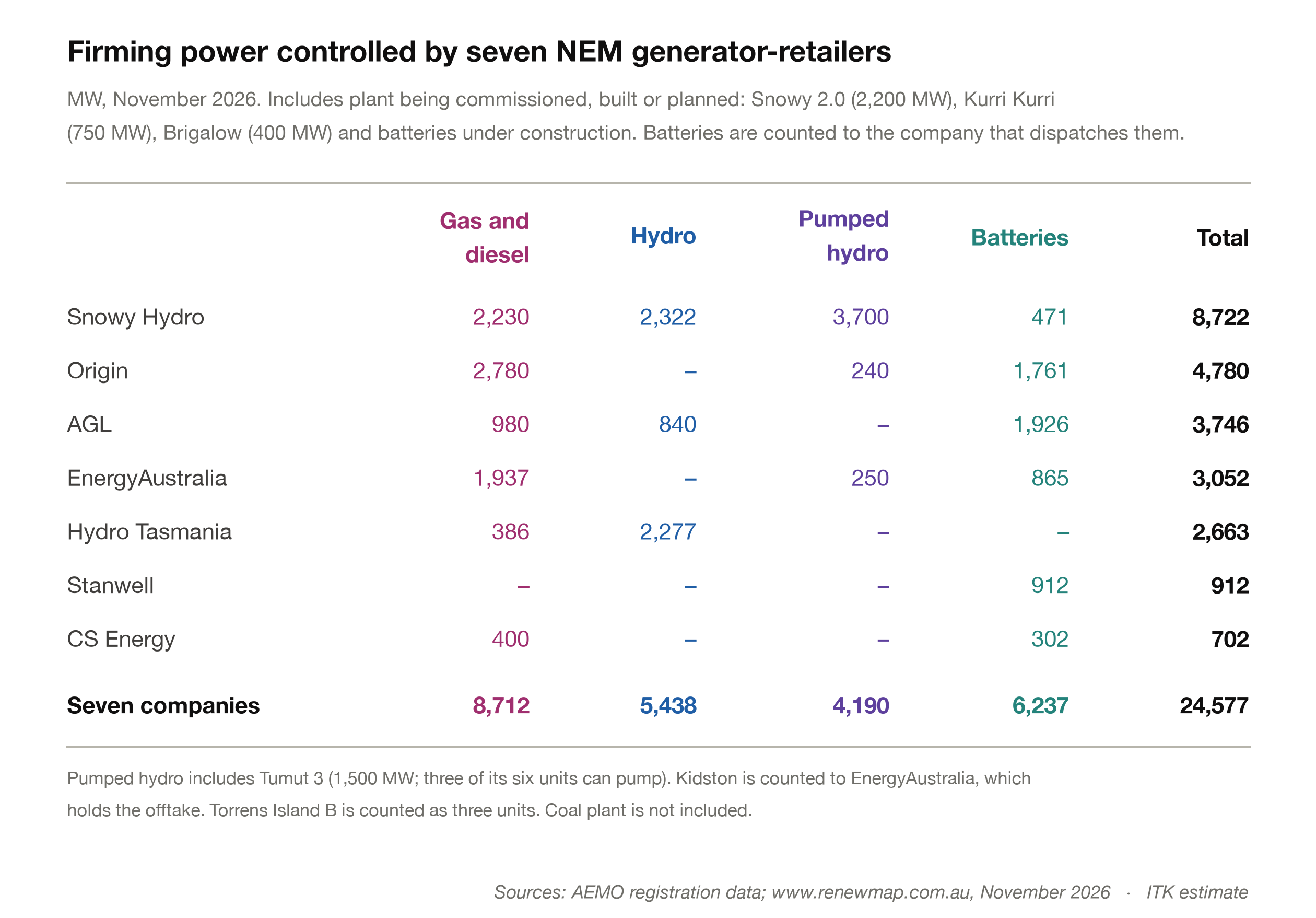
The relevant question for me is what role Snowy will play in the market going forward. As shown in Figure 7 Snowy remains the largest supplier of firming power in the NEM. It is also by customer numbers the fourth largest retailer.
Historically Snowy has not had much large commercial or industrial business. Supplying the Tomago smelter with roughly 1 GW of firmed power will just about double its retail market share, from about 10 TWh to about 18 TWh.
So looking forward Snowy is going to be a bigger player in the market:
- Largest amount of firming capacity.
- Supplying around 18 TWh, compared to operational supply in the NEM of 187 TWh in the most recent 12 months.
- Well placed by virtue of its firming capacity to support more variable renewable energy in NSW and even in Victoria.
- Once the Federal Government puts in another $8-10 bn, reasonably well capitalised, with book equity around $23 bn against Origin’s $10.1 bn and AGL’s $5.3 bn.
- A cultural reset is required: Snowy needs to act like a public company.
Snowy’s business has performed well to date
By and large Snowy’s generation and retailing business have performed reasonably well. Rather than go into chapter and verse of the history it’s perhaps easier to compare relative performance with peers.
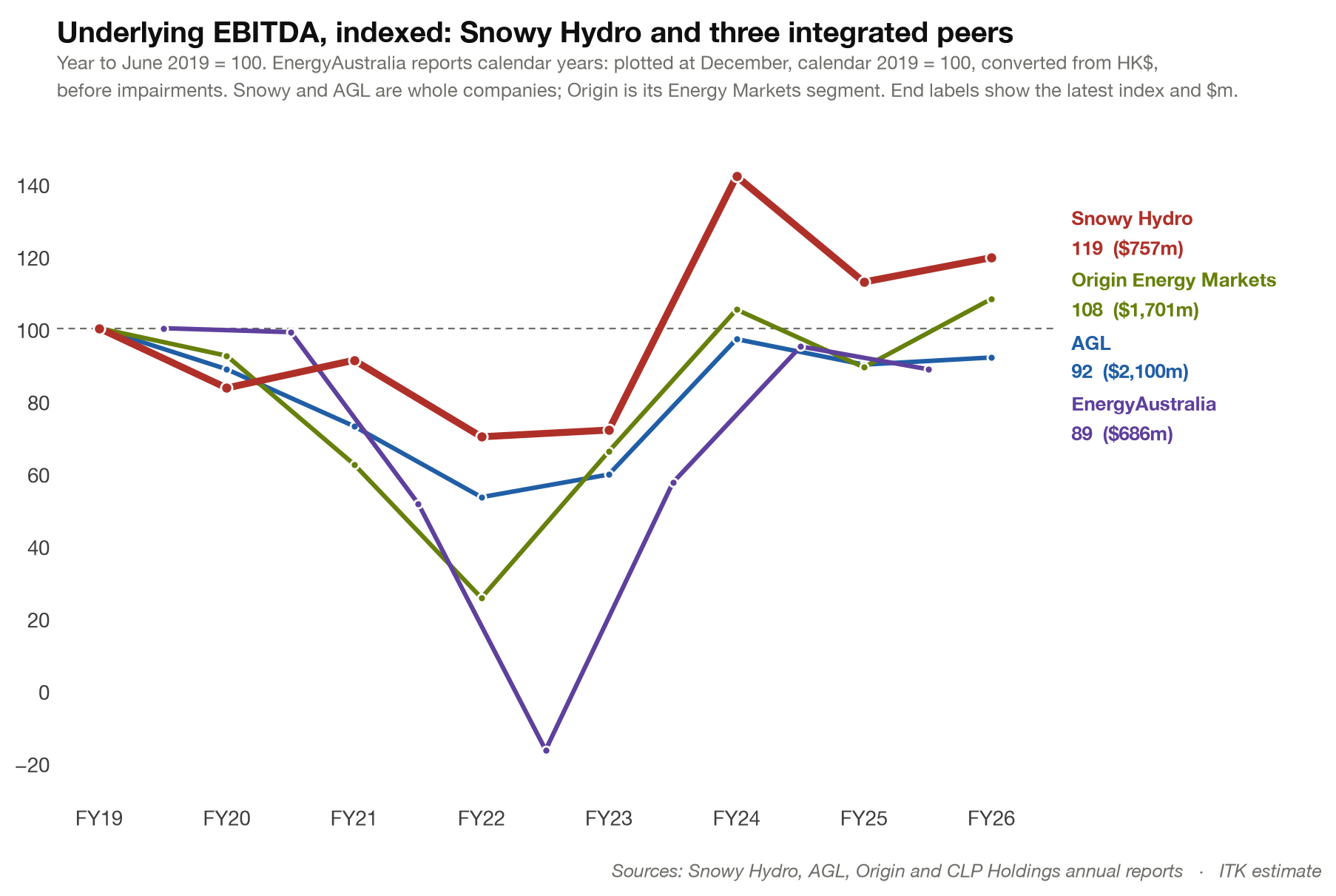
Snowy’s return on capital benefits from the fact that most of the assets were built many years ago.
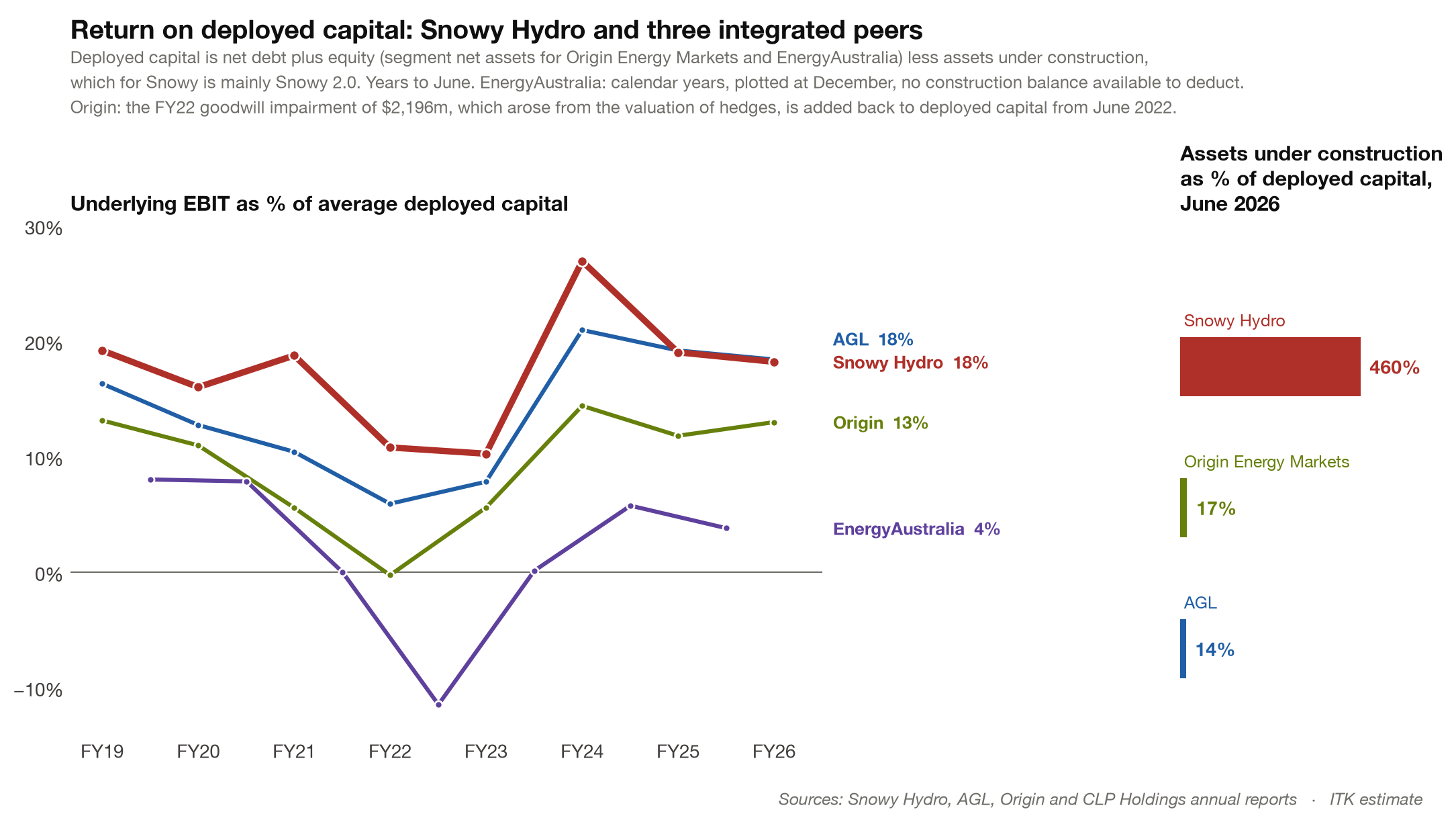
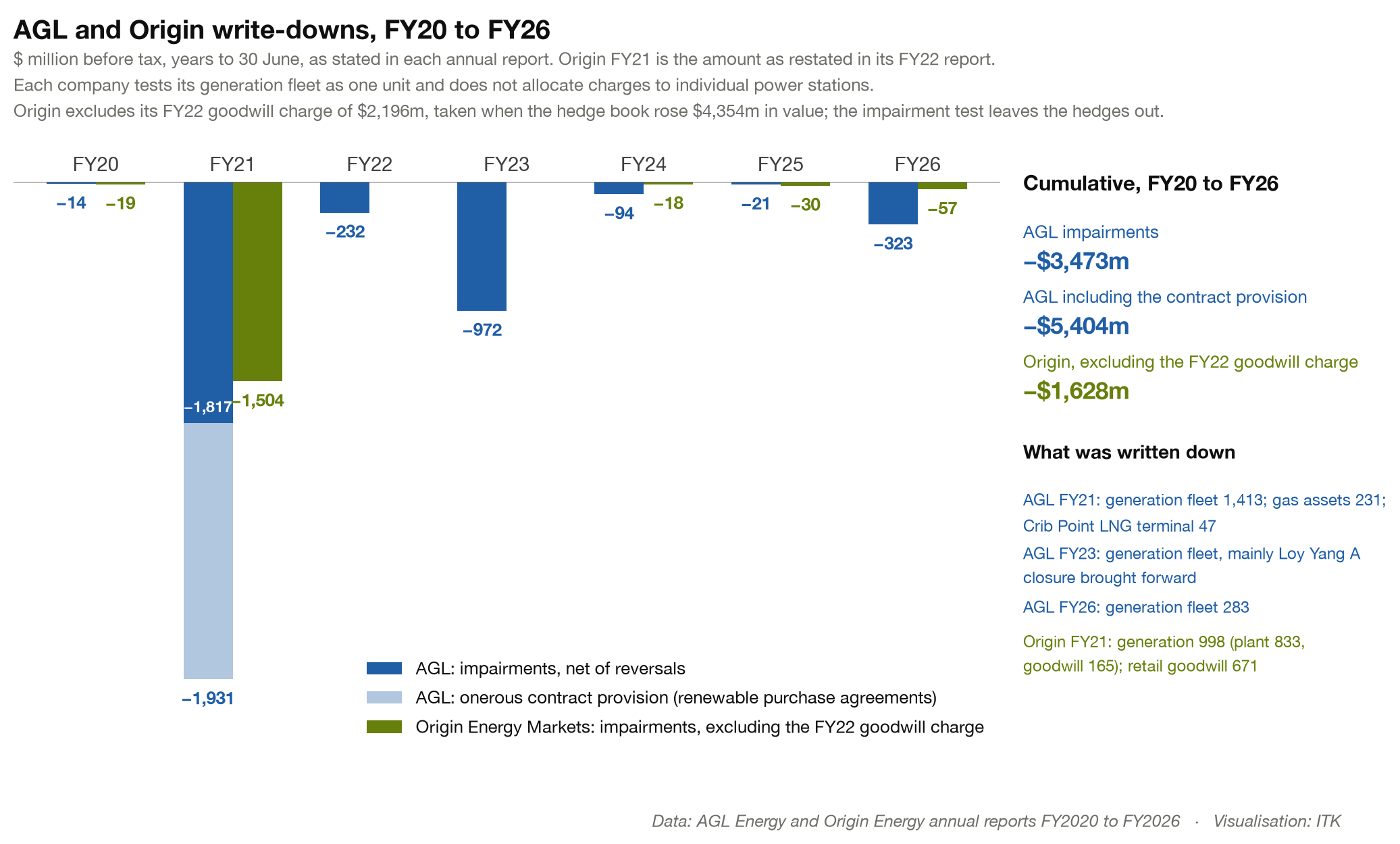
So were Origin’s and AGL’s coal assets, though, and Snowy has not written its generation assets down (yet).
Tomago
Historically Snowy has not had much large commercial or industrial business. However, in its new role supplying the Tomago smelter with roughly 1 GW of firmed power, to be 100% renewable from 2033, Snowy will just about double its retail market share from about 10 TWh of household and small business to about 18 TWh. The Federal and State Governments will provide about $2.5 bn of support over ten years. However I suspect the support is paid to Rio to cover the difference between the firmed power at market and what Rio says it needs to keep running Tomago.
Nevertheless assuming that Snowy is a true risk taking counter party and not just a manager acting solely for the Commonwealth it’s another big piece of business that has to be negotiated and managed along with Snowy 2.0 construction. To be clear to get 8-9TWh of wind and solar requires around 3 GW of wind costing say $10 bn, not that Snowy pays, plus it will effectively tie up about 50% of Snowy 2.0’s notional capacity. All the investment is likely to be in NSW to avoid settlement basis risk. ITK’s understanding is that such negotiations are proceeding quite slowly.
Equally if investors are going to invest in new wind and solar projects based on a PPA with Snowy then Snowy’s own credit rating has to be up to the job. In my view it’s arguably more effective to let Tomago close and to build data centres there where tax would be earned rather than requiring Government support. You could put GWs of data centres at Tomago. Never mind, that isn’t the way the ALP thinks.
What Snowy has to manage
Snowy’s business model historically has been very broadly to provide insurance to the NSW and Victorian gentailers. Hydro generation is very reliable. The water supply is limited but there is always some water. In fact Snowy’s returns tend to increase in droughts because the scarcity value of its supply means that the prices it can charge go up more than the reduction in volume it supplies.
There are several issues that Snowy will have to manage:
Hydrology
Hydrology is weakening, only four years in the past ten, one of them marginally, have seen inflows above the long term average.
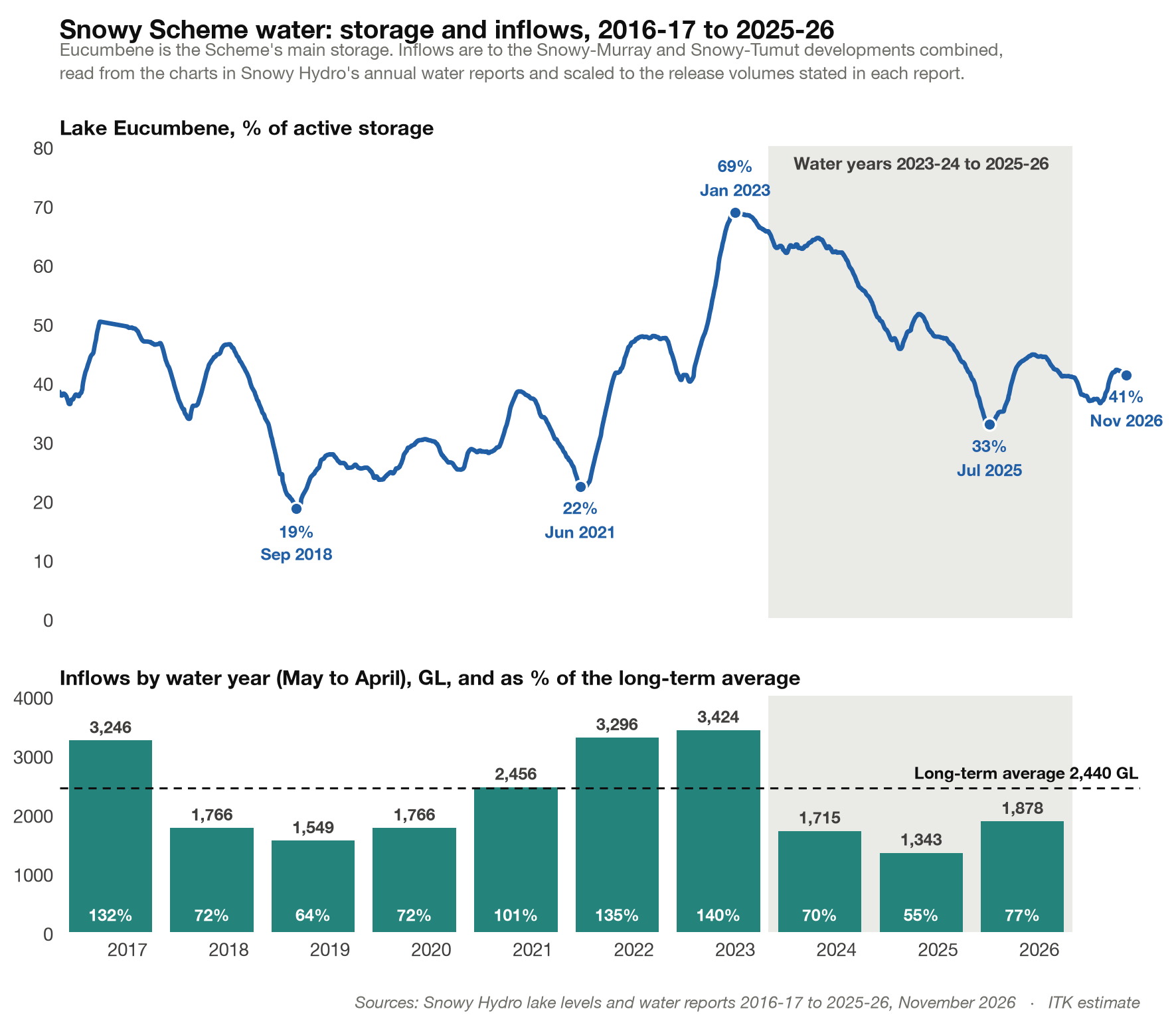
Snowy’s annual report carries pages of climate change analysis, against one unchanging sentence each year on the retail profit outlook. According to that analysis, inflows are likely to weaken structurally, but probably not quickly.
I checked with Claude and the explanation is:
A warmer atmosphere can hold about 7% more water vapour per degree of warming, but global rainfall rises by only 1–3% per degree, because rainfall is limited by the atmosphere’s energy balance and not by how much vapour it can hold. The extra holding capacity shows up mainly as heavier individual downpours, not as more rain in total, and the modest global increase is unevenly distributed: the wet tropics and high latitudes gain while the subtropics and mid-latitudes tend to lose. South-east Australia sits on the losing side. As the planet warms, the Hadley circulation widens towards the poles, the belt of high pressure over southern Australia strengthens, and the winter storm tracks that deliver the Snowy Mountains’ cool-season rain and snow are pushed south. April to October rainfall in south-east Australia has fallen about 9% since 1994, and the IPCC projects further cool-season decline for southern Australia with medium confidence. Snow adds a second effect: the IPCC projects declining snow cover and depth with high confidence, so more precipitation falls as rain, the snowpack that stores winter precipitation and releases it in spring shrinks, and higher temperatures raise evaporation from the catchment. Inflows then fall by more than rainfall, because runoff is what is left after soils and vegetation take their share: Australian studies find that a 1% fall in rainfall typically cuts streamflow by 2–3.5%.
So longer term this is a risk that may gradually cramp hydro earnings.
Batteries provide insurance
For many years the only alternative insurance to hydro was open cycle gas and gaslike (diesel) generators. Even though Origin built a relatively large fleet the underlying position was that only a few players had the access to gas, the pipeline arrangements, the capital and the knowhow to build gas generation. This meant supply was rather oligopolistic, capacity growth was slow partly due to permitting, partly due to lack of opportunity.
Moreover with the benefit of hindsight a lot of Australia’s gas generation is not that well suited to a renewable market. Combined cycle gas for instance has poor part operation efficiency. Even open cycle gas takes time to ramp up and ramp down and the more often you do it the more the maintenance costs.
Hydro by contrast can start within 5 minutes and shut down just as quickly and is very reliable and has little or no maintenance. So Snowy remained advantaged.
Batteries though are another story. In aggregate there will be about 70 GWh of batteries in the NEM by the end of 2027 and I’d suggest even more by the end of 2029.
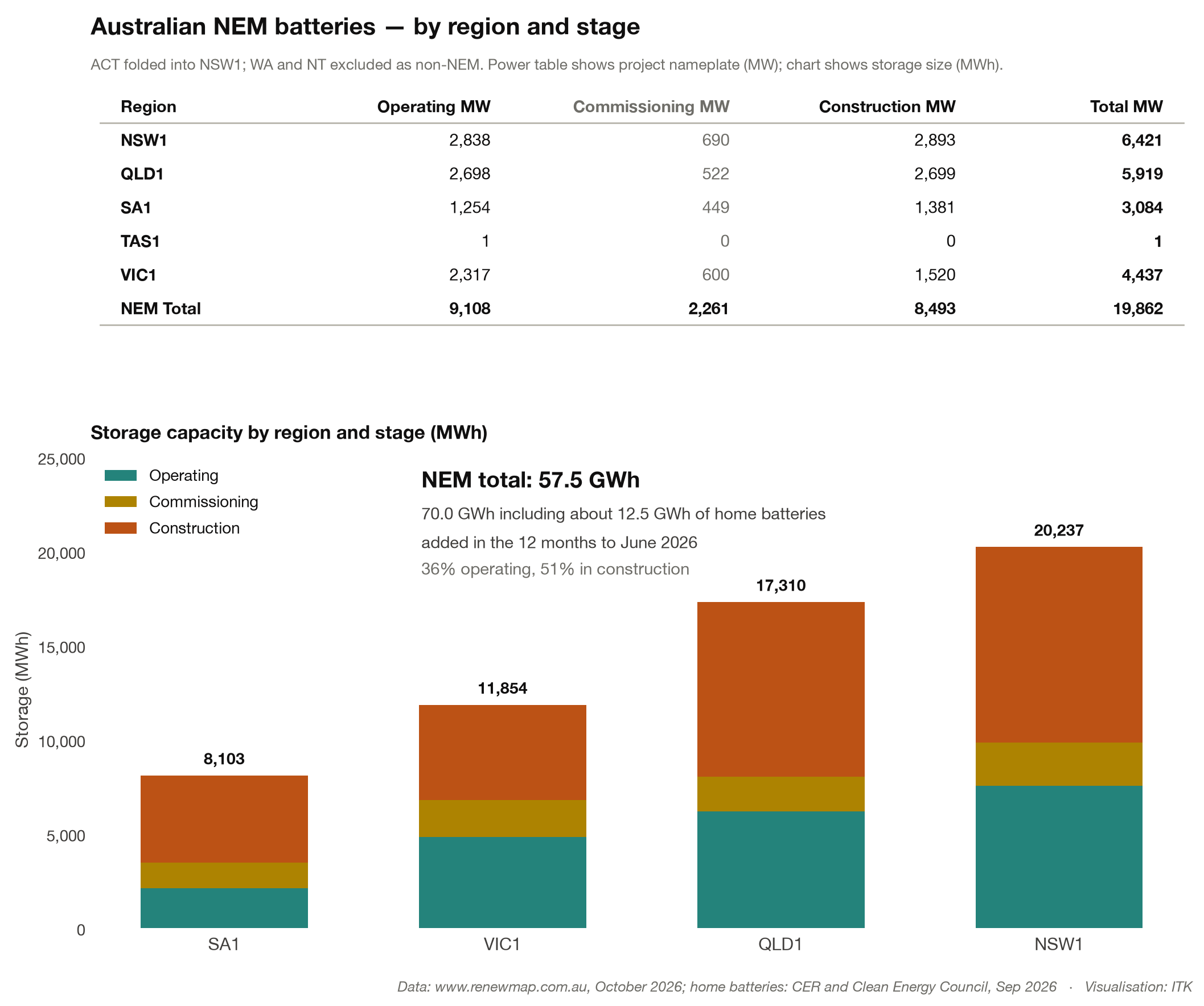
Seventy GWh is about 20% of Snowy 2.0’s total storage but massively more nimble and efficient and distributed. Those batteries have 10X the power of Snowy 2.0. Running flat out Snowy 2.0 needs about 8 days to discharge and recharge 50% of its capacity. In the same 8 days the batteries could cycle 30 times delivering ten times as much total energy. Even at one cycle a day, if that is how they operated, the batteries could still deliver about 3X the energy in total that Snowy 2.0 could.
It’s been my very long standing view that power is more valuable than energy in the NEM. I don’t even much like the term long duration storage. I prefer underpowered storage.
The other side of it is market structure. Fortunately, in my view, attempts to control household batteries by the gentailers and AEMO and anyone else who wants to dictate what happens have been largely unsuccessful. Households can choose to join a virtual power plant and some do. Many do not. I don’t even talk about EVs, either cars or arguably more potently trucks. I estimate in total EVs are adding about 11 GWh of storage a year. Of course that is largely dedicated to transport but it’s quite comparable in aggregate to home batteries.
Leaving households aside, the battery market is not yet concentrated, because barriers to entry are low. Anyone with the capital (say $70 m for a 50 MW/4 hour battery) and a connection agreement can buy one. It helps to have offtake and some idea of what you are doing but those things are optional.
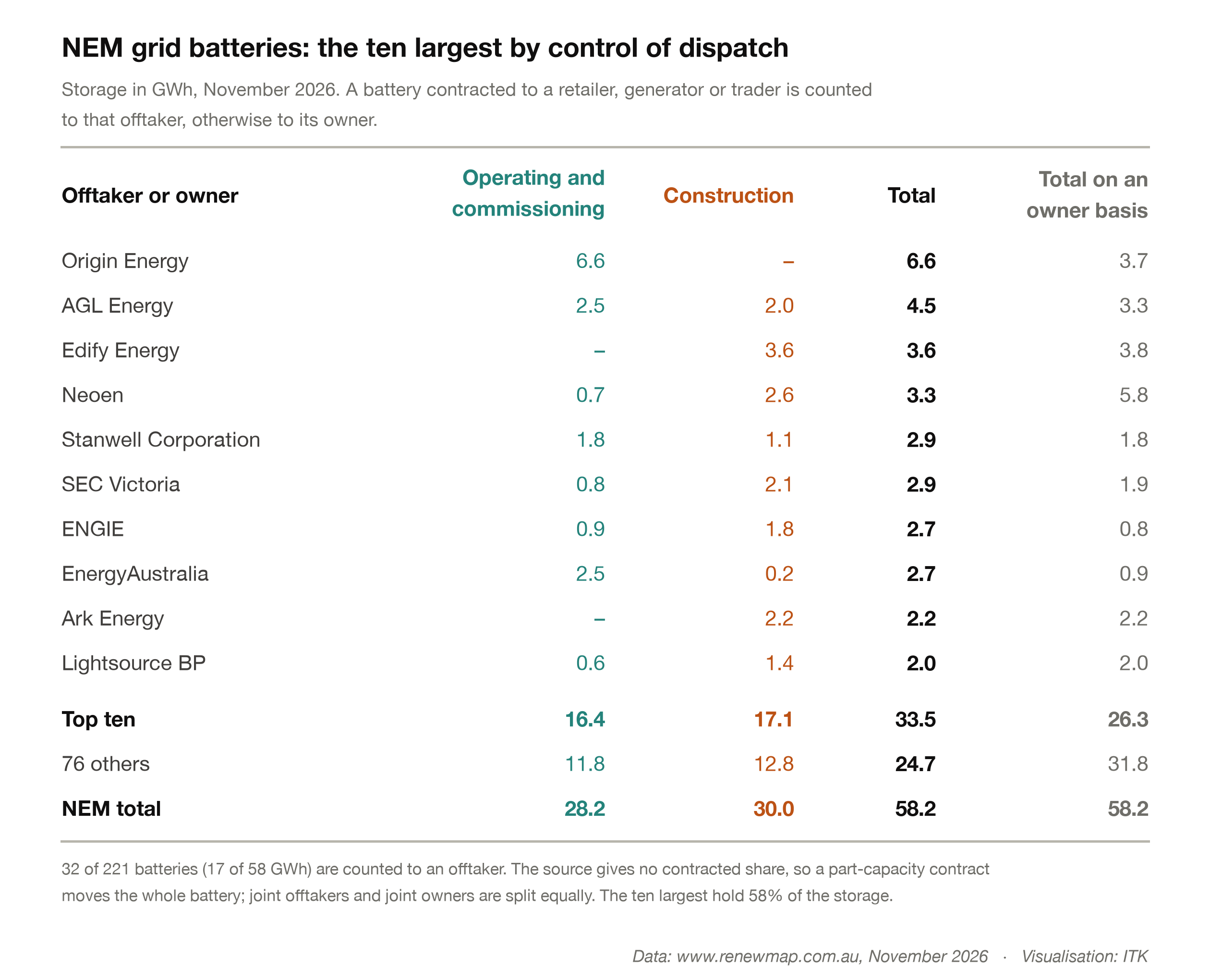
Nevertheless seven companies now control 24 GW of dispatchable power, maybe more I didn’t itemise all the battery dispatchers. Looking at total dispatchable power, excluding coal Snowy remains twice as large as the next player, Origin.
A second casual observation is that in Queensland moving CleanCo to a separate business left Stanwell and CS Energy more dependent on coal than ever. Naturally the current Queensland Government’s obsession with anything but renewables will see them fall ever further behind and they can be discounted from this market for the time being.
Batteries for this group are in aggregate already larger in power than all pumped hydro and conventional hydro. Obviously adding in batteries not managed by the seven in Figure 7 would see batteries as the dominant dispatchable power source. That’s incredible when compared to the situation just three years ago and that’s relevant when we think of the Snowy 2.0 valuation in 2024.
The proposed Electricity Services Entry Mechanism (ESEM) for dispatchable power will likely induce more supply even if market prices don’t.
Batteries have changed Snowy’s role and approach
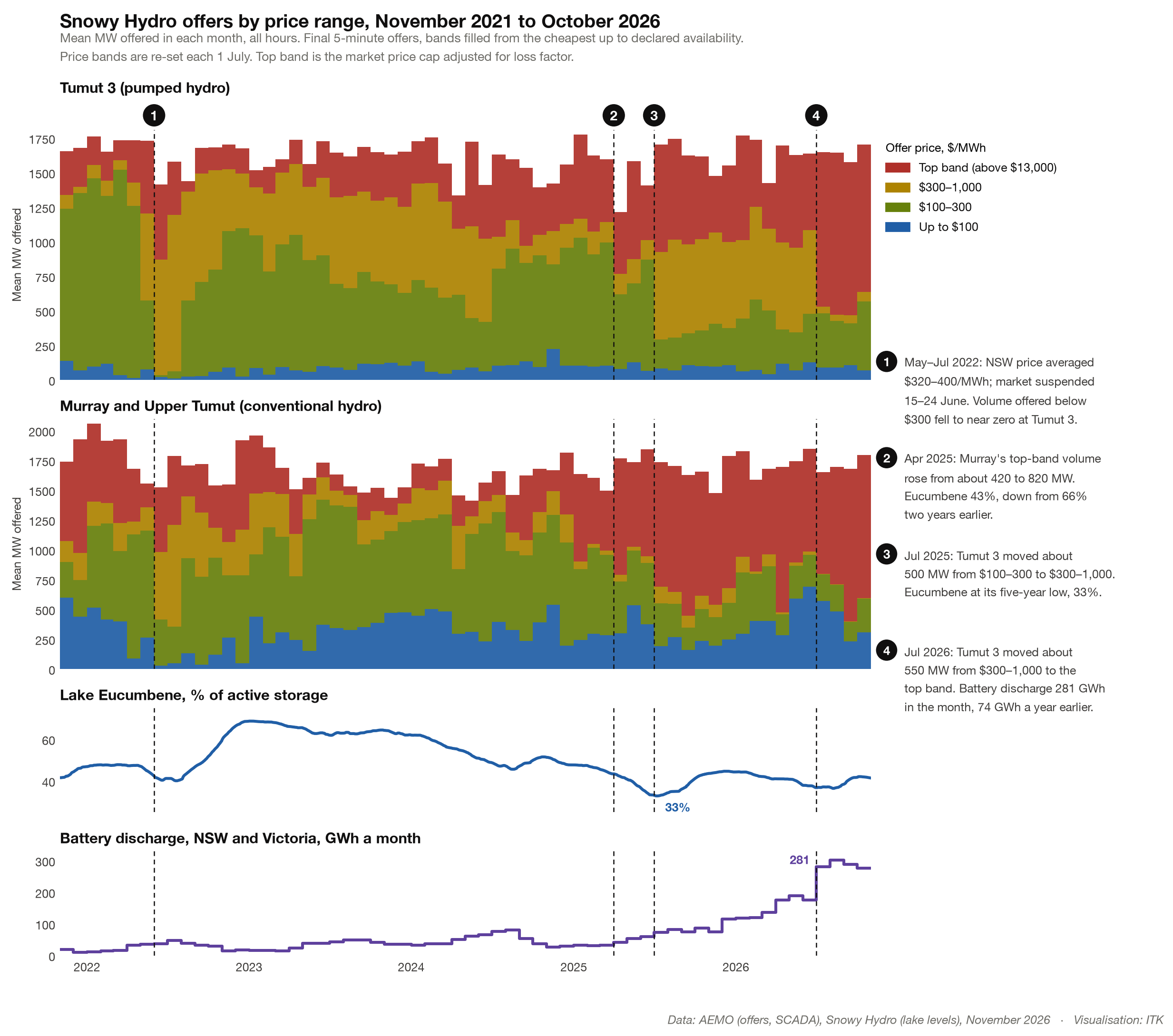
Looking at the bids data it seems that Snowy has moved more Tumut 3 capacity into scarcity bands, that’s the red bands in Figure 8. Conventional hydro offers have remained relatively strong in lower priced bands despite the hydrology. This could reflect either agricultural uses and/or Snowy not seeing much opportunity to hold supply back for when there was less market supply available.
Tumut 3, is it an indicator of Snowy 2.0? I don’t know
Tumut 3 is not a pure pumped hydro operator. Nevertheless it’s historically earned a reasonable spread and unlike many batteries it is ready to generate when prices spike. Its generation includes water from upstream, so the spread is not a margin on pumping.
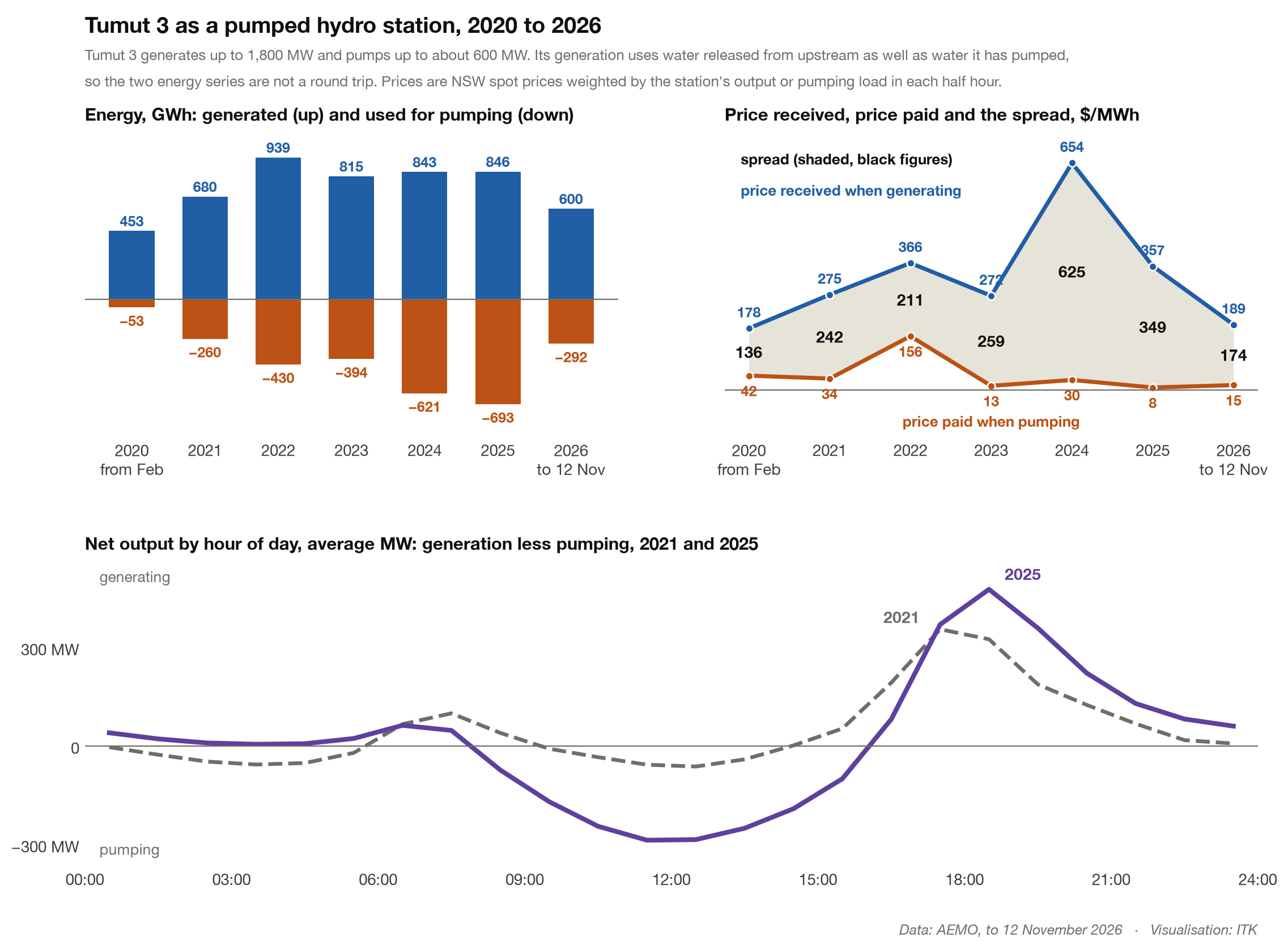
Tumut 3’s pumping has moved to the middle of the day: in 2025 it pumped mostly between 8am and 4pm and bought 60% of its pumping energy at negative prices. The differences are that Snowy 2.0 will depend on pumping for nearly all of its generation, and its much bigger: in ITK’s modelling it pumps 2-3 TWh a year against Tumut 3’s 0.7 TWh in 2025.
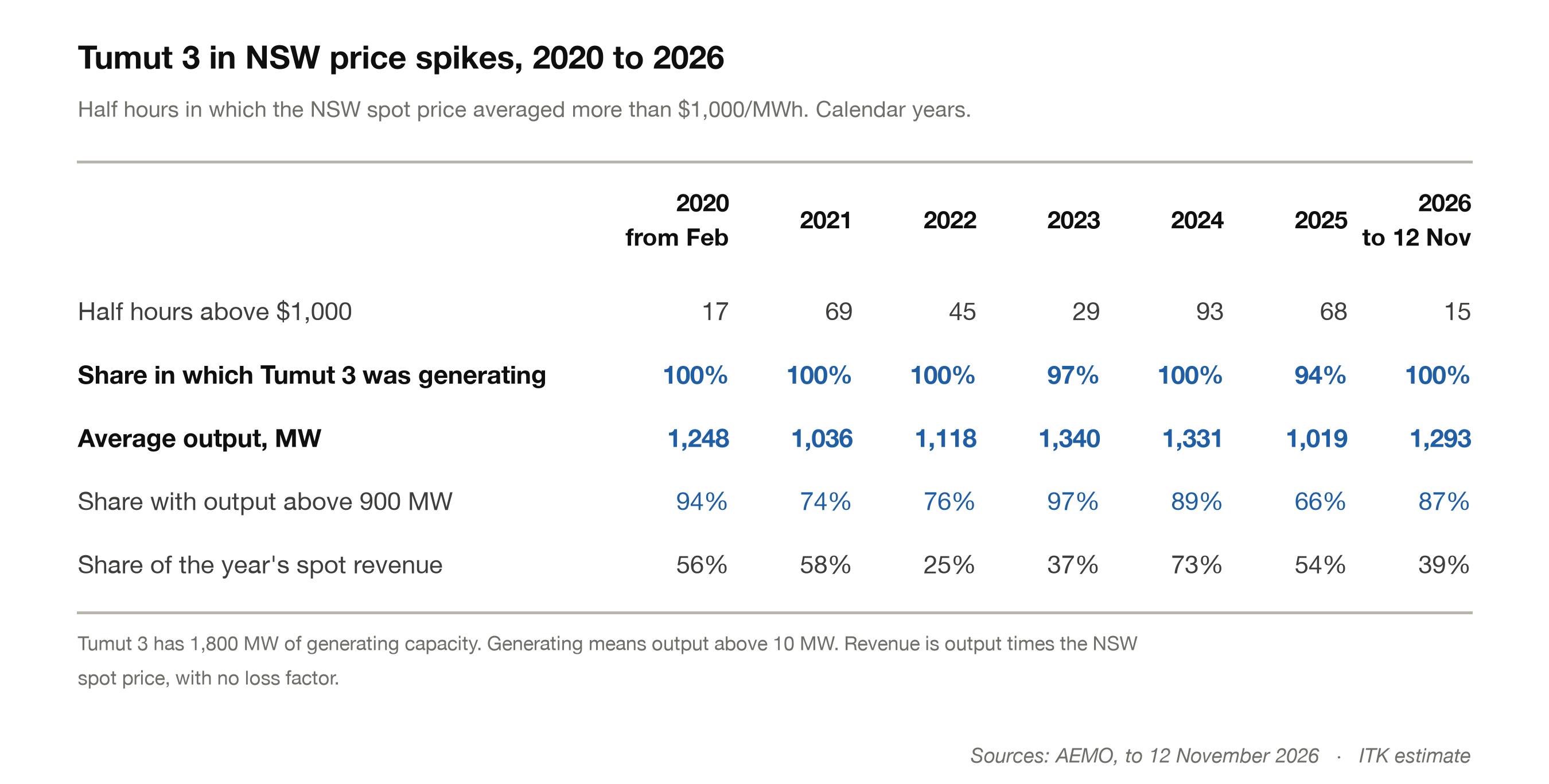
Tumut 3 has been able to participate in virtually all the price spikes.
ITK expects that in practice Snowy 2.0 will operate as an insurer not a seasonal generator
Based on ITK’s Vertex model I think management will choose to operate Snowy 2.0 as more of an insurer than anything else. Figure 11 compares some of the assumptions from the 2024 valuation with what I think a manager might actually choose. I didn’t think management assumptions were very solid when they were released and less so now.
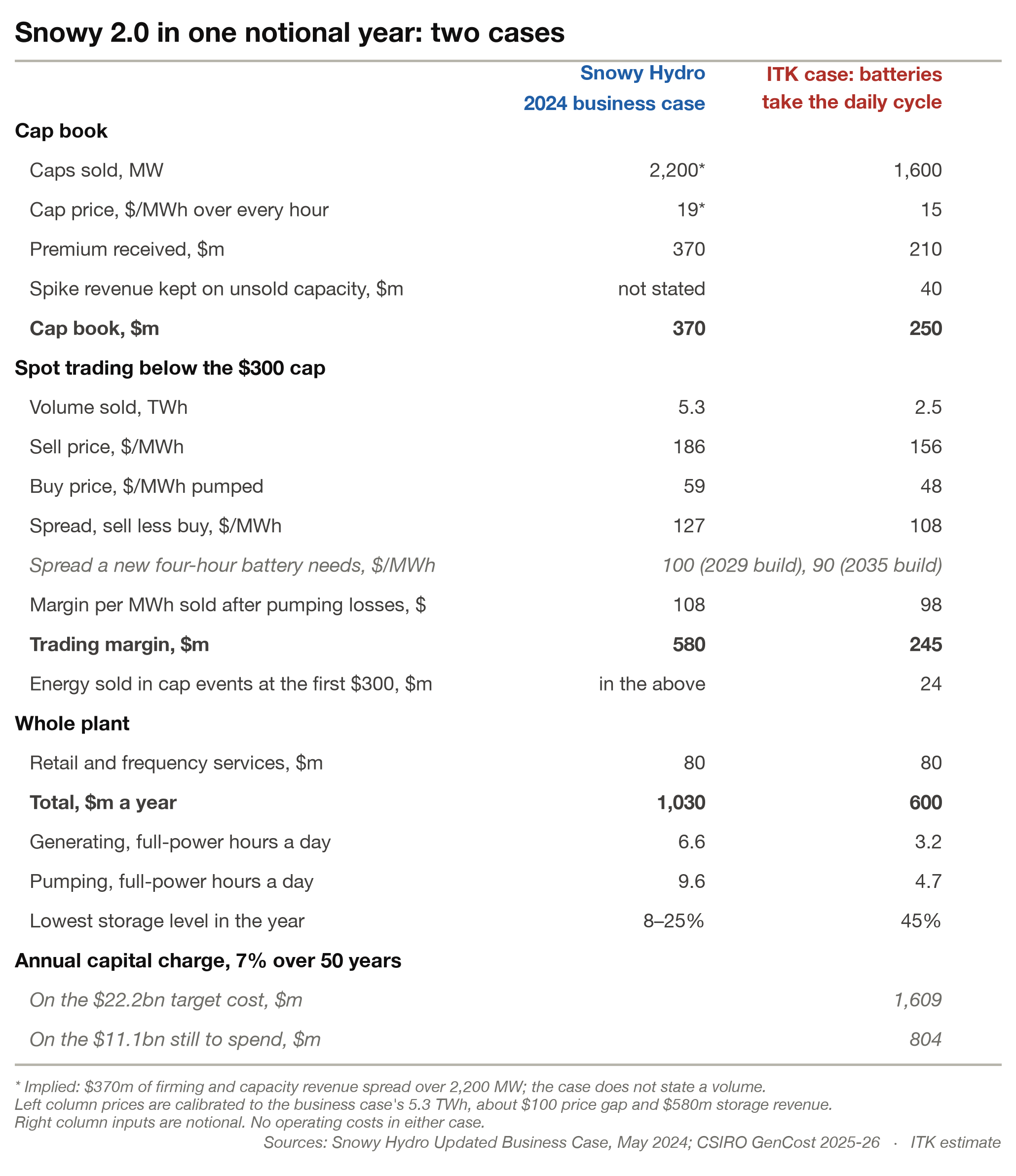
Our exercise started from a view that batteries will take most of the daily spread revenue, leaving Snowy 2.0 the cap and peak market or firming wind and solar. Each gives similar revenue.
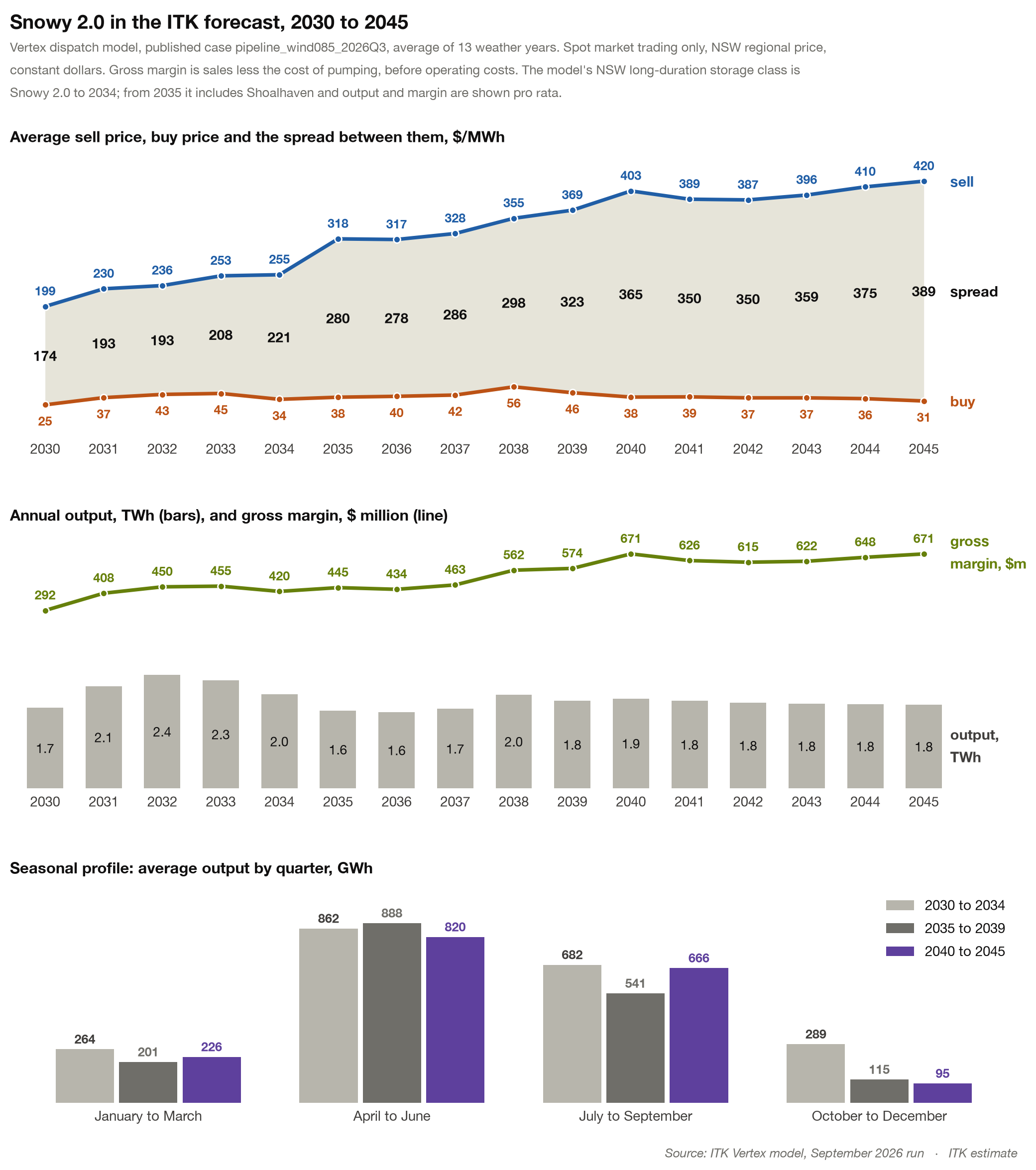
Looking at what we actually see from Vertex, ITK’s half hourly price simulation using capacities derived from a 2045 LRMC process, our spot market results are below. The spot gross margin is about $290 m in 2030, rising to about $670 m by 2040.
Of course there is little or no chance of ITK’s modelling being as good as that of a big consultancy and even if it was, that still doesn’t mean it’s at all likely to be correct.
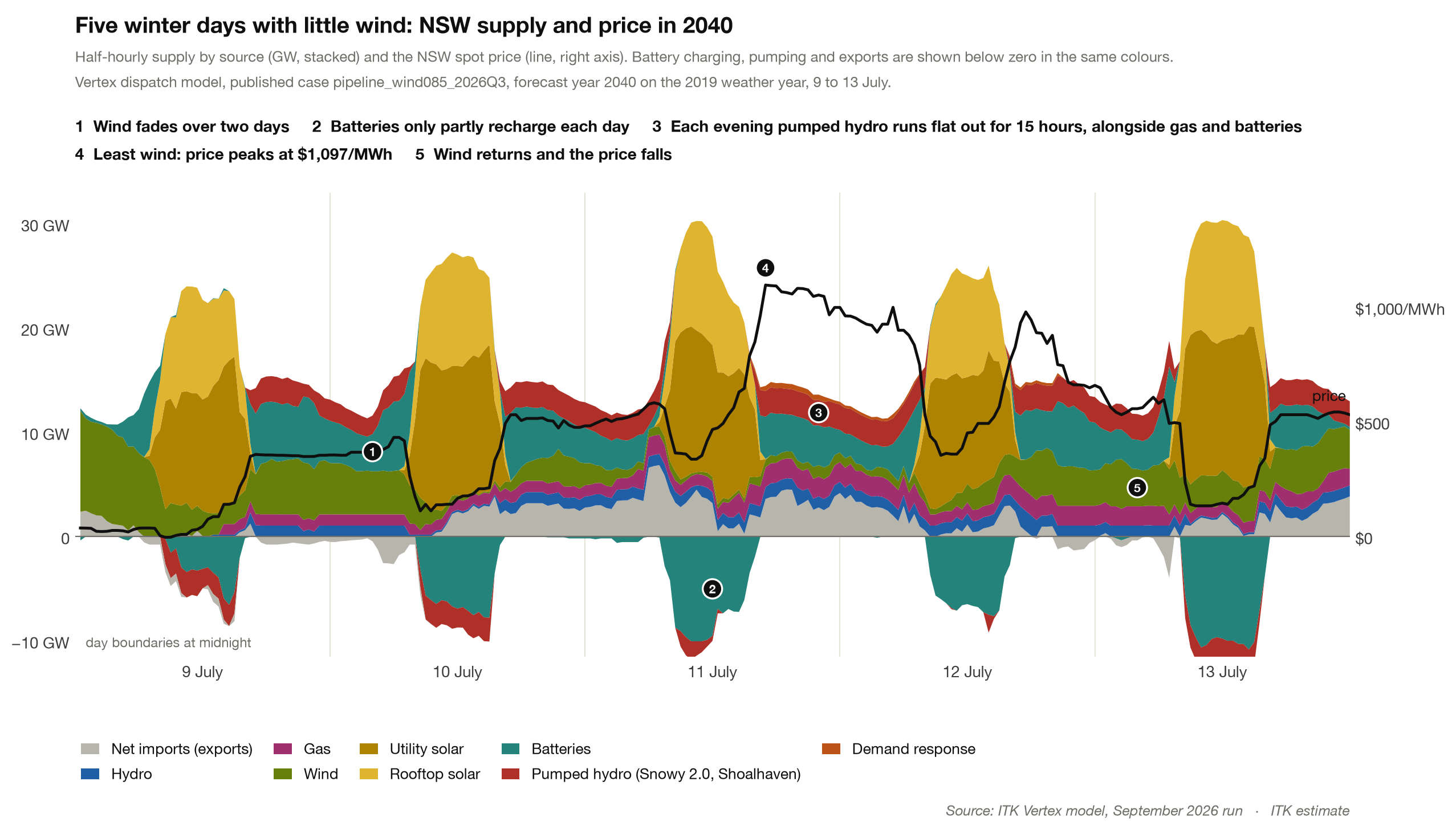
In any event here is a sample week from 2040 in July when wind dies down (the normal cause of price spikes) and the batteries only partly recharge each day. In NSW demand is met by imports, pumped hydro and gas. Price then spikes. Just doesn’t happen often enough.
No-one thinks Snowy 2.0 is worth $23.6 bn not even Malcolm Turnbull
It’s quite clear that Snowy themselves don’t think Snowy 2.0 value is above cost. There are two sources of evidence.
First in May 2024 the updated business case showed revenue with a NPV of $11.9 bn against costs of $8.9 bn, a surplus of $3.0 bn, when the project cost was $12 bn. Those are values discounted to December 2018. The cost has since roughly doubled, and there is no way known for management’s estimate of revenue to have risen enough to cover that.
Second management did an impairment test on the entire generation book. Snowy 2.0 was included along with the original Snowy assets. The impairment test result, on a different methodology to earlier years, concluded that no impairment was required. To quote:
“Based on the assessment performed (including the probability-weighted scenario analysis over a range of potential outcomes), there is no impairment to the carrying amount of the Generation CGU at 30 June 2026.”
And on the sensitivity of that:
“Based on sensitivity analysis of the variable assumptions, the recoverable amount is most sensitive to changes in the discount rate applied in the valuation (holding all other assumptions constant). A reasonable possible change of 0.7% to the WACC would result in the recoverable amount falling below the carrying amount.”
A change of 0.7 percentage points in the discount rate is small in the bigger scheme of things. The implication is that even allowing for the fact that the existing assets are worth way above book once Snowy 2.0 is included the whole thing is marginal. I make no comment except to note that I would have taken a write down, that reduces future depreciation and leaves the business better placed. I suspect the asset will or should be written down at some point. If AGL and ORG and every other big company does it why shouldn’t Snowy? I assume the reason is politics.
However the value the asset is recorded it t doesn’t make much real world difference. It’s not like there is a price:book calculation that might be relevant to an investor.
Future costs and benefits
As any first or second year accounting student can tell you sunk costs are totally irrelevant to good decision making. What is relevant is future costs and benefits (revenues). Broadly speaking Snowy has around $11 bn left to spend, but if it was to abandon the project I assume there would be considerable abandonment costs.
In any case although it’s an entirely proper and correct question its also irrelevant. The project is not going to be abandoned whatever the estimated net present value of future costs and revenues is. Snowy 2.0 is going to be completed. The CEO having written off the best three years of his retirement to steady the ship and get the project in shape to actually be completed is never going to suggest it be abandoned.
Funding: maybe another $8-10 bn Government equity required
Snowy states a target credit rating of BBB+. That’s basically the minimum for a utility that wants to raise debt in the corporate bond market.
In the private sector that would generally require for a utility net debt:EBITDA of less than 3X. Right now Snowy is at about 9.7 times excluding the shareholder loan, with a further $11 bn roughly to be spent subsequent to June 2026. That’s based on a midpoint total cost of $23.6 bn.
S&P suggests that Government ownership enhances the credit rating such that a net debt:EBITDA of 4-5X is consistent with a BBB+ rating. In Figure 14 I worked to 4.5X. Assuming the shareholder loan is treated as equity roughly $8-$10 bn of additional equity is required.
There are other tests based on funds from operations to net interest but I haven’t looked at that.
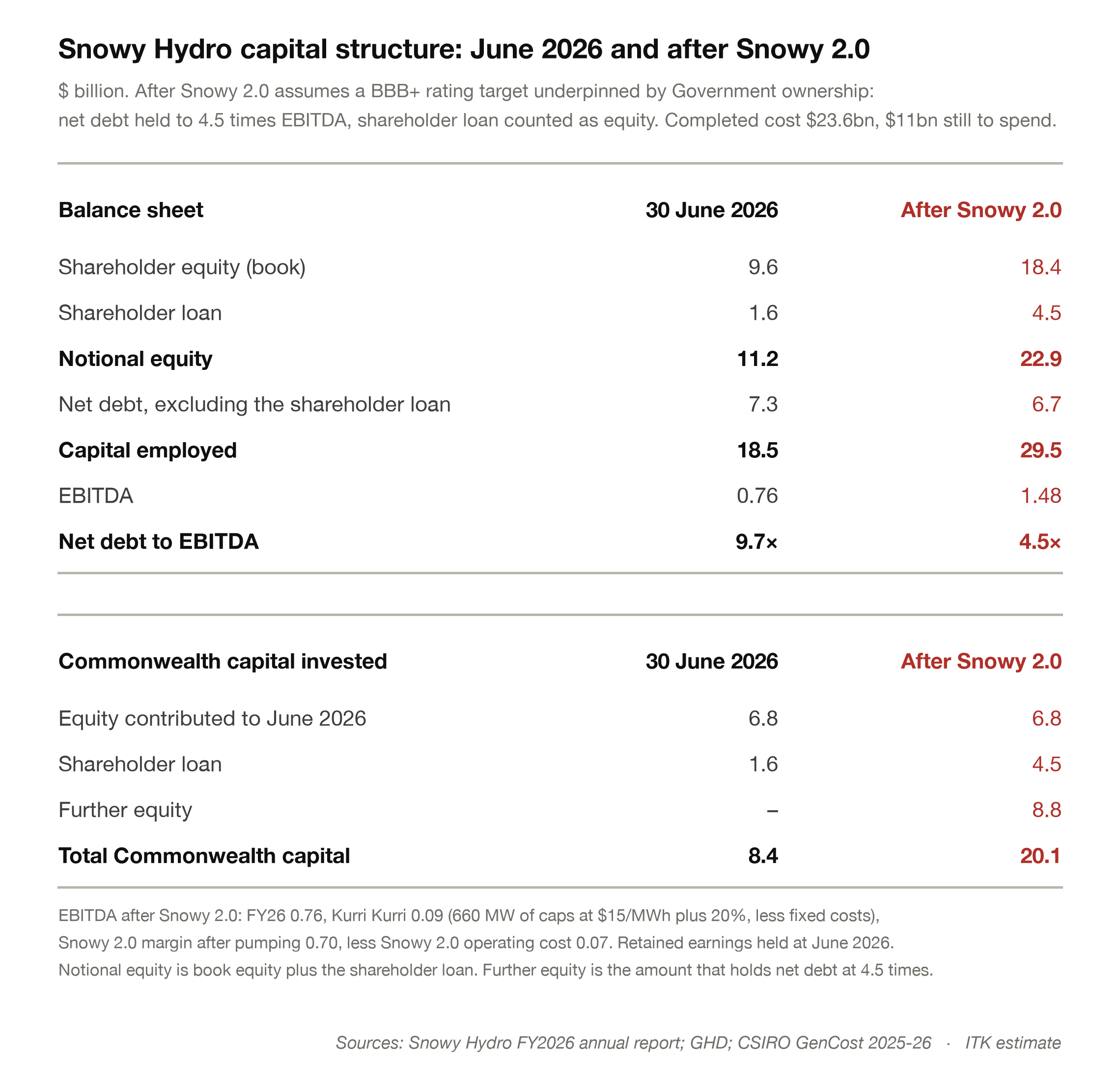
My estimate of Snowy’s required equity for BBB+ credit rating rests on a debt:EBITDA ratio of 4.5 and doesn’t have earnings from a Tomago contract, say $4/MWh x 8.3 TWh or $33 m a year included. The resulting debt:equity book ratio is lower than AGL and Origin because their book equity has been written down and because ITK’s estimates of Snowy 2.0 earnings is lower than the 2024 business case estimate. Therefore less EBITDA and less supportable debt. But the overall point is that from any point of view Snowy is a big and powerful player in the market.
In 2033
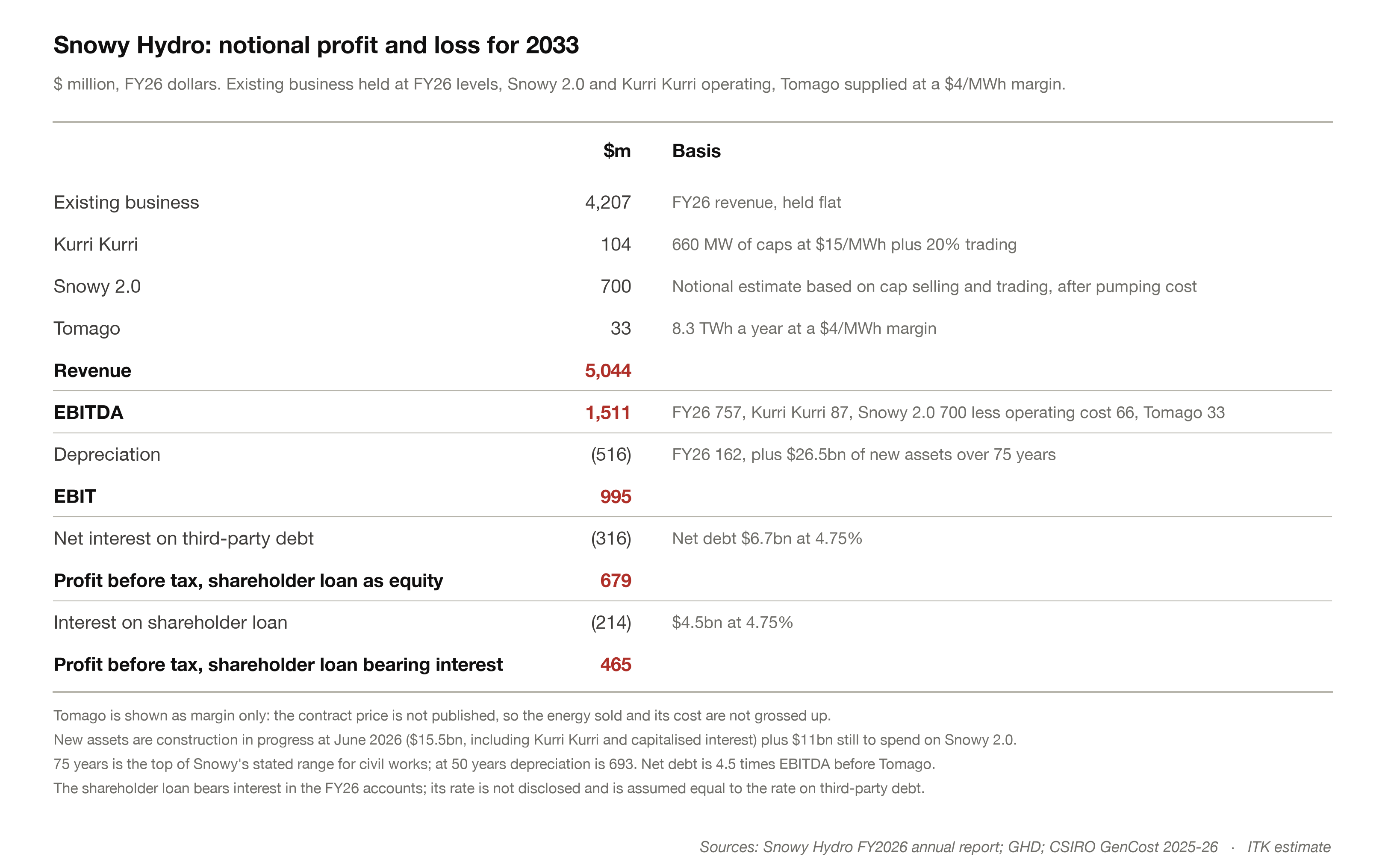
2033 is supposed to be the year when Snowy supplies Tomago with fully renewable power. Even a pessimist might see Snowy 2.0 actually operating by then. Coal generation in NSW will be running down. I have constructed a conceptual P&L that reflects things as I understand them at the moment. There is no doubt it will be wrong. It shows EBITDA of about $1.5 bn and profit before tax of $0.5-0.7 bn.
A cultural reset?
Snowy, I guess like the Queensland Government owned generators, is a public company competing with the private sector. In Queensland it’s already been shown historically how the Government, not the current Qld Government, was able to manipulate the Queensland electricity market either maximising generator profits or keeping them down and benefitting consumers. The Government, any Government, neither is nor should be solely motivated by the return on capital of its Government owned business. Fair enough, but not necessarily fair enough for the private sector.
In 2006 I worked on the proposed Snowy privatisation. That was abandoned in an early example of lack of social license. Had it proceeded Snowy 2.0 would very likely not have been undertaken, far more due diligence would have been done. For an example see how Origin abandoned its Shoalhaven pumped hydro when it did more geotechnical work. Snowy’s business today might be quite different. Very likely someone like Origin would have taken it over. We don’t live in that world.
We live in a world where Snowy is at once one of the biggest players in the NEM and a business where its shareholder must have considerations over and beyond Snowy profits. But my point here is that Snowy needs to act more like a public company. Its annual report, half yearly report, management briefings, strategy need to be more like those of AGL and Origin.