Gentailers go for gas - Consumers need renewables
Summary: the song remains the same, ESEM cavalry is over the horizon
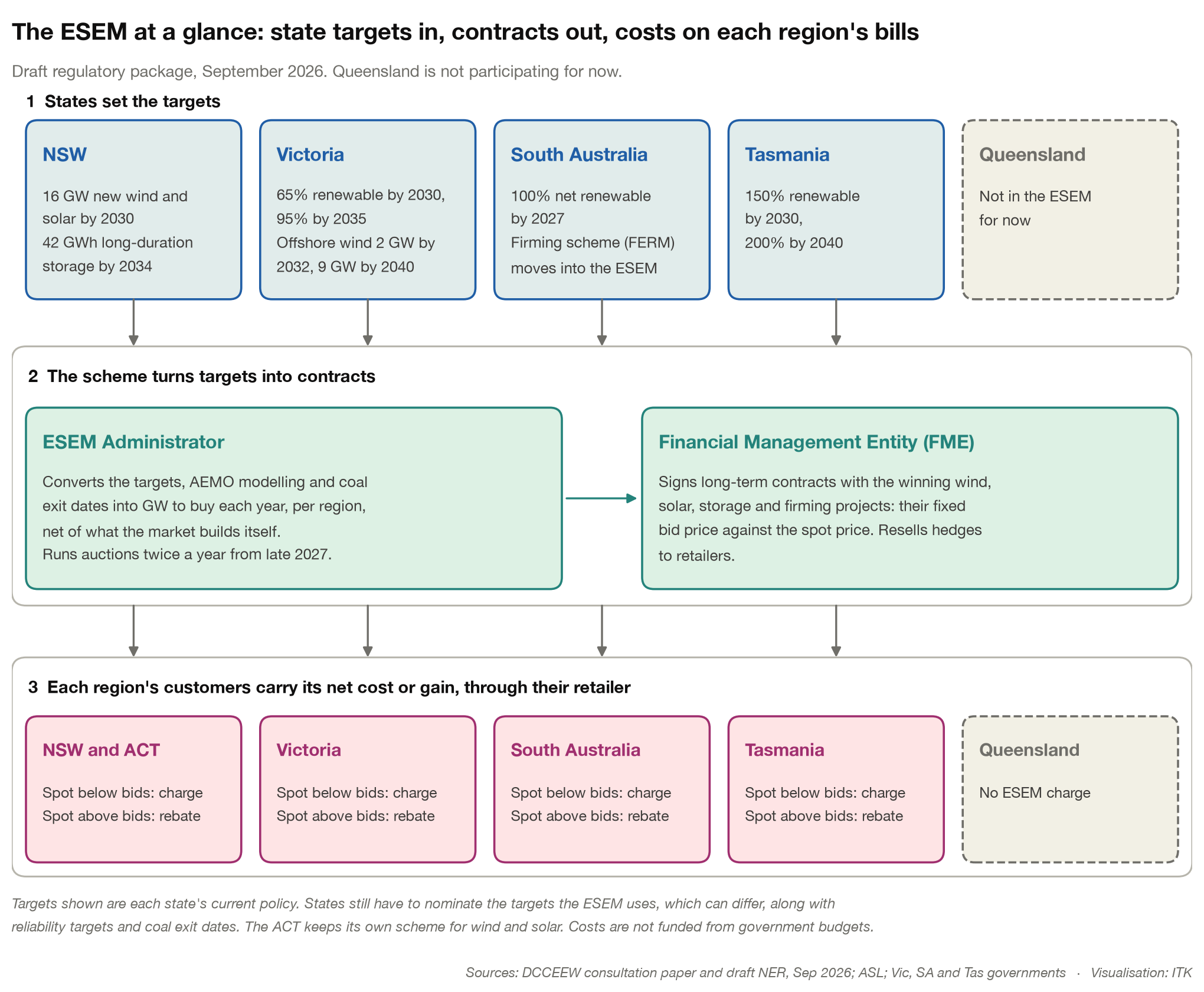
- Gentailers neither need nor want to write PPAs for wind and solar. The Nelson Report’s ESEMs may fix that because ESEMs take the PPA role away from Gentailers: State Governments set the targets, a national administrator buys the contracts and consumers carry any net cost.
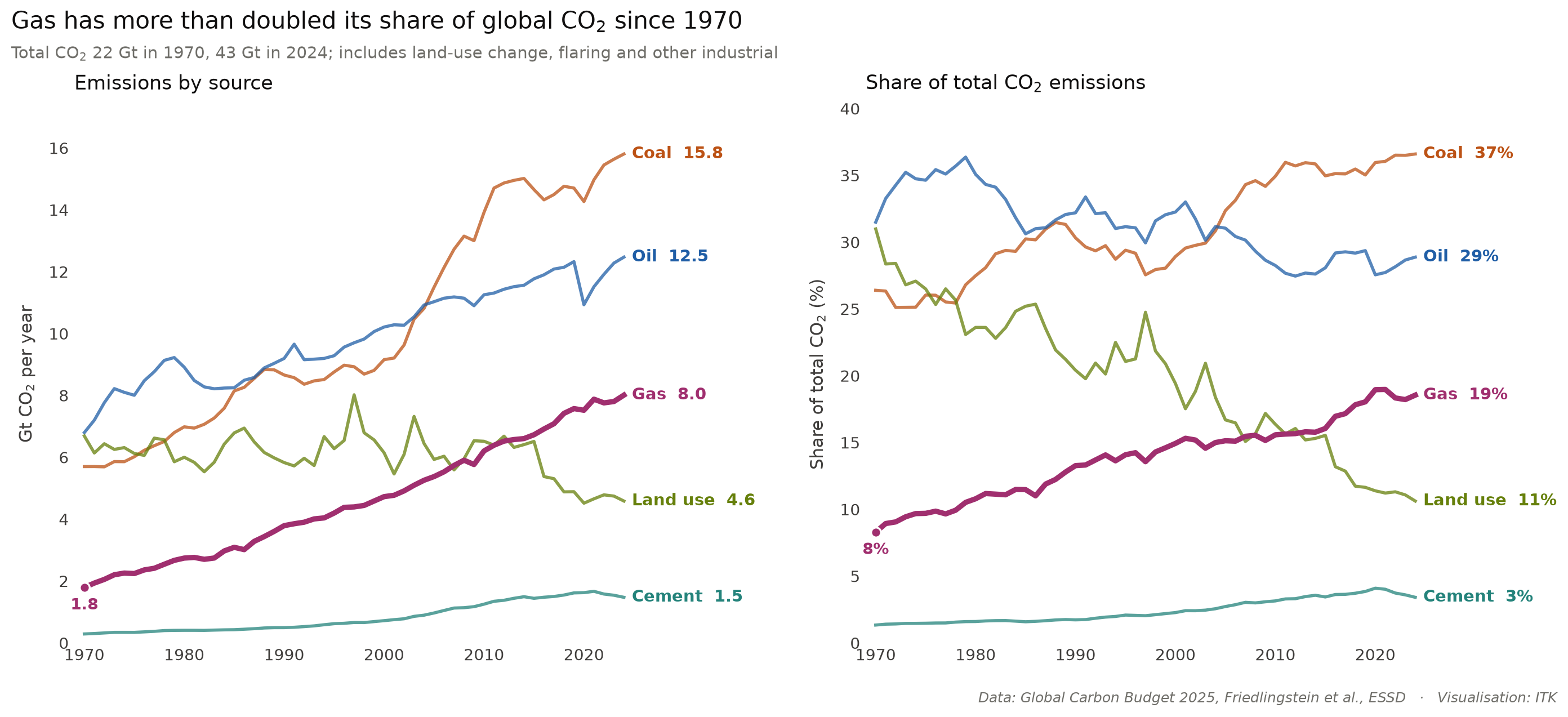
- LNP Governments have an ideological desire to finance gas generation and would do coal if they could get away with it. Somehow gas still carries a clean image although it’s more than doubled its share of global emissions since 1970. In Queensland they can get away with it. In Victoria not so much.
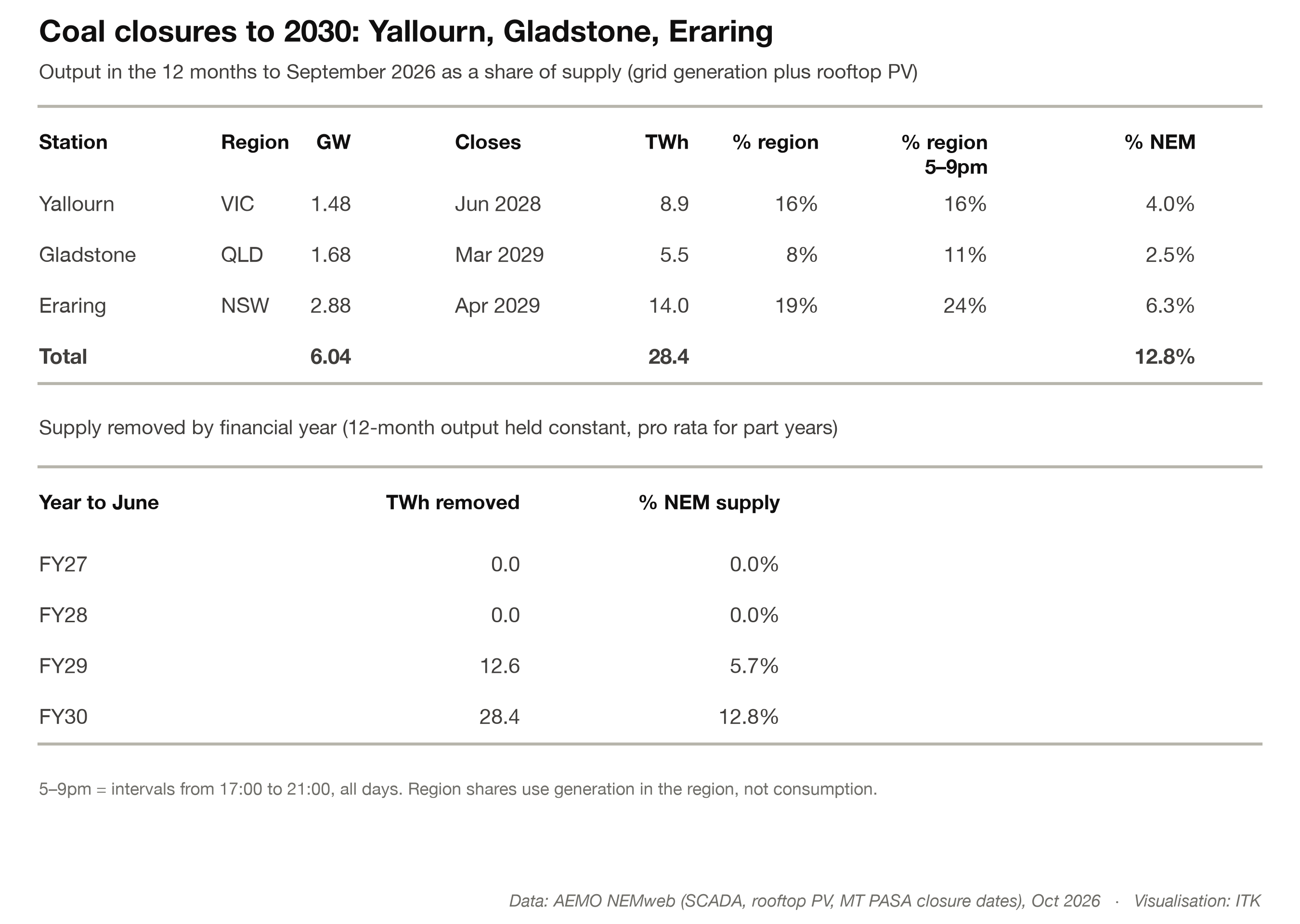
- 13% of NEM supply (close to 28 TWh from Yallourn, Eraring and Gladstone) is going away over the next 44 months (by mid-2030), most of it between July 2028 and April 2029. At the moment we are not going to be able to replace that supply. Now that major overhauls at Eraring are off the table and Yallourn has stopped overburden removal the risk of serious failures increases, maybe a lot.
- The market has finally worked this out. NSW time weighted (base load) futures for FY27 and FY28 are up 22% in the past three months, Queensland and Victoria about 15%; South Australia is down. But futures prices are still not high enough to incentivise new wind. Solar dances to a different beat not covered in this note.
- Australia’s per capita GDP has benefited greatly from firstly the rise of coal exports and then the rise in gas exports to get to a point where we were or are a top-three global fossil fuel exporter. But that growth has gone and arguably is gradually turning to decline. We need to use what is left of the business to find the next export industry. I argue that starts with replacing oil imports a story for another day. Still we should not listen to the coal and gas industry too much. They are yesterday’s heroes.
- ESEM, the Nelson Review’s answer to the problem identified turns out to have progressed very strongly and to be quite a comprehensive solution honouring what each State sets as its own decarbonisation target. I don’t like ESEM complexity but it is a much more comprehensive scheme than I had previously realised.
- Conclusion: If the Federal Govt wants to avoid a real risk of lots of things going wrong in electricity in a year or two it needs to further incentivise new bulk wind and solar. ESEM is a the_new solution to the problem but doesn’t help over the next few years.
Gentailers go for gas
It’s actually not surprising to see Gentailers following the Qld Government’s lead into a new push for gas generation. For years and years now it’s become every clearer that the one thing Gentailers didn’t want to own was wind or solar. Origin for instance has never wanted to own much wind or solar. Grant King, ex-ORG CEO, would rather build hydro in PNG and connect it via transmission to Australia than build a wind farm in Queensland. Wind farms didn’t offer enough risk or return. Nothing has changed since. And this attitude has rubbed off on the present Origin CEO. In fact it’s so long since Origin has done any decent development of its own it no longer knows how to do it. The best, indeed only, example is Yanco Delta a large wind farm proposal close to Jerilderie and the Dinawan substation in South West NSW. Origin bought the development for a nose bleed inducing $300 m and then has seen that the cost of development is much higher than it anticipated and additionally has had to put the project back into the EIS process. In my opinion some of the pain could have been avoided if ORG had just doggedly put its nose to the grindstone and kept developing, financing and building wind and solar over the past decade.
VRE is a market failure and will probably have to be Govt financed
For a long time I couldn’t understand why otherwise sensible gentailer CEOs eg Mark Collette, of EnergyAustralia, would rather develop a gas power station than a wind farm. The same goes for Damien Nicks at AGL “more gas, more batteries”.
I still don’t know the answer and each gentailer would no doubt have their own explanation for why they have come to a similar strategy but I think it must be that it’s hard to add value as the owner of a wind and solar portfolio. You can, in my opinion, add heaps of value by building at ever lower cost but that is different to gentailers trying to use dispatchable power to maximise returns. With dispatchable power you can dream of building a position where management action can influence price.
Gentailers also want to build gas generation because they have a comparative advantage. They already rent the gas pipelines, they have the gas contracts and relationships. In wind and solar, as ORG has shown, they are now babes in the wood well behind where the leading developers are on the knowledge curve.
But the essence of it and where the market failure lies is:
Why pay a PPA premium for a wind and solar farm portfolio when you can buy the energy from the market? You know if it’s windy and/or sunny the VRE portfolio will be going flat out and spot prices will be at the lower end of the range. Dispatchable power covers your evening risk and I guess the non VRE or low VRE risk in general.
How much gas power?
A reminder that the market LRMC is the situation where each fuel is earning a return covering its cost of capital but no more.
It’s true that gas power is not the same as gas consumption. ITK’s Vertex model dispatches every half-hour against modelled bid bands, using AEMO weather years with wind output cut to 85% of AEMO’s traces to be conservative. It was built at ruinous expense, and I think it’s as good as any other consultant’s model at estimating TWA, DWA and FWAP prices. Because the bid-band dispatch captures volatility, I have some confidence in the model output. I will say there is a kind of “whack a mole” feeling to the model in that there are always output elements that I personally judge unlikely across 20 years of output and five regions, and multiple fuel classes. But broadly my judgement is that the 2045 LRMC is robust.
The model still builds lots of wind, in some ways this is the most important finding. In this run of the model wind capex is above Gencost, wind output is below AEMO models. Prices in real terms are higher than today but not so much as to really care. The lights stay on. The model doesn’t build much gas capacity and burns about 77 PJ of gas a year in 2045. 2045 is assumed to be a coal free year. Wind gets $98/MWh and solar $36/MWh. That reflects the required LCOE at the assumed WACC, capacity factor and capital cost for 2045 for plant built on day one of the year and dispatched over that year. Quantities of each technology are adjusted until LCOE is achieved.
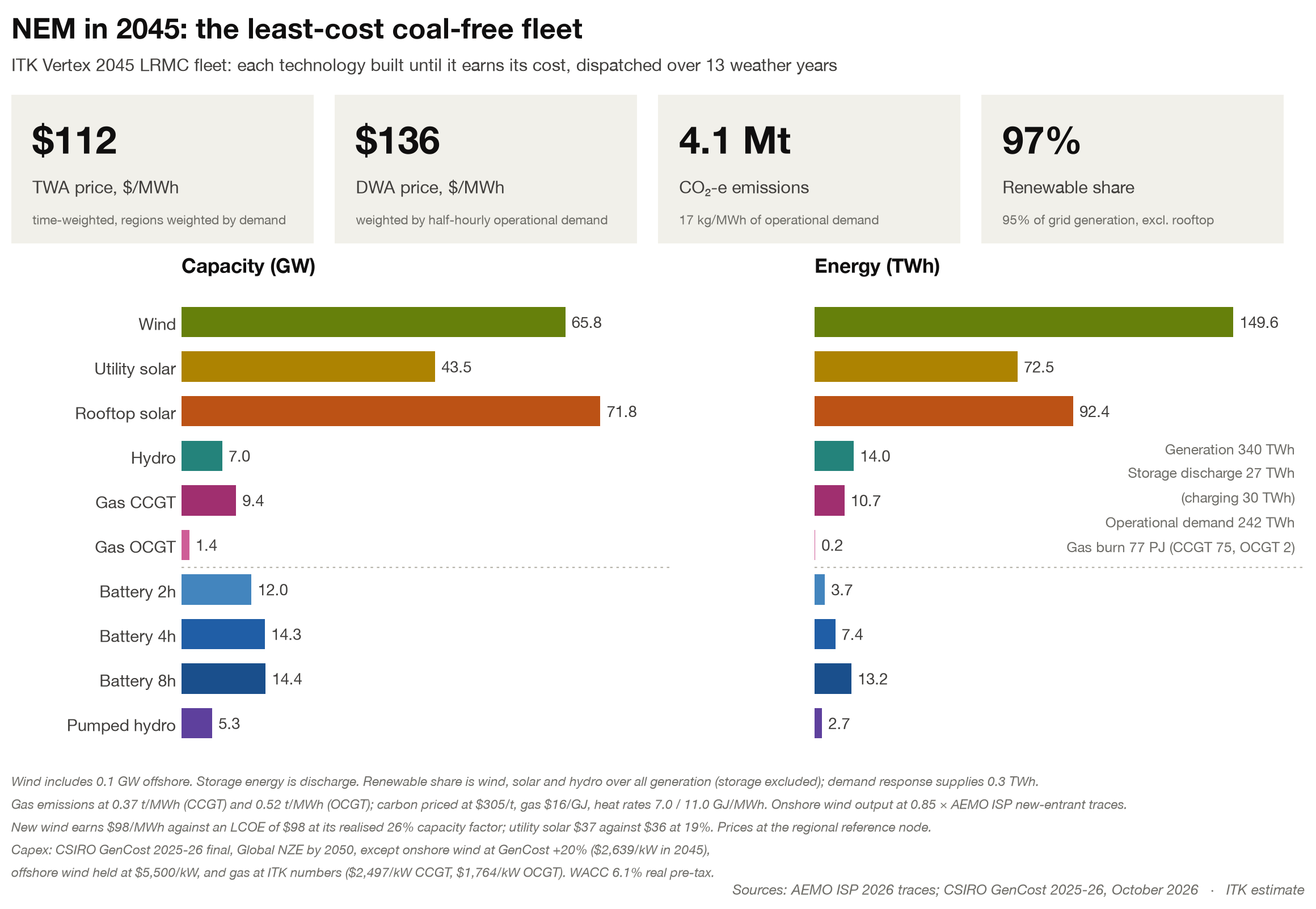
If this kind of model is to prevail the Gentailers are going to only be invested in a relatively small segment of the market, but, in their view, the influential price driving segment.
And in case anyone forgets gas combustion is still ruining the lives of the future generations. Gas has more than doubled its share of emissions since 1970 to now be 19% of the total. It almost certainly will be higher again in a few more years as oil emissions fall in absolute terms and likely coal emissions as well.
Meanwhile back in the jungle
The AFR energy and climate summit is of course grossly misnamed. Climate barely rates a mention and then only by accident or so it seems to me, reading from a distance. I was offered a free ticket but the Summit mainly seems a place for the AFR and its readers to catch up on what the electricity industry worked out six months ago or more. Still if I wasn’t there I probably missed all the best bits.
If the Summit agenda providers actually looked at the title of the summit and made an agenda to suit, they might have considered climate’s impacts on the economy. I use insurance as a very imperfect proxy. It’s up by more than electricity. I asked Claude and we reckon the average homeowner has an house and car combined insurance bill of $4,500-$5,500 compared to an electricity bill of say $1,500. But no-one gives a rats about insurance.
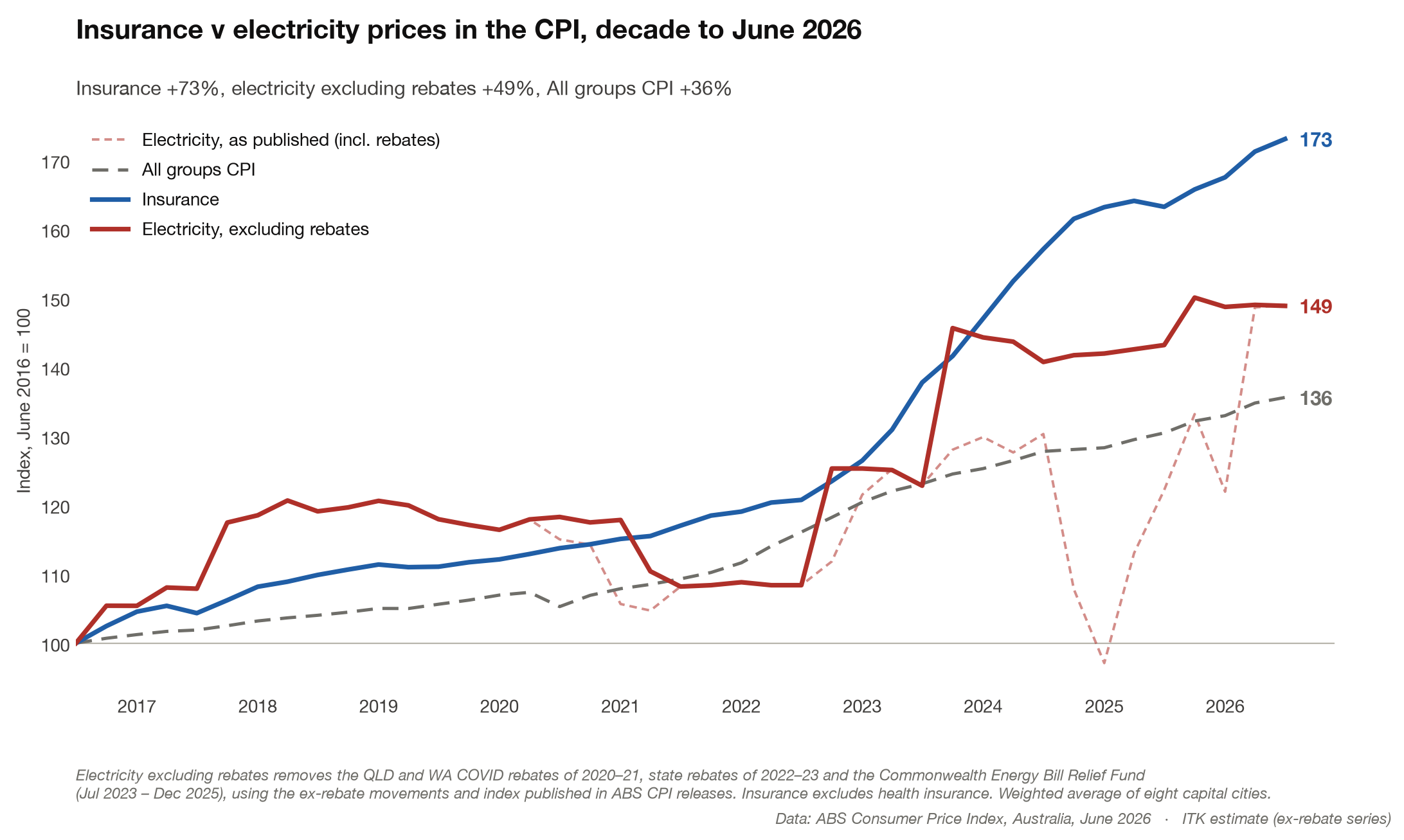
Why are insurance costs up? Insurer profits are a factor, they need them, home and car insurance also factors but disaster losses and reinsurance costs, themselves driven by disasters, are also a factor. Thanks to both growing population and growing climate issues 1 million houses or something like that are uninsurable. Road repair costs from floods in Qld in particular are big.
But when was the last time you saw a thorough investigative analysis of the costs of climate change for the Australian Economy reported in
But my abiding interest is in global decarbonisation achieved by electrification and decarbonising electricity. It’s a simple plan. All the best ones are. And right now in Australia it’s stalled.
Mark Collette summed it up perfectly as far as I’m concerned.
“When you look beyond Yallourn and Eraring – there’s a lot of conversation around those because they’re the next [to close] – there is no hope of shutting any of the others after those two, based on current progress,” he said. “That’s the real issue to work through: the speed on the transmission and the replacements and the gas-fired back-ups and everything else.
“Every year we don’t do it, you’re basically pushing out all of the other coal an extra year. That’s the real issue. It’s not the Yallourn and the Eraring issue. That’s the real issue when you talk coal.”
As Rob Wheals, CEO of Squadron, noted, low spot prices are acting as a barrier to investment.
However investment decisions are made with an eye to the future and the best market view of the future, albeit a highly imperfect view, is the futures price. The table shows how far each region’s FY strip has moved.
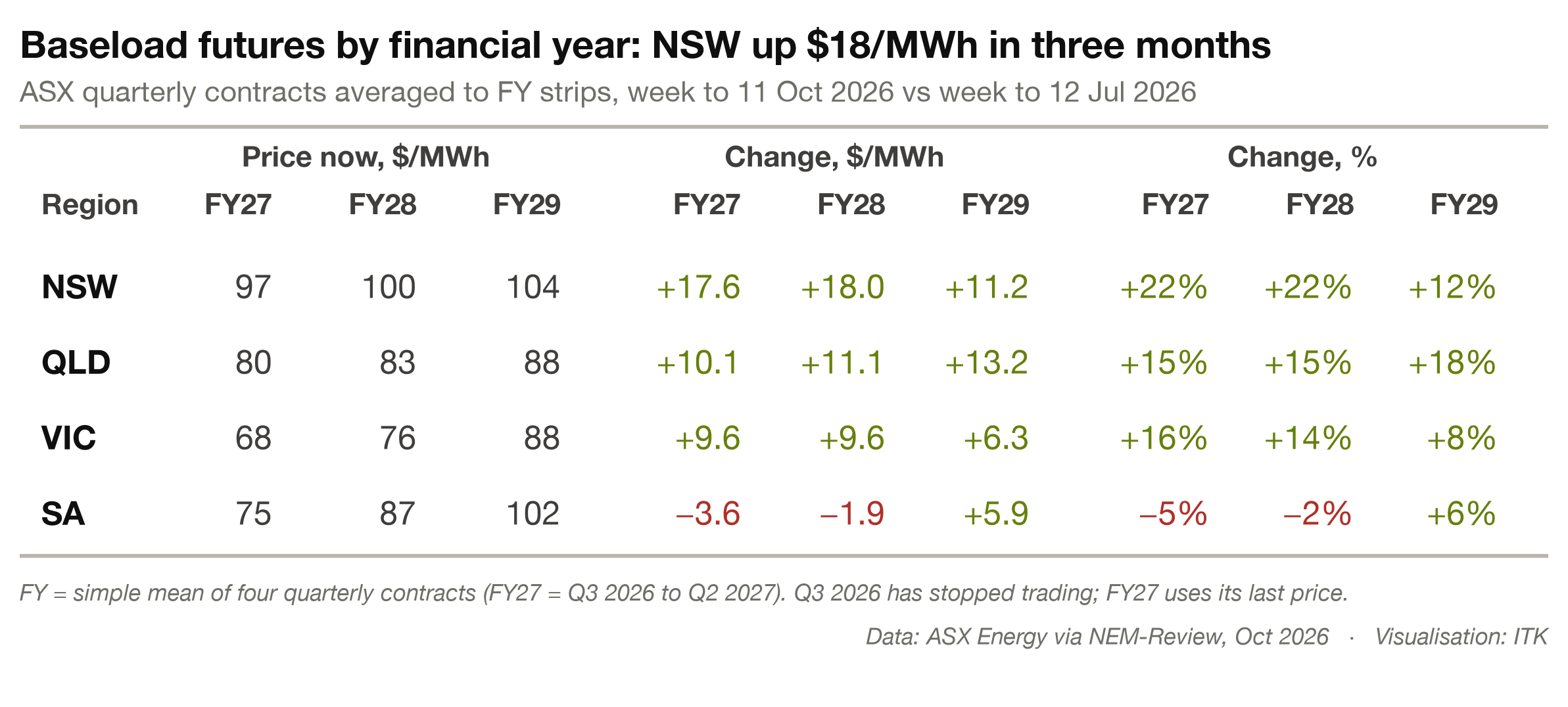
Baseload is the same as, and better expressed as time weighted average (TWA) and generally speaking the wind FWAP (flow weighted average price) will be less than the TWA and the point here as any wind developer will tell you is that prices of $100/MWh let alone the price in Victoria or South Australia are below what wind requires. Never mind the political obstacles.
Post hoc
When something happens in a market there is always an army of experts to explain why it happened. But as many a trader has lamented where were those people forecasting the event before it happened.
So I did point out that futures prices were rising in a previous note but the recent rise in September has caught me out a bit.
At the end of the day the futures market is thin, gentailers have teams of people building books, selling generation output forward and so on. It’s not like the oil futures where there is huge depth.
The rise came mostly from late September, when AEMO’s outage outlook cut forecast coal availability for the rest of 2026 and Eraring had three units booked out in turn.
That said, recent events show that, even conceding that outages can be expected in spring, coal outages are becoming more relevant every year.
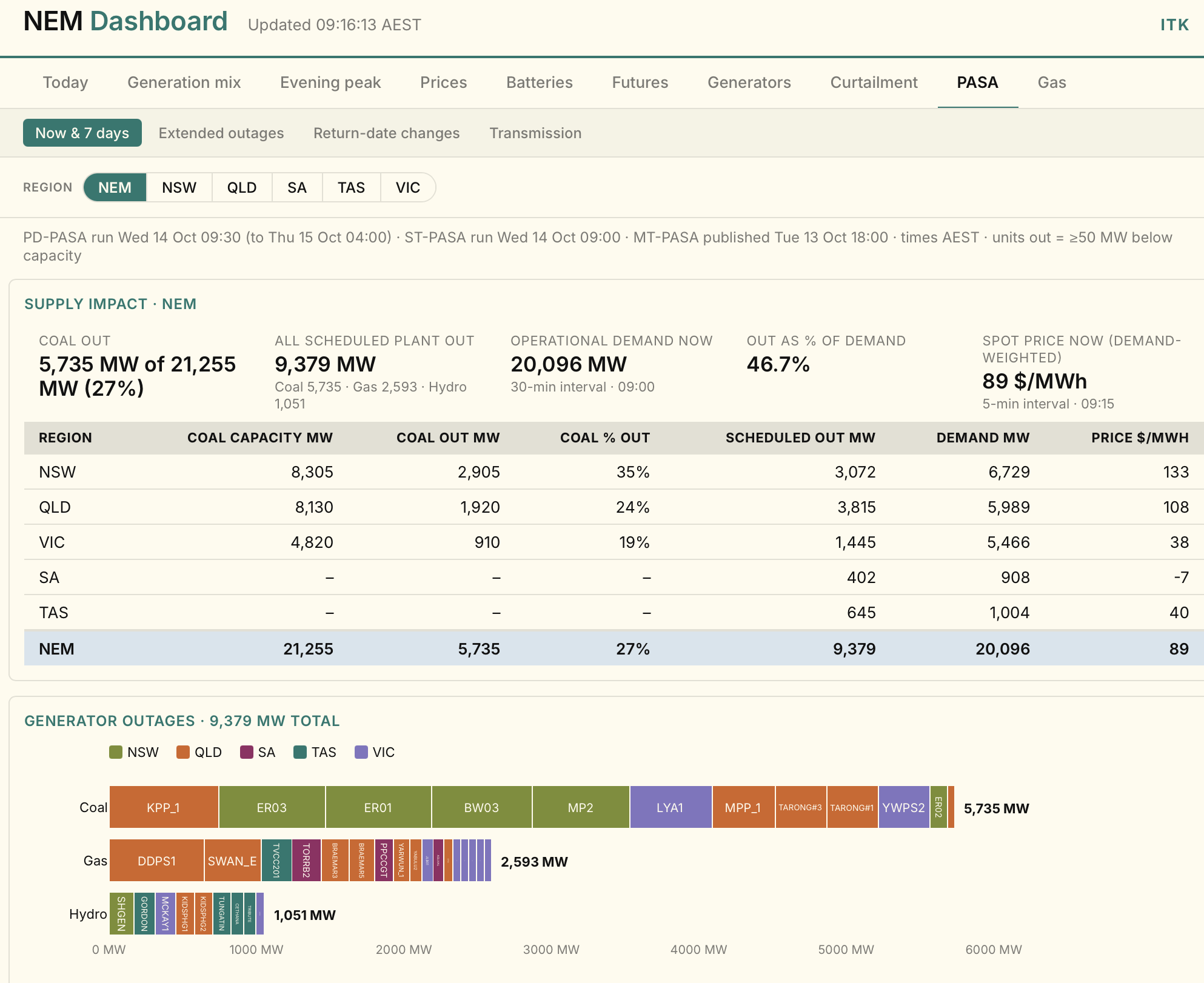
Further (shoot me), my personal view is that when competing generators see someone else’s coal outage they are likely to reduce their own output as the consequent price rise outweighs the loss of volume. That is just a hunch.
Coupled with that is an increasing realisation that at least in the case of Yallourn it really is closing. In a news event I didn’t previously see, a Victorian MP noted that overburden mining ceased around last Christmas, with up to 40 jobs going.
Origin has clearly said it won’t invest in further major maintenance overhauls at Eraring. Decommissioning planning has begun, including for the 35 Mt of toxic coal ash. In particular the Newcastle Herald reports Origin has lodged a scoping report with NSW Planning. There is some further indirect evidence that space for ash is tight and therefore costly.
In addition Origin said back in 2024 that “Current Government agreement does not allow operation past April 2029.” All of this can change and 2029 is still some distance off but to me the closure looks more likely now than it has before and if I can see it so can everyone else.
In Queensland, Powerlink is clearly proceeding with the network changes required to allow Gladstone to close in 2029 although progress is about 3 months behind the 2024 target. Specifically construction has started on a new 275 kV line and four synchronous condensers have been bought.
In my own shoot from the hip view there is plenty of capacity of all sorts in Queensland to allow Gladstone to close. In my view there will be enough batteries never mind the generation. So perhaps the Gladstone closure is a touch less certain than the others but I wouldn’t put much money on it.
Still the timing of the closures means that prices really should be impacted in FY 29 and FY30 rather than earlier. The FY27 move reflects this spring’s coal outages, not the closures.
ESEMs are an answer but maybe too late
It turns out that the ESEM process is much more structural than I had envisaged. I had thought they were a complex voluntary contract. In my mind they added unnecessary complexity. In addition to the complexity the ESEM requires essentially three or even four sub services (different spec contracts) just for bulk energy, eg wind, wind hybrid, solar, solar hybrid. Price is the sole driver so wind and solar can’t be in the same service. Hybrids are apparently treated as separate but linked so I have classified them in their own group here.
Secondly the contract starts no earlier than year four. So you are exposed to merchant or short term contract risk in the most NPV sensitive part of the project.
Thirdly ESEMs discourage merchant construction. That’s because a project that moves to FID before the ESEM is offered cannot then enter the ESEM process. So if that rule didn’t exist a project could enter FID now in the expectation of winning an ESEM. As it is there is an incentive not to commit.
But considered against the issues in the market at present they offer a good enough answer.
They essentially let the State Govt decide the amount of renewable and firm energy to be procured with any net costs passed on to consumers. If ESEMs had been presented like this at the beginning I’d personally have been far more on board. I guess once the Barnabys of this world start looking at them closely they will have something to say as well.
And looking at a simple worked example with three wind farms bidding. 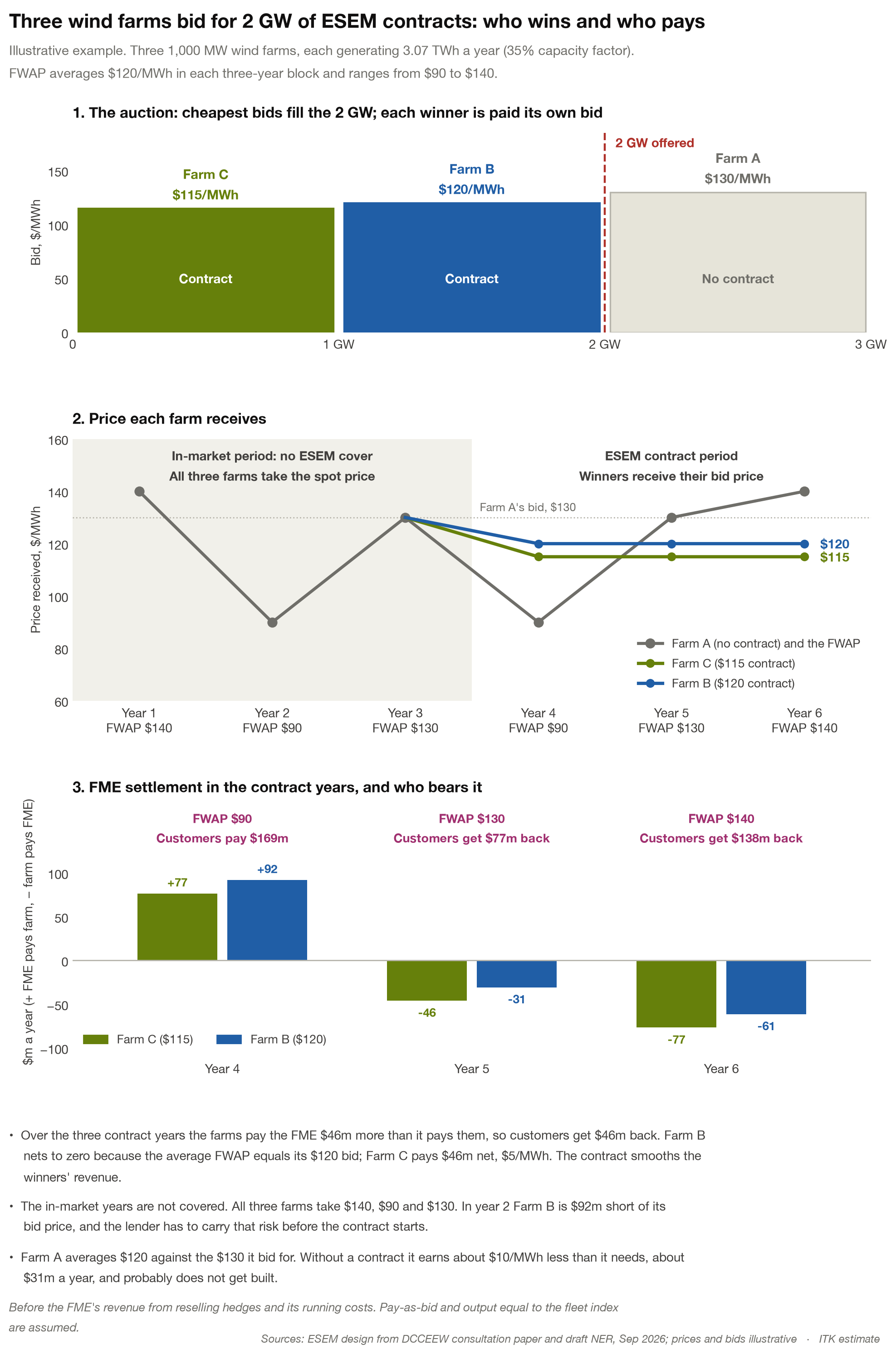
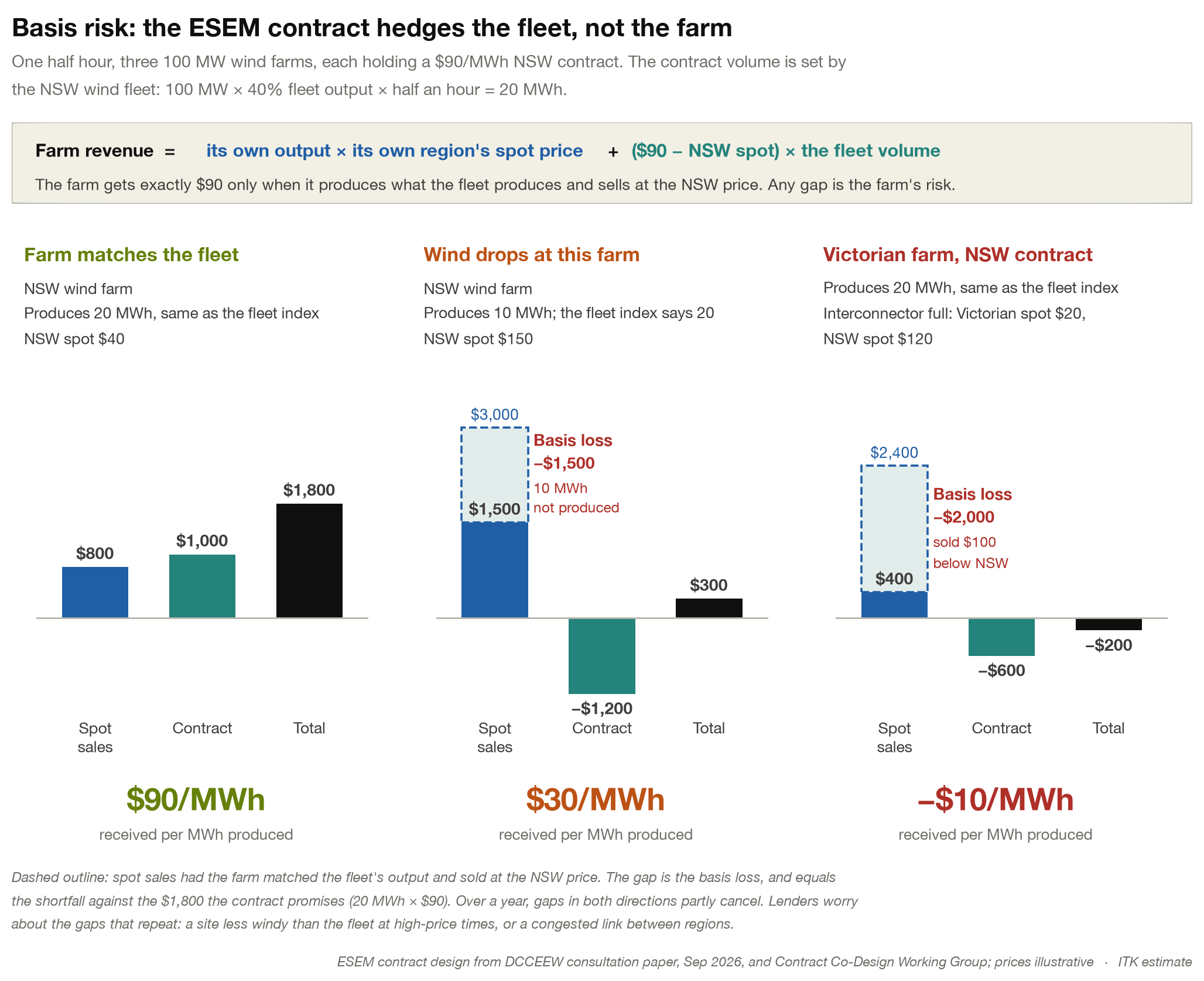
A key feature of the ESEM is the idea that wind and solar farms have basis risk, that is the projects are less productive than the overall wind or solar projects for that region. In addition a project in a different State eg a Queensland wind farm can bid into say the NSW scheme but it then also carries the risk of being settled against output in that particular region.
Without something like ESEM it won’t happen
Even if I ignore that the rooftop market is going to saturate soon there is no way it’s delivering 28 TWh. And that number ignores demand growth. We also need to power data centres, run electric trucks and cars, electrify houses and buildings, replace gas for process heat.
28 TWh of wind at a historically generous average 35% capacity factor is about 9 GW, required within 4 years. 9 GW is about $30 bn of investment. If instead it’s more GW of solar then that requires a corresponding increase in batteries. Overall we definitely need more solar as well as lots more wind.
The NSW LTESA is just a small fraction of that. In Victoria it’s likely that following the next State Election most development will effectively and at a minimum go on pause while the industry tries to work out what the Victorian LNP’s actual policy is.
If I look at QLD what the industry saw was a version of Theodore Roosevelt’s speak softly and carry a big stick. That is say nice things to renewables before the election and then do your best to kill the industry afterwards. More to the point you can’t rely on pre-election comments as a guide to actual policy.
The LNP in Victoria will almost certainly back new gas generation. I’m not sure where the gas would come from, the Victorian LNP will probably incentivise exploration but it will take years and years and years and be expensive. There is little evidence of good quantities of economic gas resources in Victoria.
Paradoxically getting rid of VNI West and likely Western Renewables Link would seem to make offshore wind the only viable way forward for Victoria. But offshore wind will itself be less viable because it won’t be able to export as much power North. The entire plan, if it can be called a plan, is beyond dumb and therefore one way or another it won’t happen.
Quite possibly what will happen is a big fat nothing, maybe with a few Victorian solar farms thrown into the mix and a wind farm that can access existing transmission. It’s like the toothpaste tube you can always squeeze a bit more out. Still putting the toothpaste tube under the rolling pin is not going to build the new energy system in Victoria that will make the State attractive to energy intensive business eg data centres. Maybe Portland can be sacrificed. We will have to wait and see.
Bottom line as stated many, many times in this space and as reiterated by Mark Collette and Rob Wheals Australia’s energy future will be stuffed if we don’t build more bulk wind and solar.
I could make a case that the private sector, and I don’t mean gentailers, I mean the likes of Tilt and Neoen could take the risk and invest on spec but I think the reality is that until Governments, and I think it has to be the Federal Government, carry what is essentially the insurance risk, the bulk wind and solar won’t get built.
In the next part of this note I take a quick glance over what the rest of the world is doing and conclude, as you would expect of me, that thermal energy exports are not the way forward for Australia. Thermal energy exports is to make a half pun a sunset business. Productivity is already dropping in the resources industry generally, the world is very slowly, but I think surely, moving away from thermal energy. Australia needs to get in front of that trend. Perhaps not too far in front but we cannot stand still.
Let’s review the last decade in a few slides.
The global history of thermal energy trading over the past decade is unencouraging for Australia’s future
Coal and gas electricity generation is broadly flat on a global trend basis. In 2025 coal-fired electricity output fell in both China and India in the same year, for the first time since 1973 according to CREA analysis for Carbon Brief. The IEA confirms both falls: about 1.5% in China, only the second decline since the 1970s, and about 3% in India, mostly due to an early and strong monsoon.
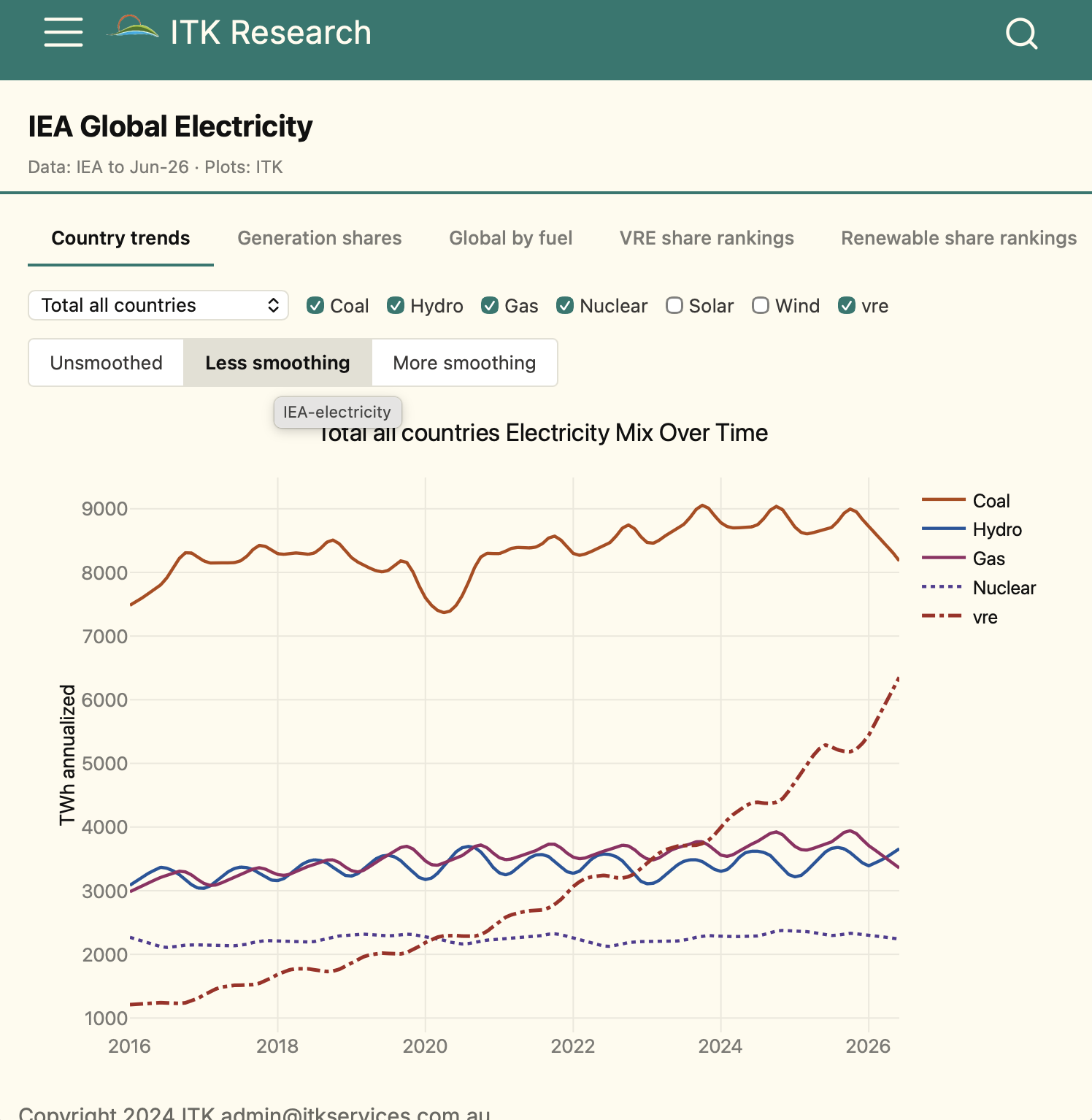
I wonder if presenters went through the global coal outlook at the AFR Energy and Climate Summit?
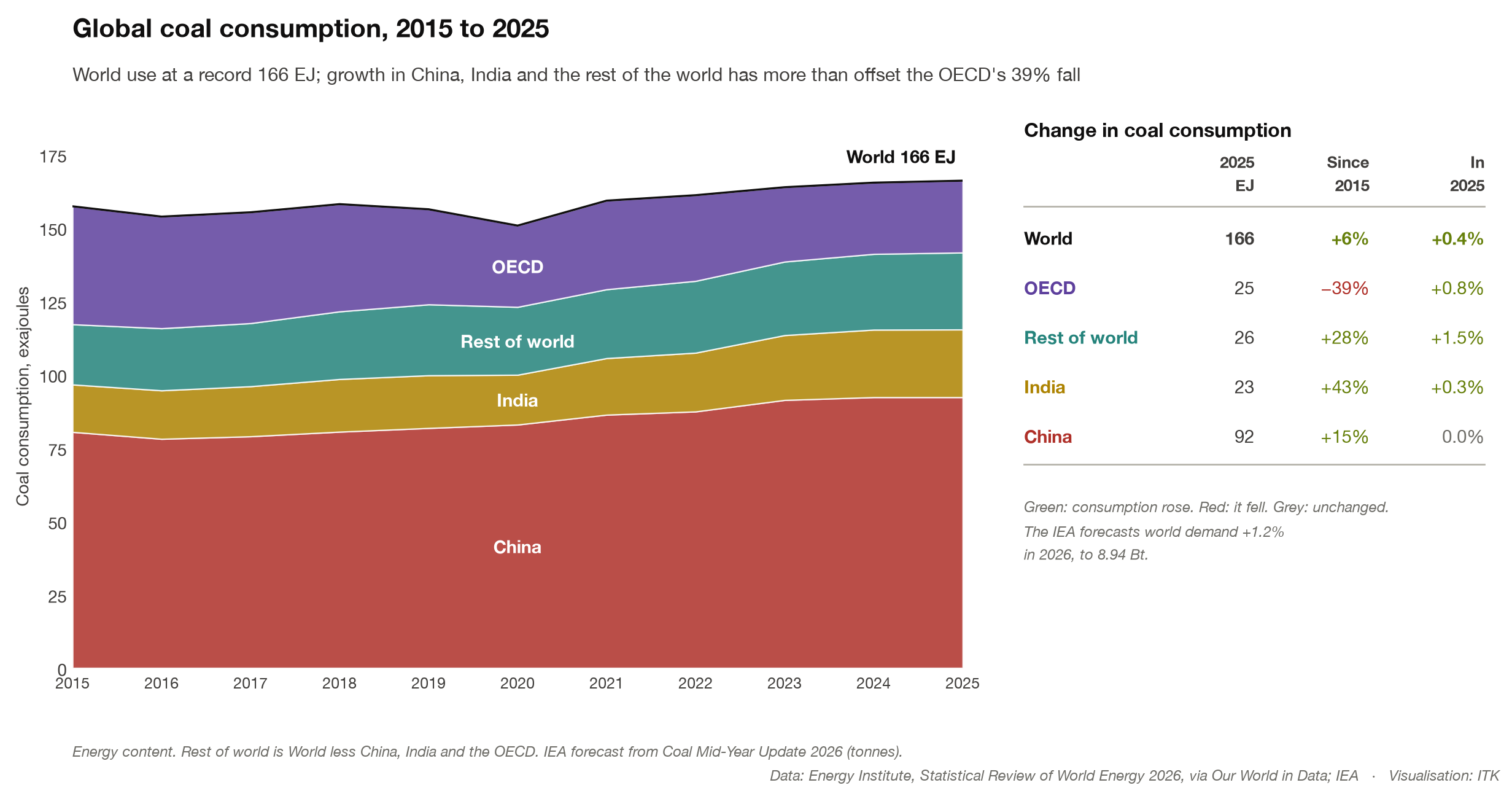
Global coal consumption matters for the climate and a big picture of what is happening is no doubt important to every coal producer. Again the broad outlook is flat to very modest growth. China’s policy is therefore very important from a global and climate perspective but to export countries it only matters if there is a surplus or a deficit. As far as it goes I can’t see a meaningful increase in China’s coal consumption over the next year or two given the state of the economy and the growth in renewables. I covered China’s coal previously However electrification of transport is driving up electricity consumption and may continue to support coal generation for a bit.
What matters to Australia is the trade.
Australia has lost some share in the seaborne coal trade. Indonesia is now clearly the leader.
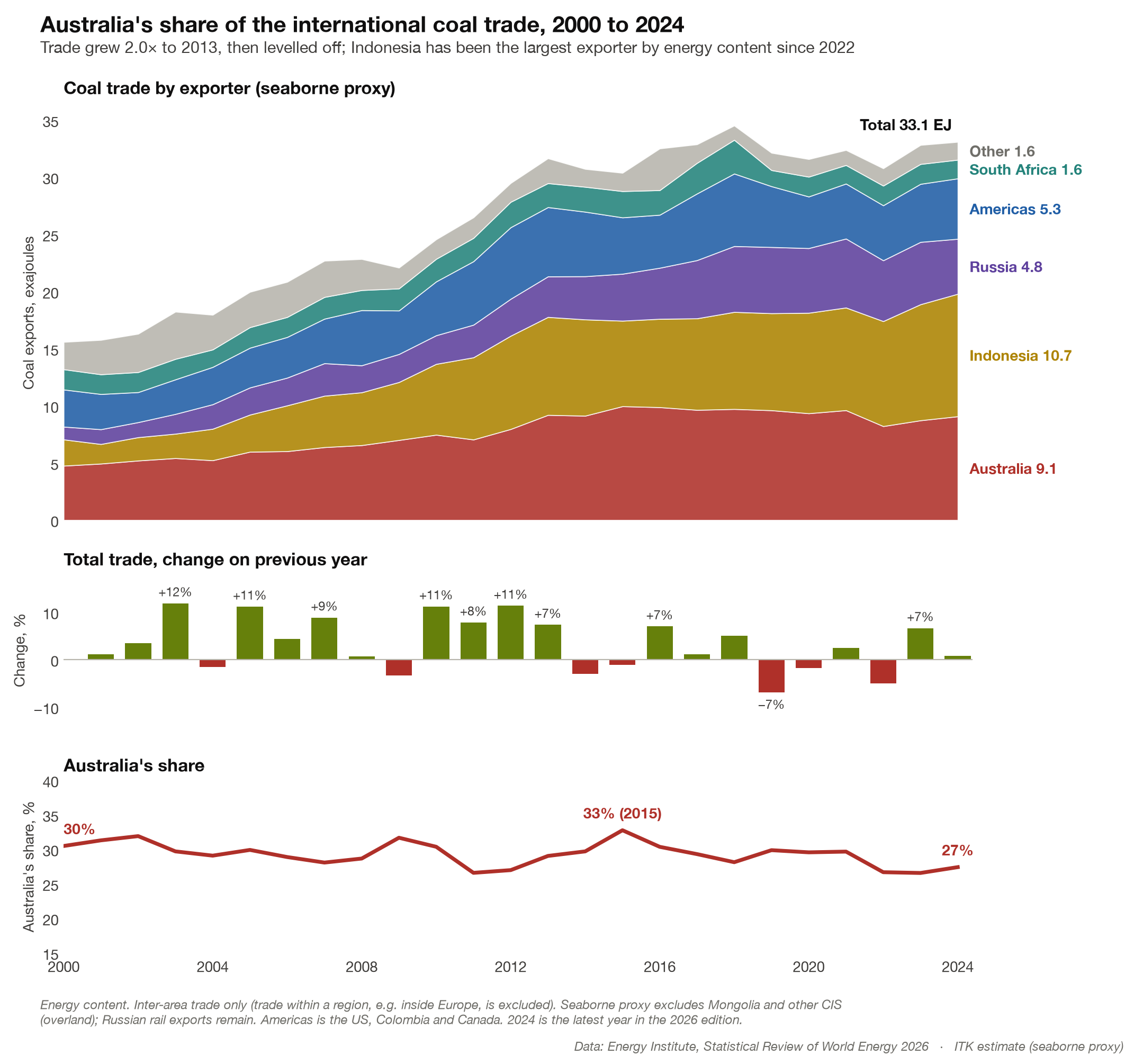
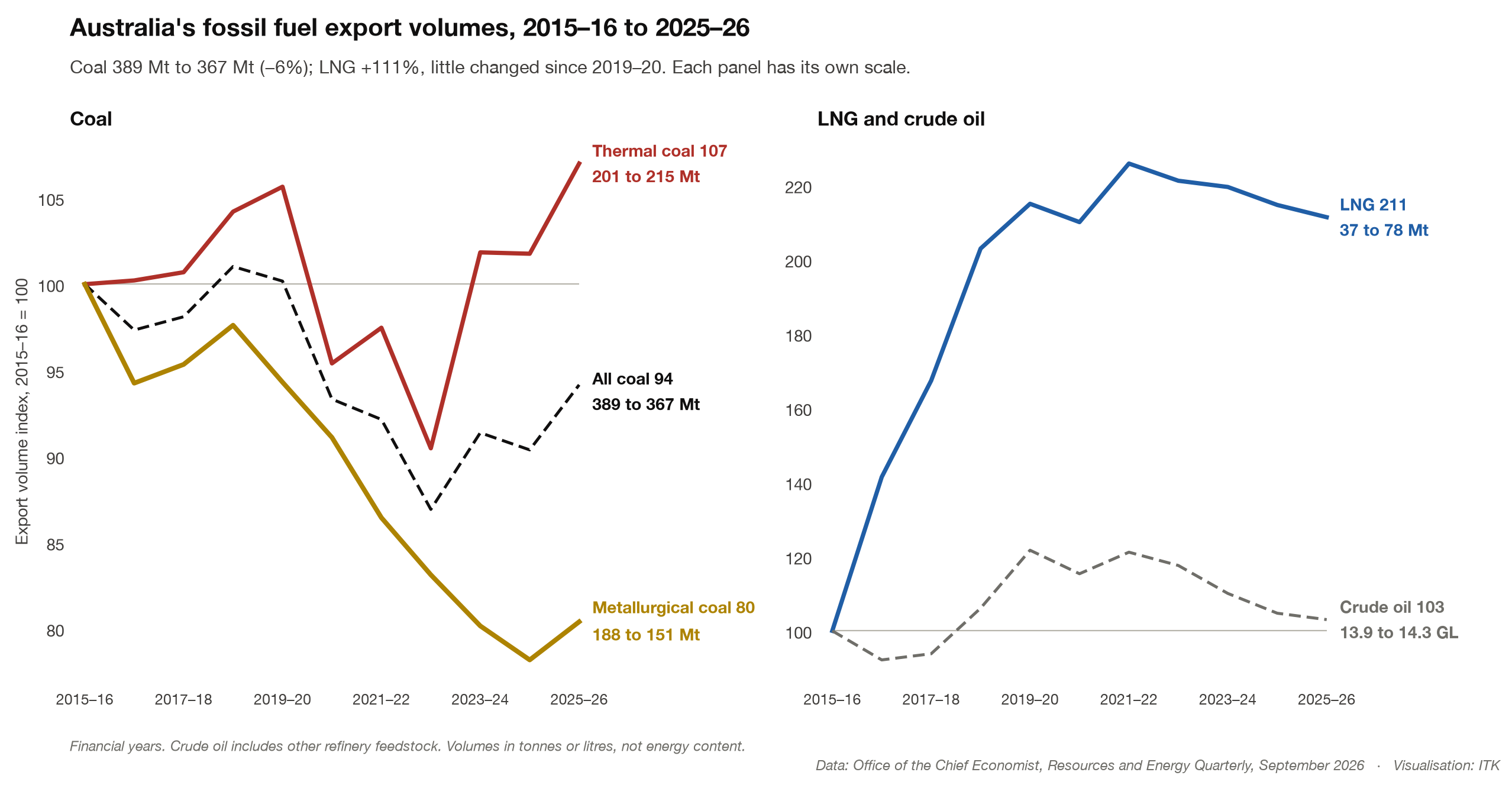
And looking at Australia’s energy exports more broadly. Thermal coal exports are up 7% over the past decade. A pretty good performance I have to say. The problem is metallurgical coal and more recently LNG exports also falling away.