Victoria: Higher prices and more gas without VNI West
In this note I compare prices and fuel mix in a “with VNI West” and “without VNI West” scenario using Vertex, ITK’s spot price modelling tool, and determining the fleet as the least-cost build that recovers its costs (long-run marginal cost, LRMC) at 2035, 2037 and 2040, and interpolating between.
I used capital and operating costs taken directly from GenCost, not because I think GenCost is necessarily to be relied on but because it is a standard reference and avoids putting more of my own assumptions into the result. However I used my own estimate of the gas cost, A$12.75/GJ (the mid case of an LNG import contract, shown below), and the AER’s shadow carbon price ($157/t in 2035, $221/t in 2040) in the LRMC calculations that determine the fleet. Having determined the fleet, it’s re-dispatched by Vertex without the carbon cost, to match the market today.
The outcome of my modelling is that without VNI West, Victorians build and consume more gas, even with AER shadow carbon price, and that once the brown coal exits, Victorian prices are $16–18/MWh (11–13%) higher than with VNI West. Across the NEM the gap is $4–6/MWh. The prices here are demand-weighted; these are invariably higher than the time-weighted prices I normally show.
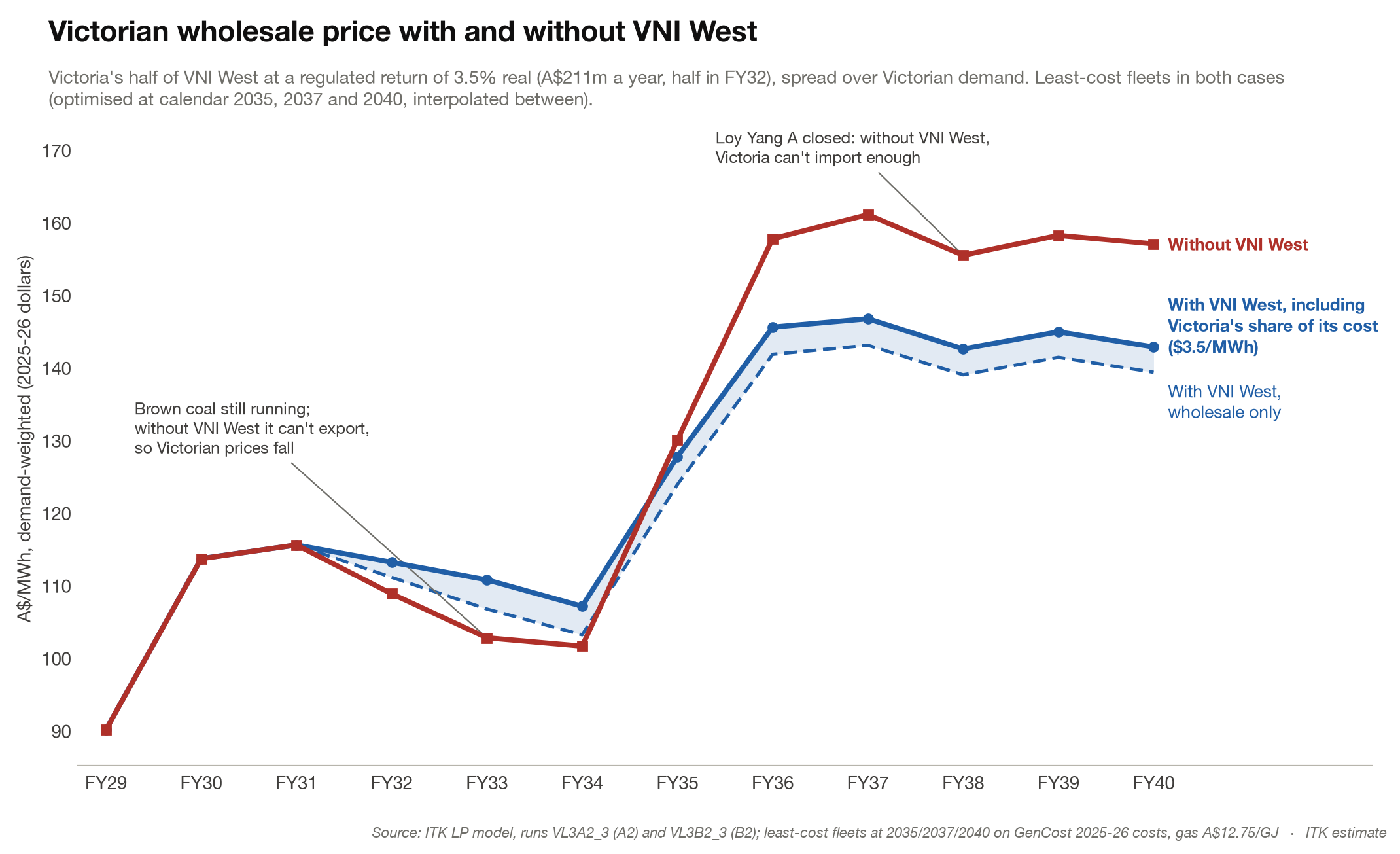
Before Loy Yang A and B close, Victorian prices are $2–4/MWh lower without VNI West, because Victoria has fewer ways to export its surplus.
VNI West costs about $7.75bn. Victoria’s half, at a regulated return, adds $2–4/MWh to Victorian bills, against a $16–18/MWh price gap once brown coal exits. Across the NEM as a whole the case is narrower.. The case for VNI West is stronger from Victoria’s side than from the NEM-wide view.
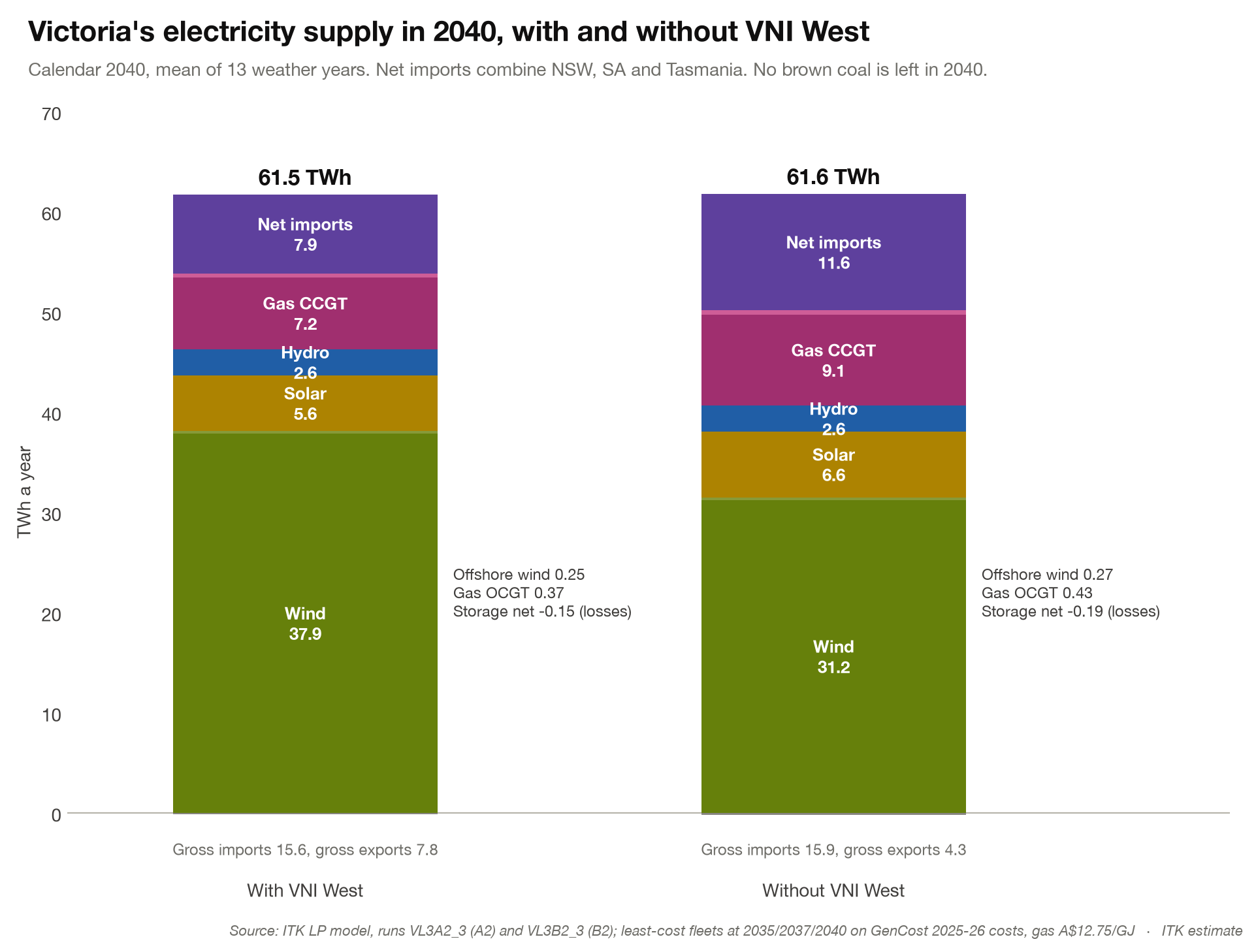
Without VNI West, about 2 GW less wind is built in Victoria, and up to 1.25 GW more gas. The LRMC process was not policy constrained. As a result it didn’t build any offshore wind because onshore wind is cheaper. I don’t show behind the meter because it’s the same in both cases by construction. Nor is battery output shown.
About VNI West and Victorian transmission
The main transmission lines in Victoria can be seen below. It’s assumed that Marinus Link, at least stage 1, is in operation; without it Victoria would be more isolated. Marinus will provide Victoria with more access to Tasmania’s hydro and potential wind energy, and equally Tasmania will benefit from more access to its bigger neighbour.
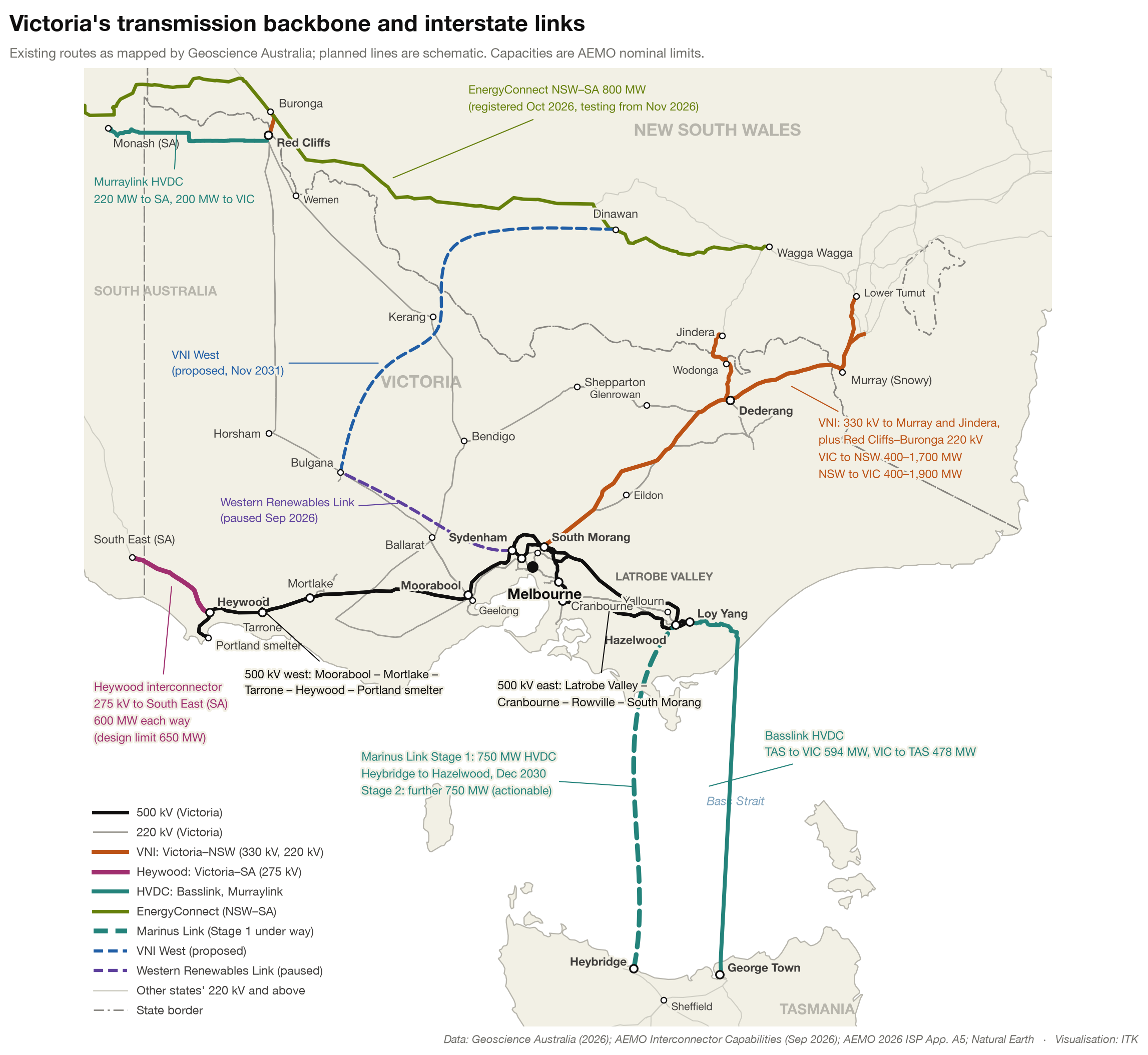
Victoria is the NEM’s most interconnected region, which has supported its historic role as a net electricity exporter.
Additionally Project EnergyConnect provides an alternative flow path of sorts for energy to flow between NSW and Victoria via South Australia.
Flows into and out from Victoria have looked as follows for the past year:
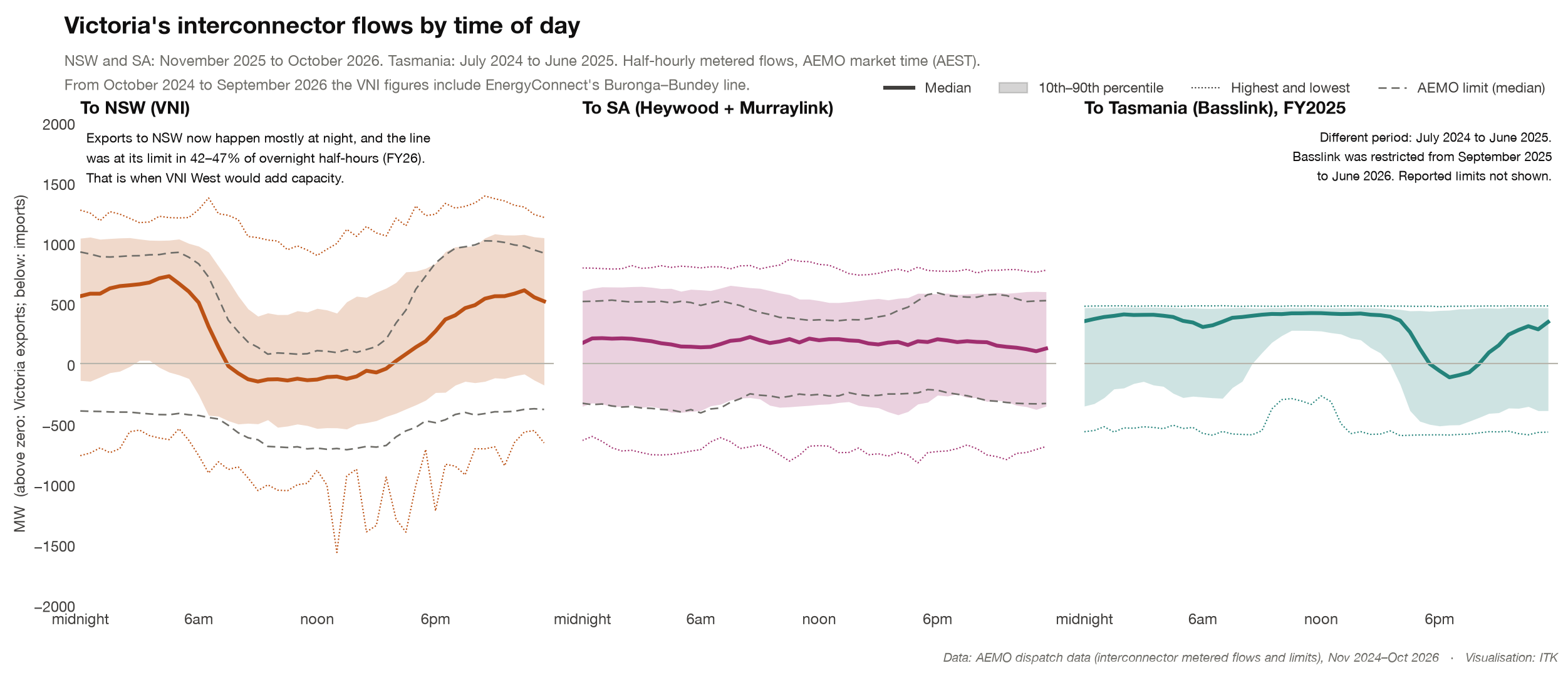
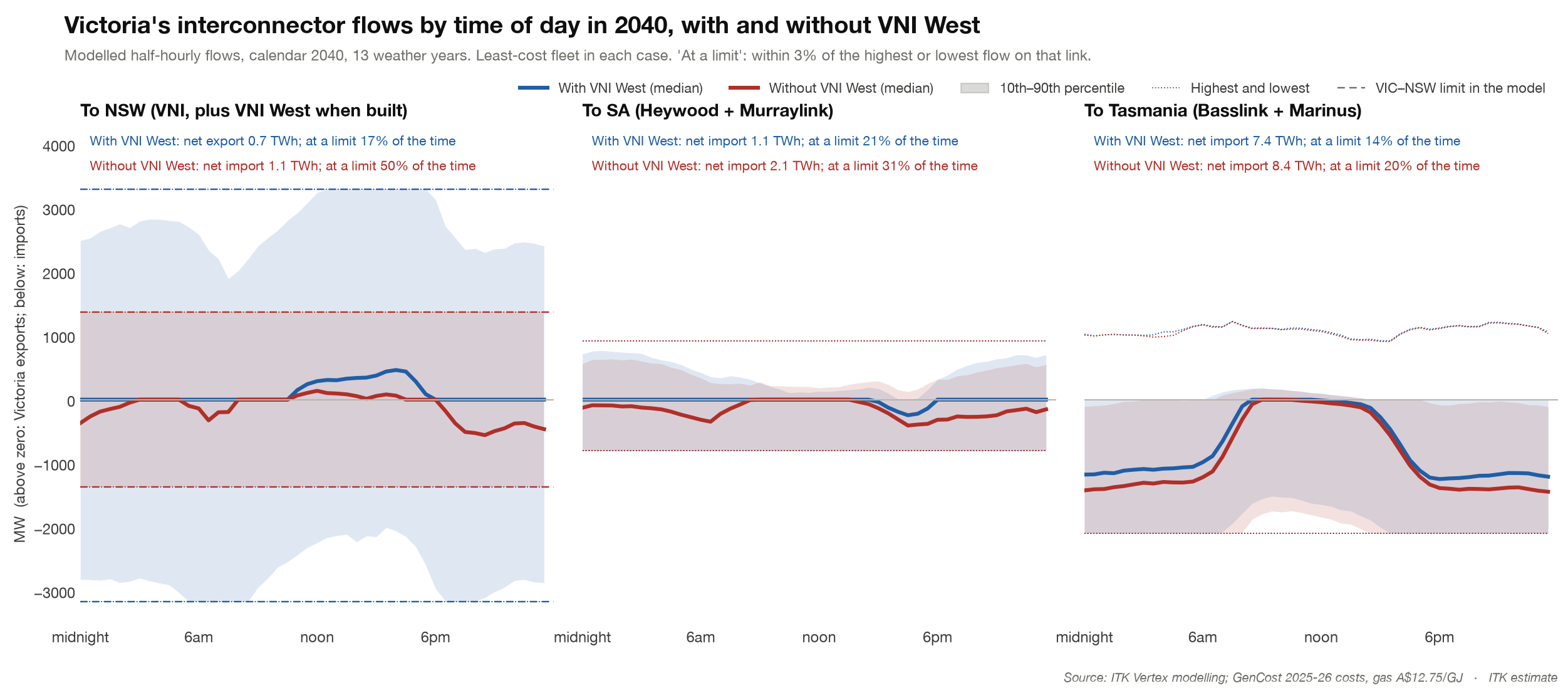
Victoria’s exports to NSW now flow mostly at night, and the existing VNI was at its export limit in 42–47% of overnight half-hours in FY26. That is the direction and time of day VNI West relieves.
In the modelled 2040 the pattern changes. With brown coal gone, Victoria imports from Tasmania most nights, and flows to and from NSW swing both ways. Without VNI West, the existing link to NSW is at a limit 50% of the time, against 17% for the larger link with VNI West. I dont really think Tasmania will be that keen to export every night to Victoria given that storage is finite in Tasmania, but I haven’t constrained it in the modelling to date.
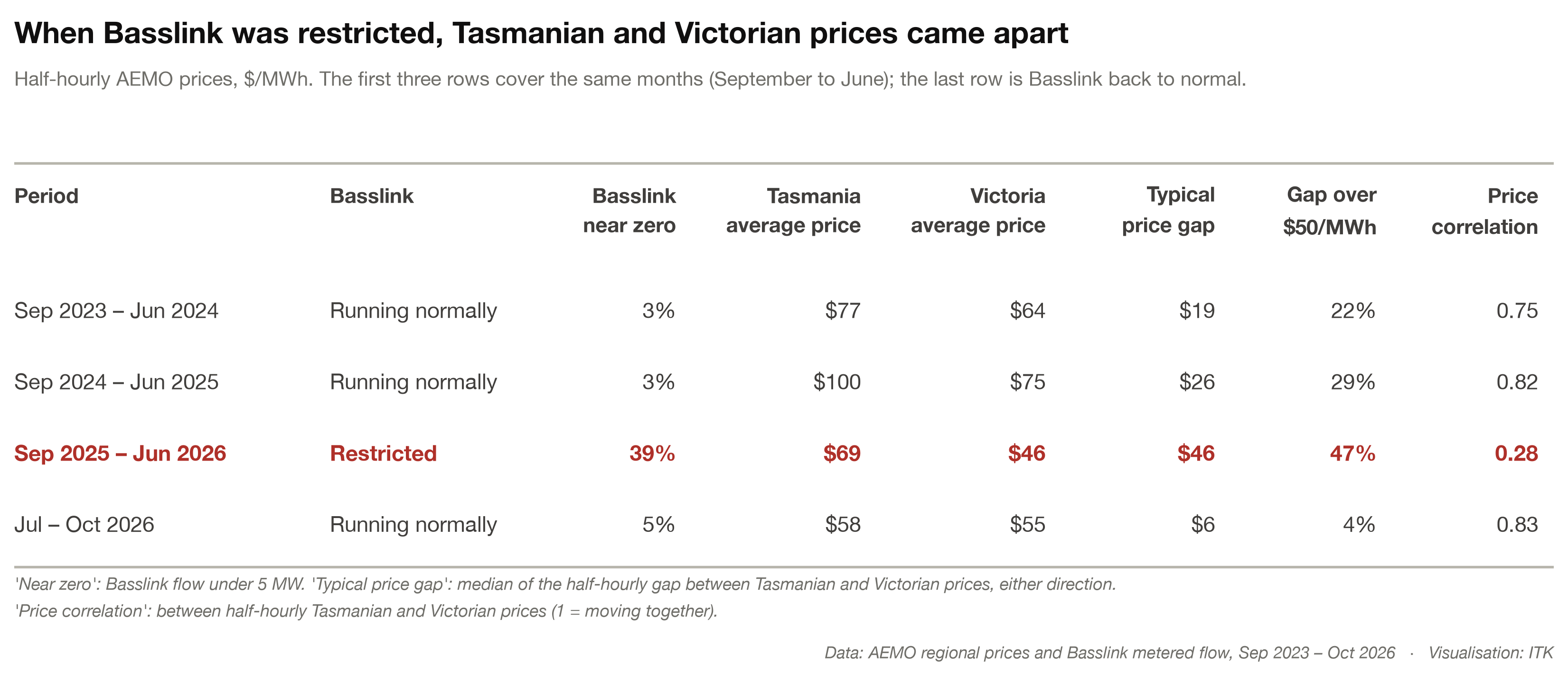
And if it wasn’t obvious already, we can see what a difference the interconnector (Basslink) makes to Tasmania via the natural experiment of September 2025 to June 2026, when Basslink was restricted. The correlation between Tasmanian and Victorian prices fell from about 0.8 to 0.28, then returned to 0.83 once Basslink was back to normal. I don’t make too much of the table but in general transmission can be expected to make prices in connected regions closer to each other and with less volatility.
What about new gas in Victoria as the Victorian LNP shadow energy minister has indicated?
ITK’s LRMC modelling ends up building some gas in Victoria whether VNI West is there or not and despite the AER’s shadow carbon price being built into the LRMC calculation. This is a disappointment to me because all the gas has to go for the future generations’ sake, all of it. But might as well let Vertex do its thing and the LRMC optimisation builds some gas. In 2040 the NEM builds 12 GW of CCGT with VNI West and 13 GW without. In Victoria, about 0.4–1.25 GW more gas is built without it. The modelling assumes LNG import parity sets the gas price, and doesn’t limit gas supply.
In considering gas generation note:
- The southern states essentially don’t have any spare gas and in my opinion there hasn’t been that much enthusiasm for developing more reserves, assuming there are economic reserves to be had at below LNG import parity.
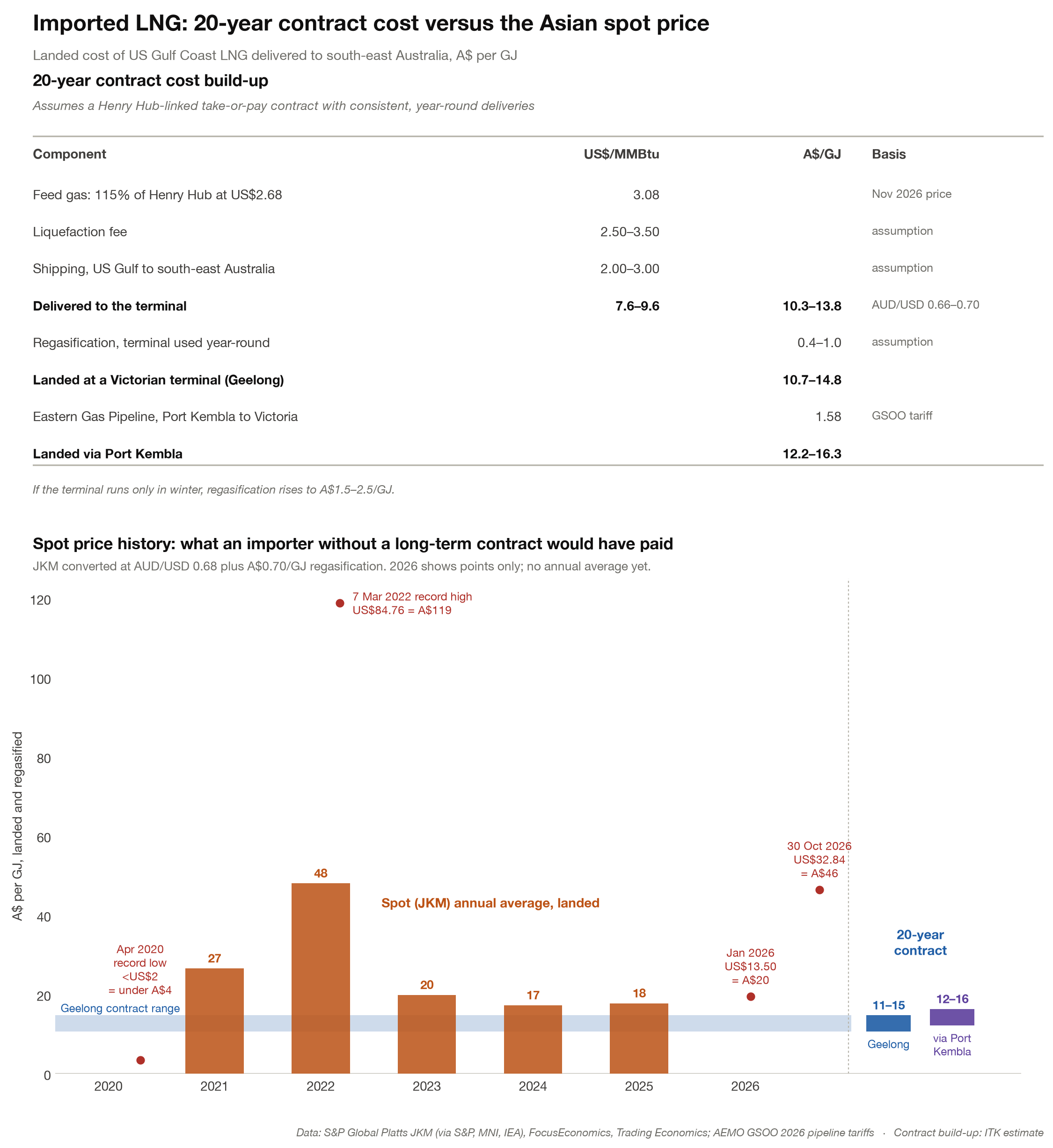
- It’s likely that gas generation investment requires an LNG import terminal. The only one anywhere near available is Squadron’s at Port Kembla in NSW and from there there would therefore be a transport fee to Victoria. In addition to avoid spot pricing volatility the LNG import price would likely require a 15-20 year take-or-pay agreed price (Henry Hub + for instance). Or you could import gas from the Northern Territory e.g., the Beetaloo Basin and lots of pipelines.
- Combined cycle gas is, in my opinion, becoming less popular even for gas centric generation systems. The reasons are relatively poor part-load efficiency and in a renewables world the need for fast start-ups. For those reasons and despite other disadvantages (higher consumption, more emissions) reciprocating engine gas generators are starting to be used more.
If we assume LNG import sets the gas cost (import parity):
And if we feed this into open- and combined-cycle gas generation LCOE (next time I will include reciprocating engines):
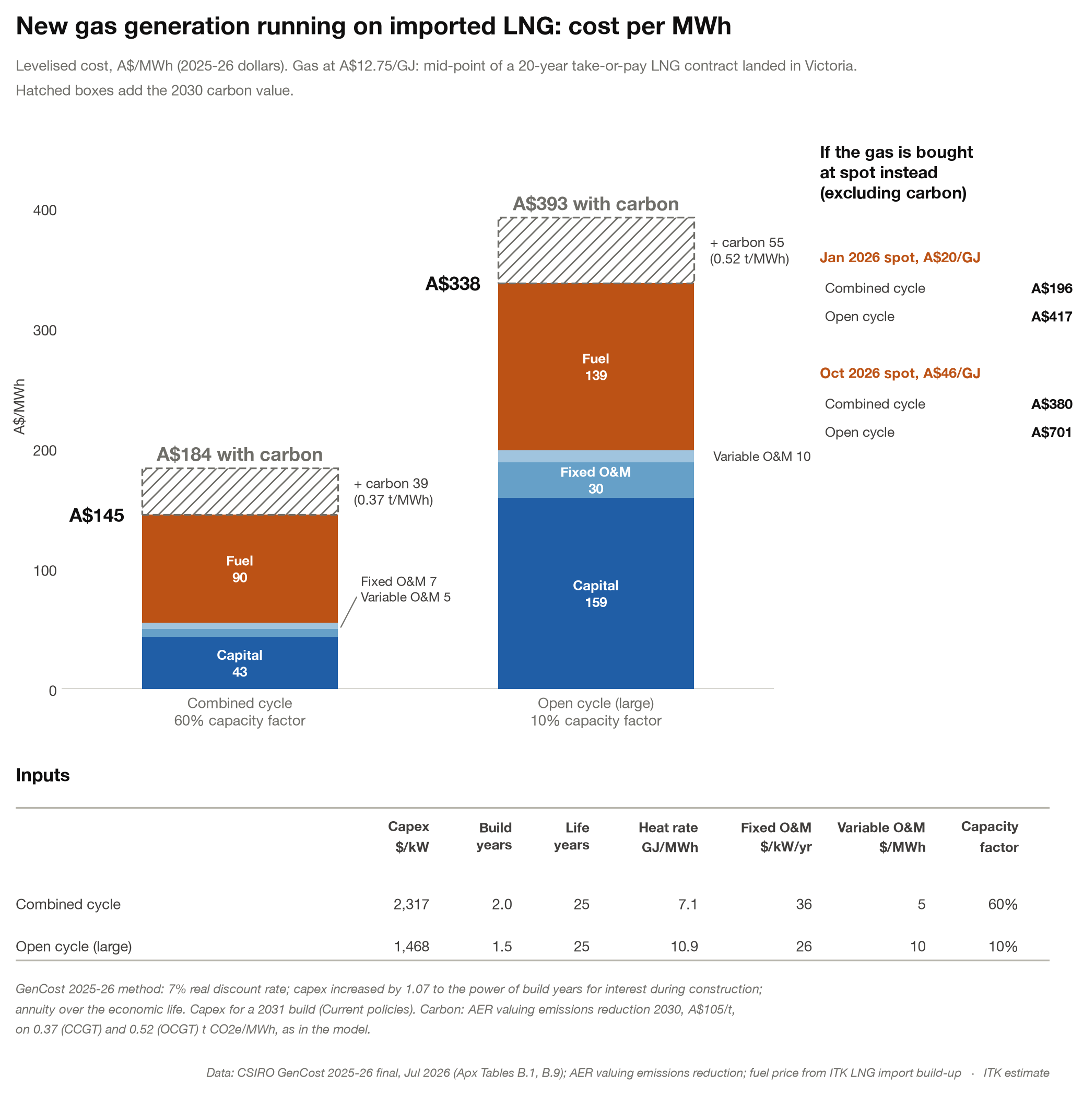
At import parity a new CCGT costs about $145/MWh, or $184/MWh with carbon. That is above the modelled 2040 Victorian prices of $139–157/MWh, so new gas may need support.
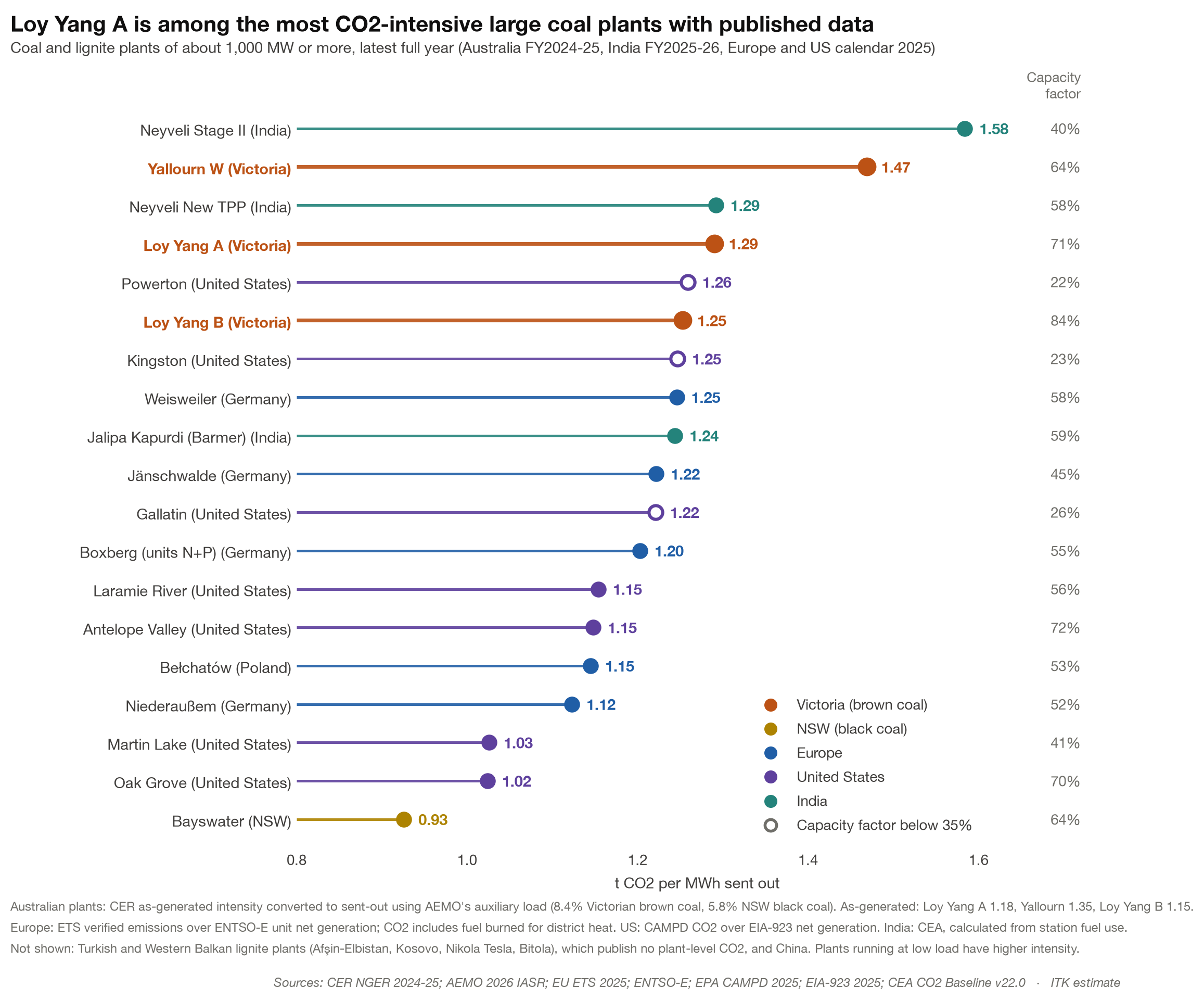
Some of the worst emitting high capacity power stations in the world
Victoria could always opt to keep brown coal running longer. Victoria’s brown coal plants are amongst the world’s worst higher-capacity-factor plants for carbon emissions, but the Liberal Party and One Nation have made it clear that they give not a rat’s about “the future generations” or global warming. I guess it’s like a young smoker, “bugger the health I need a smoke, let me buy some illegal discounted ciggys because I need them. Its not my fault I smoke, I’m only human and I started at school”.
As much as government, the attitude of shareholders and management will drive the actual closure dates of LYA and LYB. The existing LYA date is 2035. I have never been clear on what difference to LYB’s operating costs will be made by the closure of LYA (if it closes in 2035, that is; the road to hell being paved as it is, with good intentions). LYB and LYA share coal mining and LYB pays LYA a tolling fee for the coal it consumes. Once LYA closes LYB will have to cover the entire coal mining cost and one might expect at the least a complex discussion on the remediation liability. My modelling has always assumed LYB closes with LYA but that may not be the case.
Limitations (they are important)
ITK’s price modelling has only a crude representation of network and transmission constraints. New renewable capacity is allocated to AEMO’s REZs with upper limits based on AEMO’s indications of supported capacity. So we don’t allocate all the capacity to the NSW South West REZ that, in my view, a larger VNI West or Project EnergyConnect could support; we allocate only what AEMO says.
Existing interconnectors are modelled at AEMO’s ISP transfer limits. Changes in potential flows from say Project EnergyConnect are not modelled either in theory or in practice.
Gas supply is not constrained in the model. The case without VNI West would need 1,900–2,500 TJ/day of gas on a peak day, which the southern gas system can’t deliver today. The Western Renewables Link is assumed built, and it is now paused.
On top of that there is no rigorous externally validated testing of our half hourly dispatch model, “Vertex”. I think the outputs are reasonable and supportable but then I would; it’s ITK’s model. Unlike some other price forecasting tools we specifically model half hourly scarcity using AEMO weather data, half hour by half hour, and present modelled battery returns as opposed to other more notional approaches. But still our bid band assumptions, our assumptions about LRMC and demand, the trajectories are all areas with large uncertainties.