Potentially this scheme is the answer to decarbonising Australia
This review has made me a fan of the Nelson scheme. I think it will procure a steady stream of new investment that over time lowers consumer electricity costs, and it provides a way to build the capacity needed to decarbonise electricity, transport and more. It can’t come soon enough. On the negative side, and this is just my opinion, I think we need more industry focus on what potentially is a really big change. The headline problem of the “tenor gap” is something of a red herring, at least it was for me, or as I used to say a “left handed brick”.
How a perceived tenor risk became general purpose renewable financing
In my mind my biggest analysis error this year by far has been missing the point of the Nelson Review. To be frank I didn’t and don’t particularly like some of the fancy bells and whistles like the first three year window, the fact that only projects not to have reached FID are eligible and so on. Even fleet average settlement, and its basis risk, is arguably an unnecessary bell.
As such I didn’t pay enough attention. But then when reviewing what mistakes I had made this year, and my career is so littered with them that I knew I would have done something not up to par, I looked at the Nelson Review progress and had to have a BEX and a good lie down. Then I went for a celebratory game of tennis.
It turns out that the scheme is essentially, in my view, a way for States to procure electricity and have any net costs funded by consumers. Retailers are relegated to a secondary role: they essentially become customers themselves, buying semi-synthetic short-dated contracts from a government-appointed entity and on-selling to business and households. The tenor gap is kind of beside the point. It really does represent a fundamental redesign of the NEM.
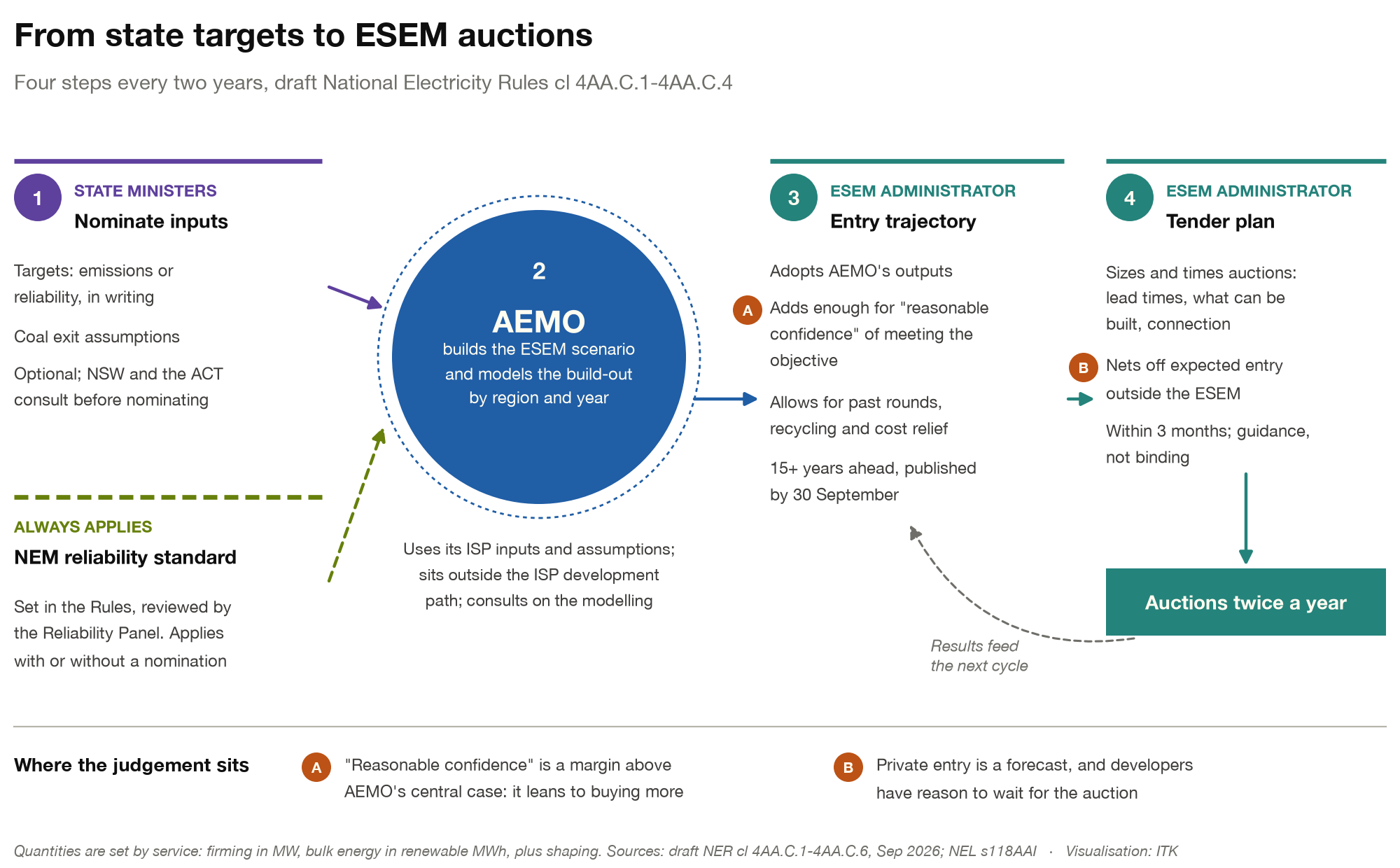
Perhaps the most important point, and the one I had previously completely overlooked, is the Minister-nominated target. At a stroke most of the decision on the quantity of capacity built moves from the gentailers to State Governments. That task is divided into two. First State energy ministers can nominate a target and coal exit assumptions, revised every two years (if they don’t, the NEM reliability standard applies), and then appointed bodies, the ESEM Administrator and the Financial Management Entity, using AEMO modelling, translate those targets into power procurement auctions.
It also goes a long way towards turning a hard-to-invest-in asset class, variable wind and solar commodity power exposed to market prices with little value add, into infrastructure where you receive a low risk cash flow suitable for a superannuation infrastructure fund and which can have all the fancy juicing up of equity returns that debt provides.
Victoria has to decide whether to join the scheme, and once in there is no way out short of changing the law. If it stays out, I suspect the Federal Government will be less inclined to help with offshore wind. Victoria’s budget is in disrepair and Yallourn is going to close. AGL plans to close Loy Yang A (LYA) by 2035; AGL remains Australia’s biggest carbon polluter. In this post truth world do such facts even matter? If LYA closes, coal supply to Loy Yang B (LYB) is likely to become more expensive per tonne and the argument about who wears the cleanup cost may be important. So for all those reasons Victoria might choose to join the scheme and use its Ministerial power to simply modify quantities it needs. However if it joins, the ESEM must at least buy enough to meet the NEM reliability standard.
How ESEMs deal with the two principal problems I saw with the transition
The ISP issue, as I said in a discussion a couple of years ago with Nicola Falcon from AEMO, was that the ISP was just a plan. And as a plan everyone could criticise it but nothing much necessarily happened except it could be used to justify some transmission. ESEMs provide a mechanism for AEMO’s modelling to drive what gets built, and when, once State governments provide targets.
The second problem was that gentailers aren’t writing PPAs for variable renewable energy (wind and solar). Without PPAs, or the likelihood of them, projects can’t get financed. ESEMs deal with that.
The process overcomes not the tenor gap, which in my opinion is an academic artefact, but the broader difficulty of writing PPAs at LCOE when LCOE is above spot. But in my very strong opinion this does not mean wind and solar capture prices will in the long run be below LCOE. In all the post-coal LRMC modelling I have done on supply, wind and solar recover their full costs from the market. That is the definition of the market LRMC. If ITK’s dispatch model, which mimics AEMO’s dispatch engine, shows wind and solar earning a return then that is evidence (in our 2045 run wind earns $98/MWh against an LCOE of $98, solar $37 against $36). Even if ITK’s model is flawed and it’s not that bad, AEMO’s own dispatch engine if run to produce a post coal optimised fleet would be expected to see wind and solar recovering their costs from the market. So the fact that right now historic and even near term projected capture prices are below the LCOEs that new wind and solar farms need is not an argument that there will be a permanent consumer subsidy; it is rather a temporary transition cost that causes a market failure. And that is the true ESEM rationale.
Handing the targets to State governments has its positives and negatives, but overall the fact that targets are set individually by a group of States makes it, in my opinion, more likely that in aggregate common sense will apply. Studies of human information processing show that groups generally make better judgements than most individuals. Democracy has stood the test of time.
Since it seems to me completely obvious that we need to replace our coal generators, which are on their last legs, with something more modern, that is wind, solar and batteries, I am confident that giving each State its own powers will, even if not in a straight line, end in a good result. So that’s another big tick. It also respects the fact that electricity has traditionally been a State responsibility even if carbon targets are a national one.
In the rest of this note I set out my understanding of what is proposed and where it’s up to, letting my figures do most of the talking. It’s still very early days.
The mechanism
Let’s start with an overview.
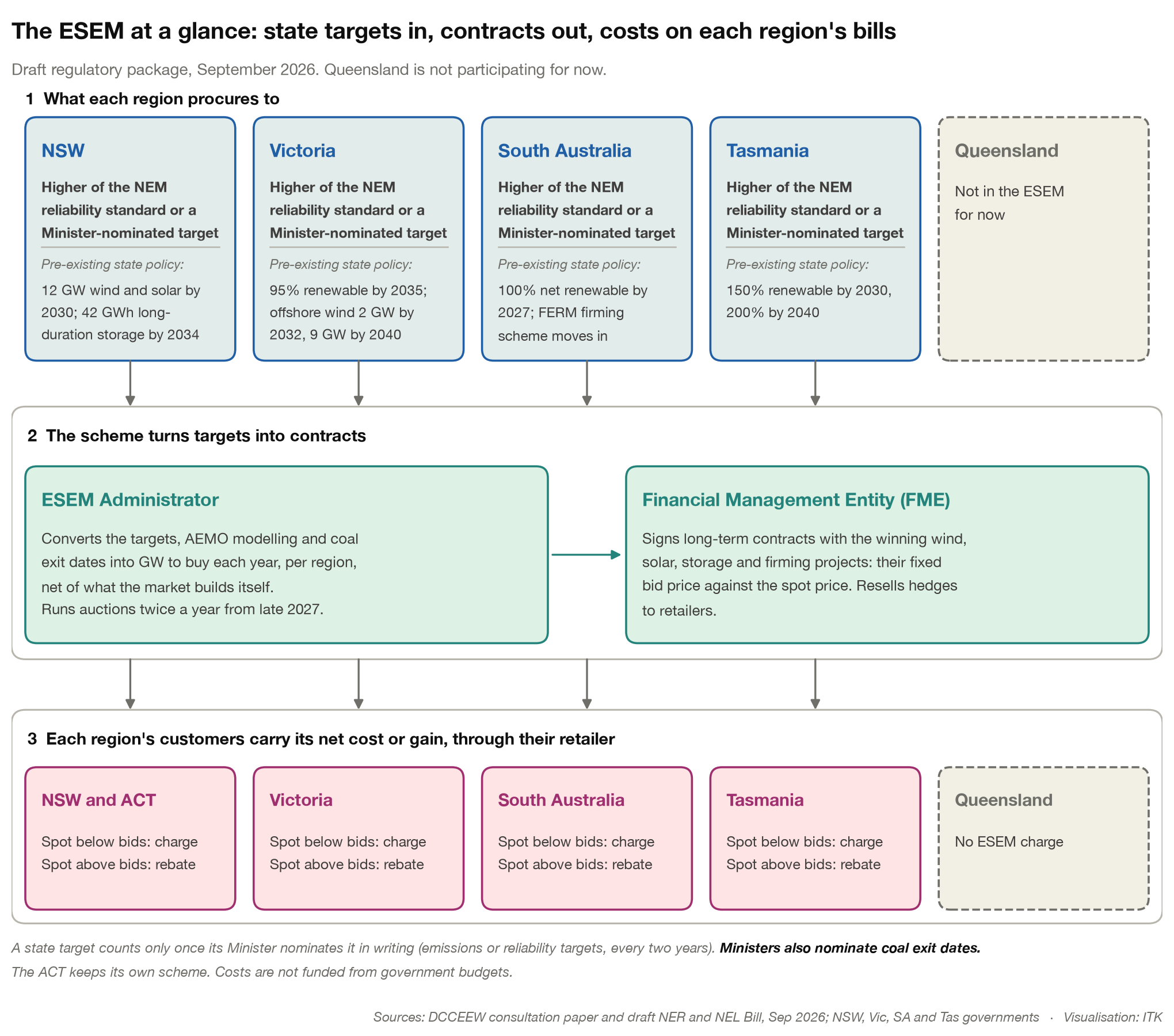
Developers bid a price into the auctions and build their project. They then earn from the spot market, and after at least three years the FME pays or receives the difference between their bid price and the fleet index.
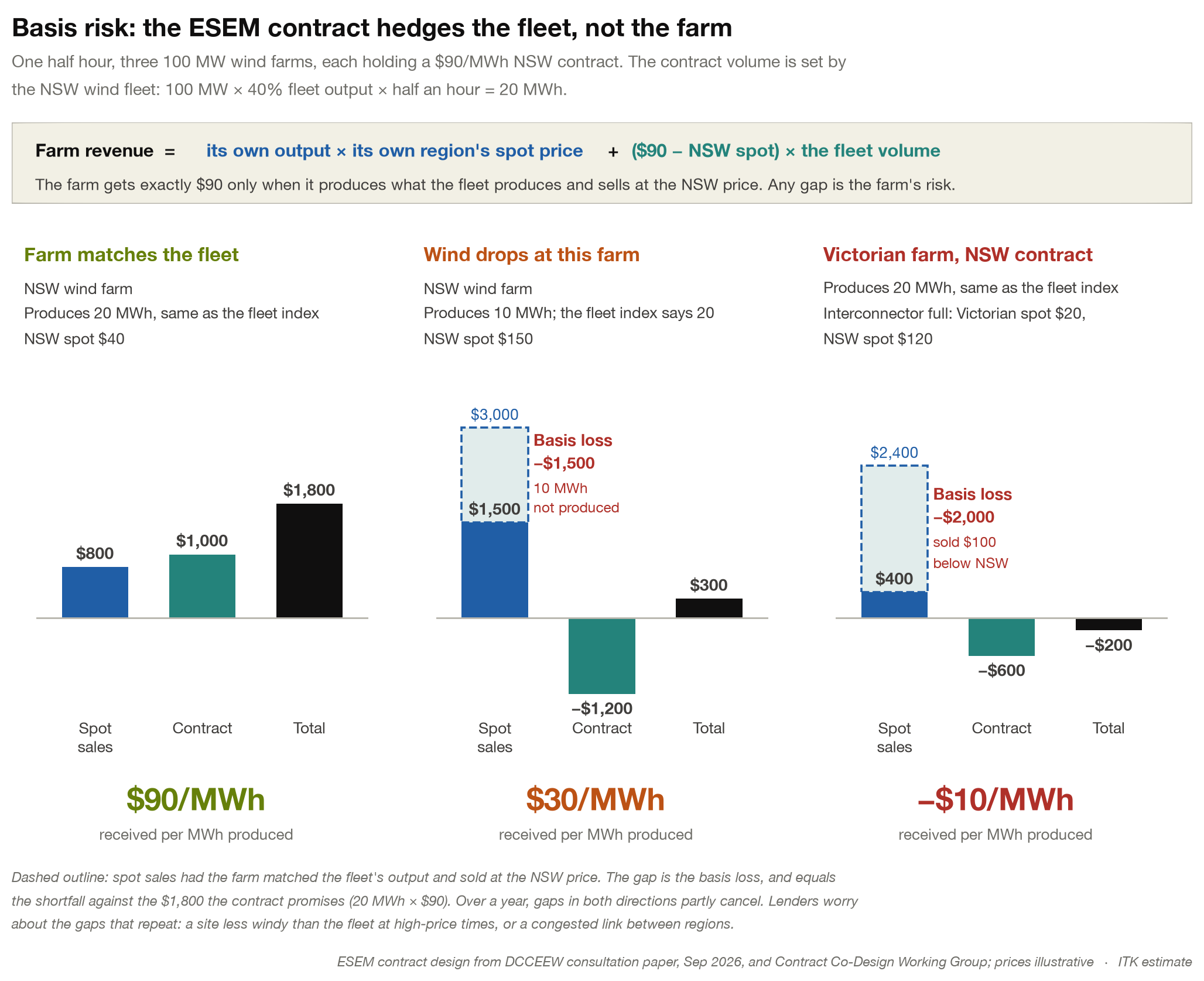
- Payments are settled against a regional reference fleet index, not the project’s own spot revenue. The developer keeps the basis risk, that is, the risk that their project does better or worse than the State average.
- Settlement is weekly, not on an annual average (a co-design preference).
- There’s a preferred $600 cap and $0 floor, and the first three or more years are merchant or under the developer’s own PPA.
- Firming contracts work differently. The FME pays the project a fixed premium, and the project pays the FME any spot price above $600.
- The FME resells the hedges to retailers, and consumers carry only the loss, or gain, between the bid price and the resale price.
- The AER determines the net cost or benefit, which AEMO recovers from, or pays to, Market Customers through settlement.
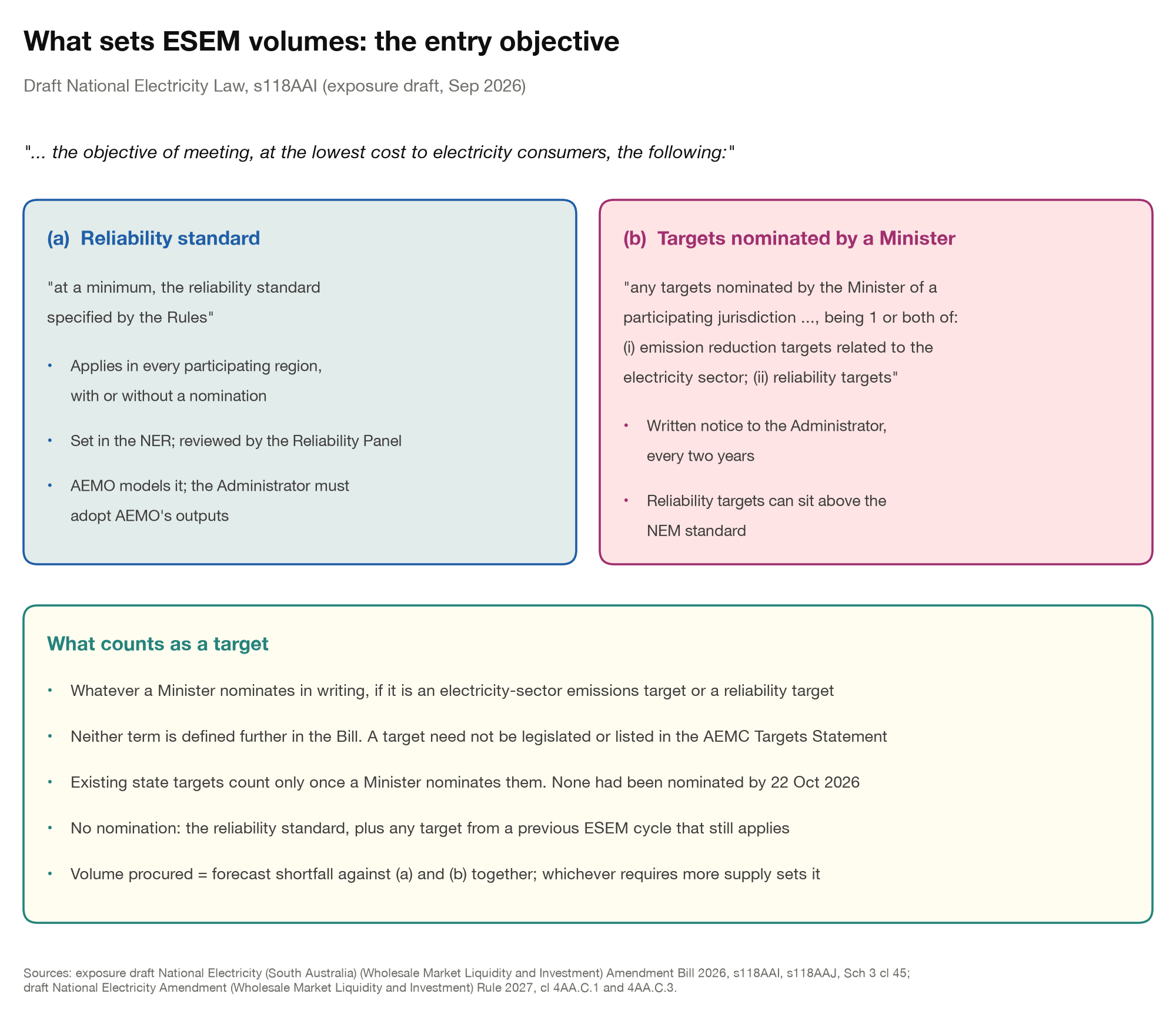
It’s interesting to see how fast this has moved in just over 12 months from the Nelson Draft Report.
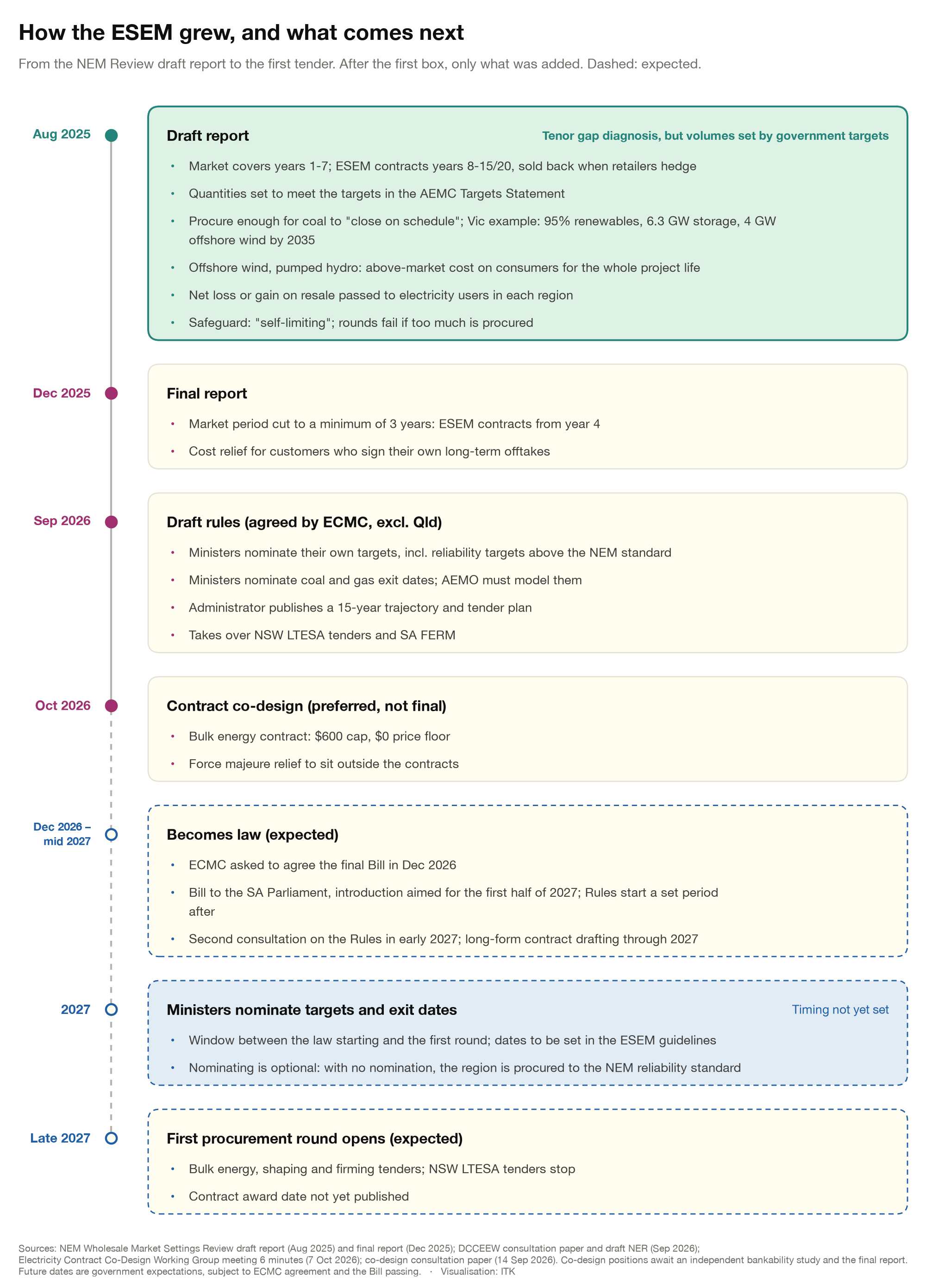
As I mentioned, the key thing is the objective, alongside the reliability standard. States have had objectives before, some of them formal. This one is different because specifying it leads more or less directly to new investment, and once it’s specified the process is out of the State’s control for two years.
Whereas the ISP was an abstract plan designed to support transmission…
An AEMO ESEM scenario translates into action.
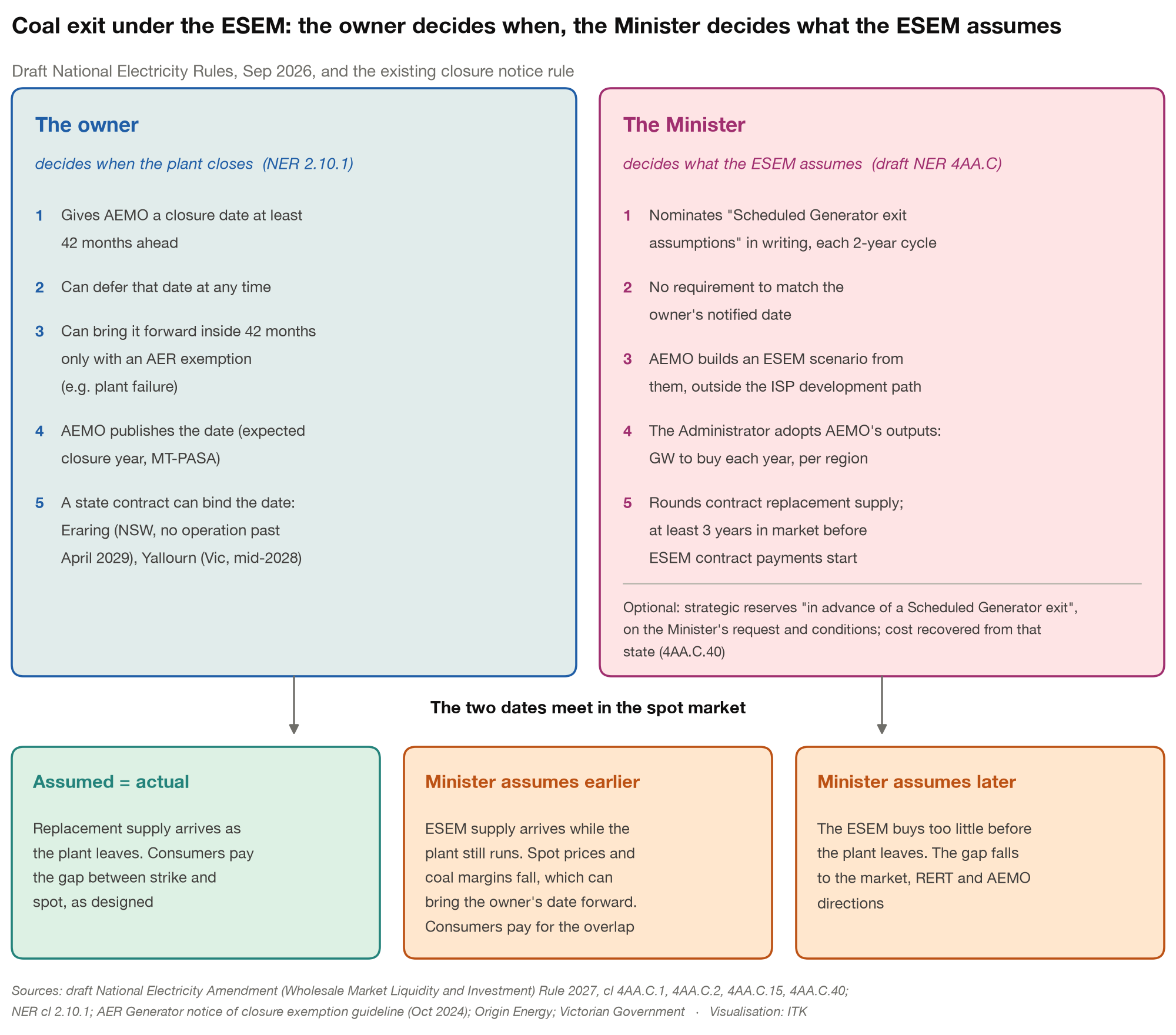
Ministers also nominate coal exit assumptions, and these need not match the date the owner has notified although I have not really researched this as well as I might and in practice there is bound to be agreement and driven by the generator. In my view coal generator fixed costs will see them closing once volumes and evening prices fall away.
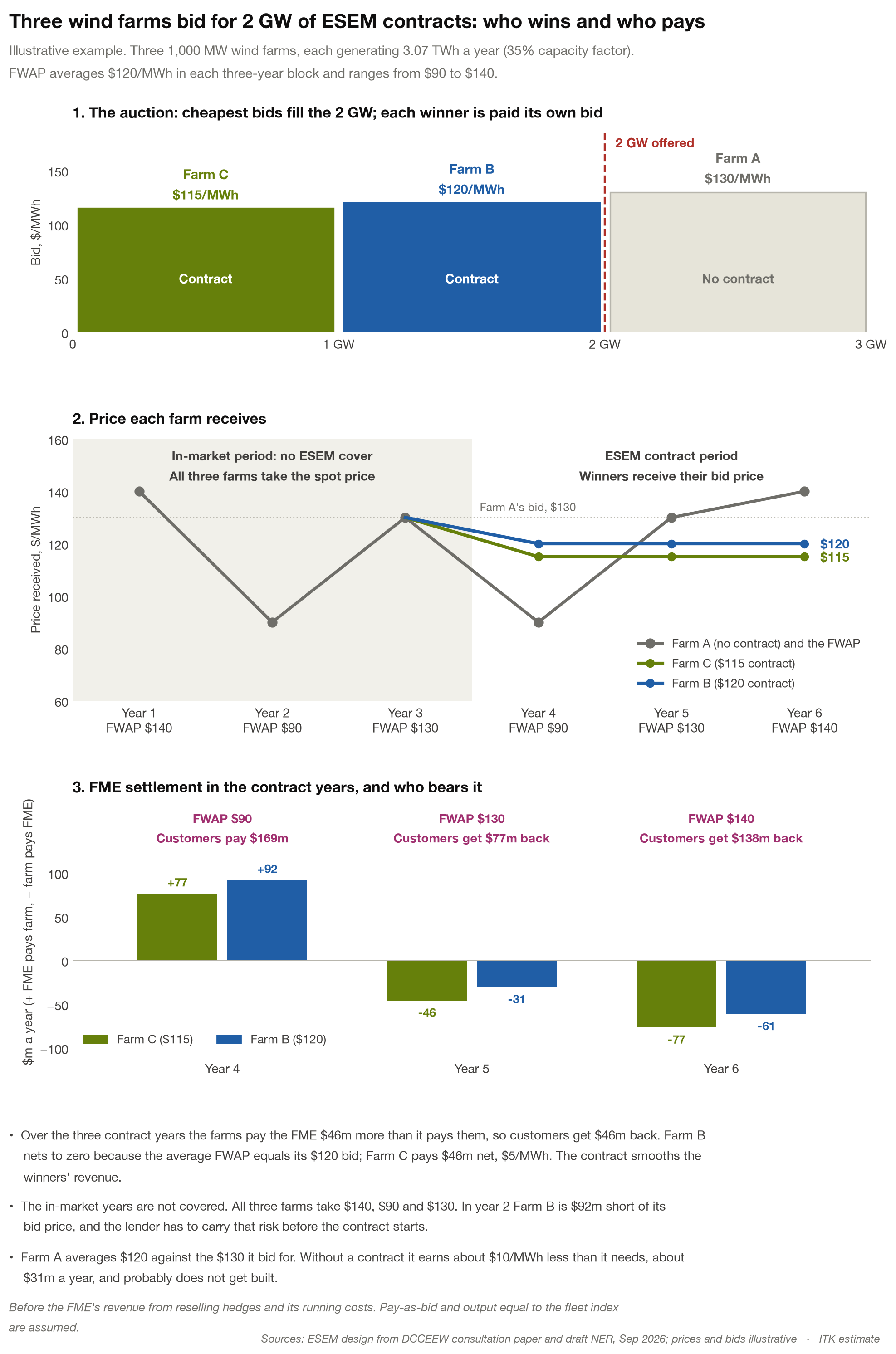
This repeats an example from an earlier note. In fact this is not really whole story because as disussed below we also have to to consider the contract bank and how that impacts generators and consumers.
And basis risk: the contract pays on the regional fleet index, not on the farm’s own output. I could care less about this fancy feature but its there.
The Warehouse
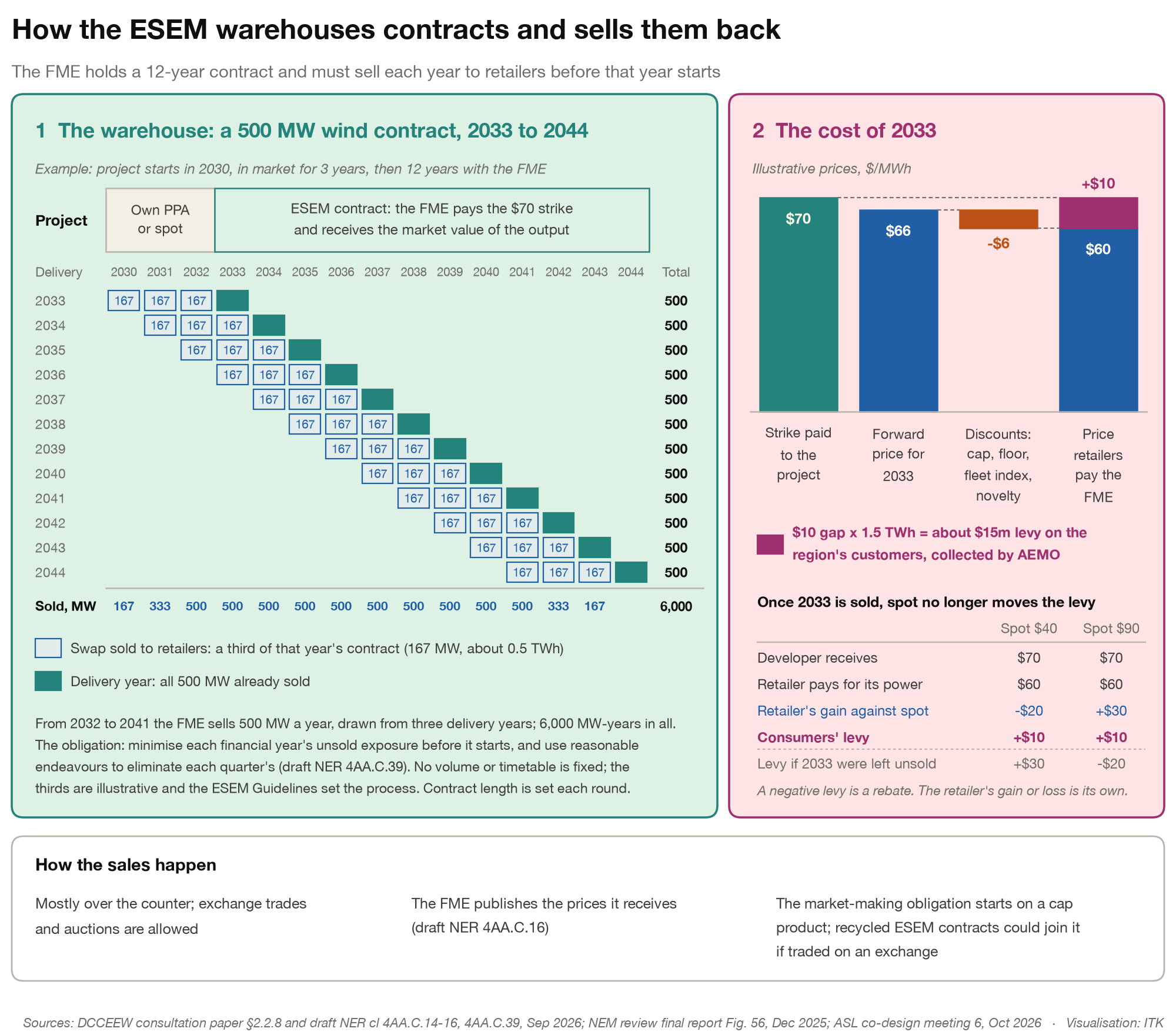
Let’s look at the warehouse. Is this another wool mountain? The draft legislation tries hard to prevent this by requiring the FME to sell each year of each contract before that year starts.
The underlying concept appears to be that gentailers would prefer to hold say four year contracts to match their customer risk. I don’t completely agree with this as the household base in total is statistically a perpetual customer but never mind.
Say the FME has awarded a 500 MW ESEM contract that runs for 12 years after the project’s three years in market, that is years 4 to 15 of the contract. So the FME trader sells some of each settlement year every forward year. In other words of the 500 MW settlement in year 4 it sells 167 MW in each of years one, two and three. In year two it also sells 167 MW of the year 5 settlement. So by the time each year settles it has locked in the gap between the bid price and the resale price and laid off the spot risk to a retailer.
The retailer buys the contract because it needs a hedge, and pays the market forward price for it. The cost of capital advantage goes to the developer through the long ESEM contract, with consumers carrying the risk. Gentailers’ incentives are more complicated. They will weigh their own firming and self-hedges, market behaviour, and the fact that retailers as a group pay or receive the FME’s net costs. No doubt you could write a book on it. Boom boom and I’ll get my hat.
ITK modelled the FME’s wind and solar book using the build needed for a coal-free NEM in 2045, excluding Queensland, then replacing retiring plant in a steady state, and assuming all of it is ESEM contracted (an upper bound). In other words we use the capacities modelled in our 2045 coal free LRMC and the trajectory to get there. The trajectory starts from today and is limited by assumed maximum build rates each year. It is one of many possible paths, but it is useful as an illustration.
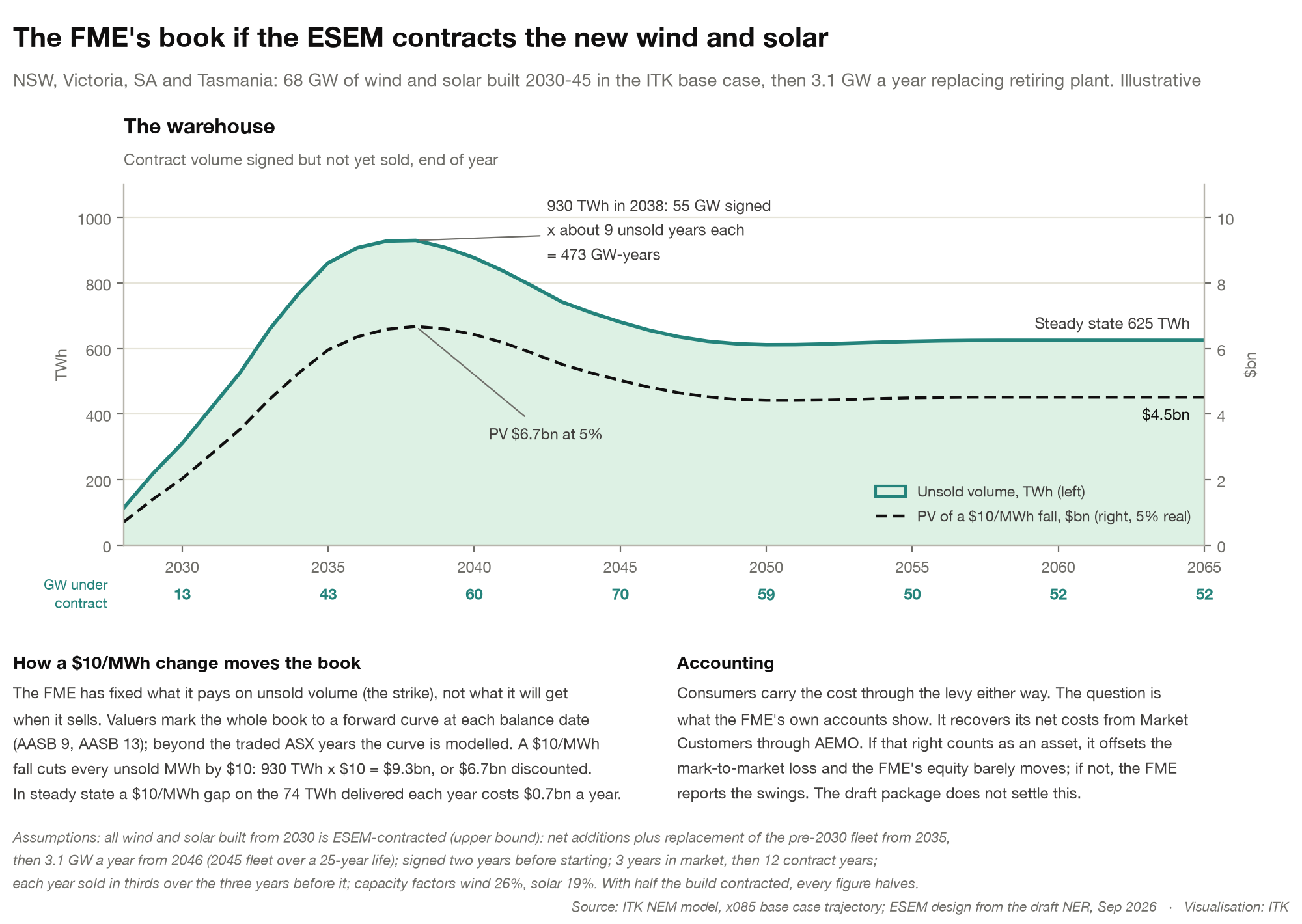
The scheme largely avoids the wool mountain problem, because:
- price comes from competitive auctions
- the quantity is capped
- the FME is required to sell before the year starts
- there is no physical stock.
On the other hand GenCost assumes capital costs keep falling as the industry learns, so later projects will undercut earlier ones locked into higher strikes. Consumers will carry that cost, but it’s kind of unavoidable at the system level during the transition. And it’s only by doing the building that we get the learning and bring future costs down.
Discussion: consumer bills, and will it work?
Consumers pay in two places: the wholesale cost built into their retail tariff, and the ESEM levy. ESEM supply arriving ahead of coal exits should lower spot and contract prices while the levy rises.
The positives are listed in this image: 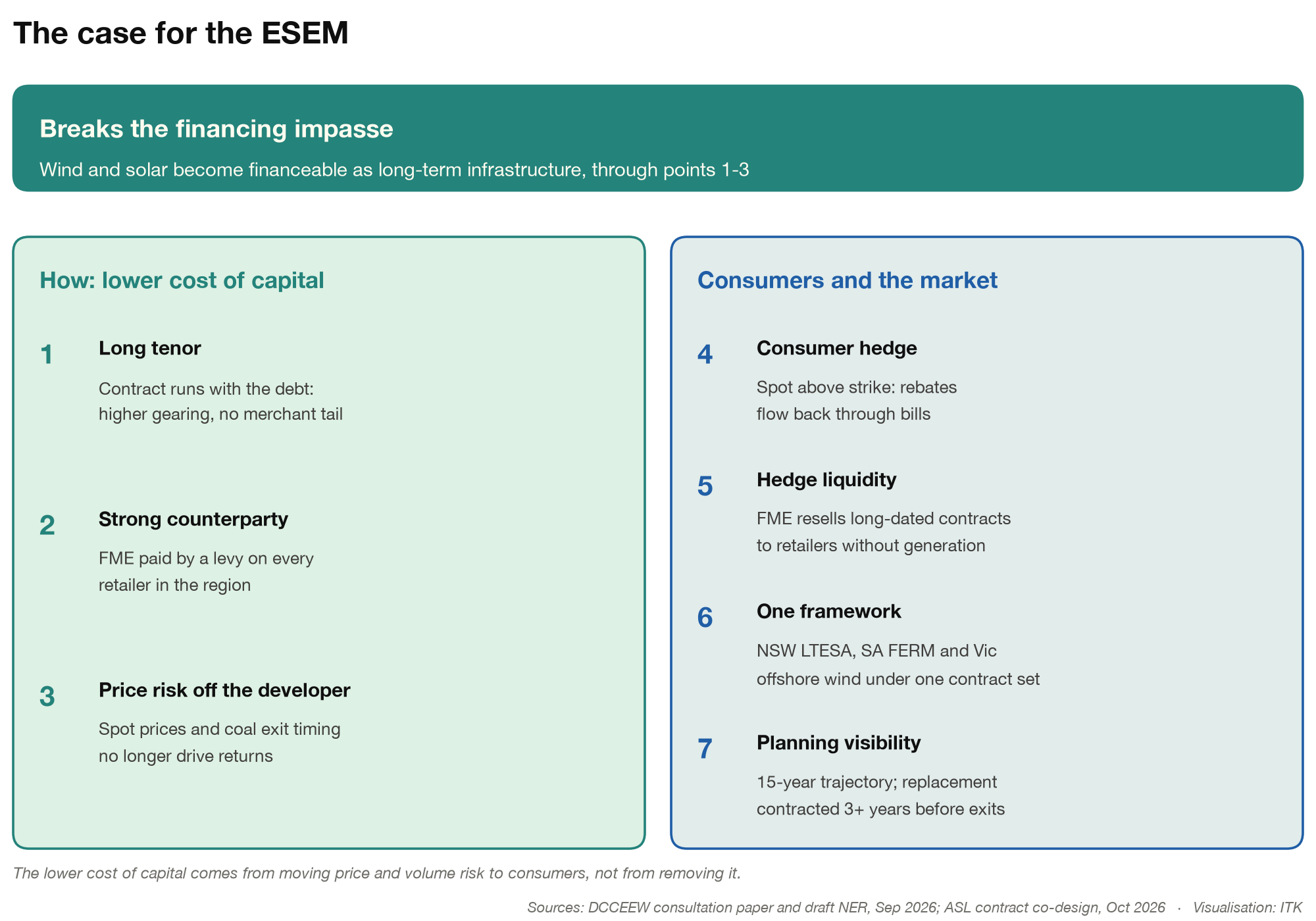
On the other hand the striving for “perfection at the expense of the good” will erode some of the cost of capital advantages.
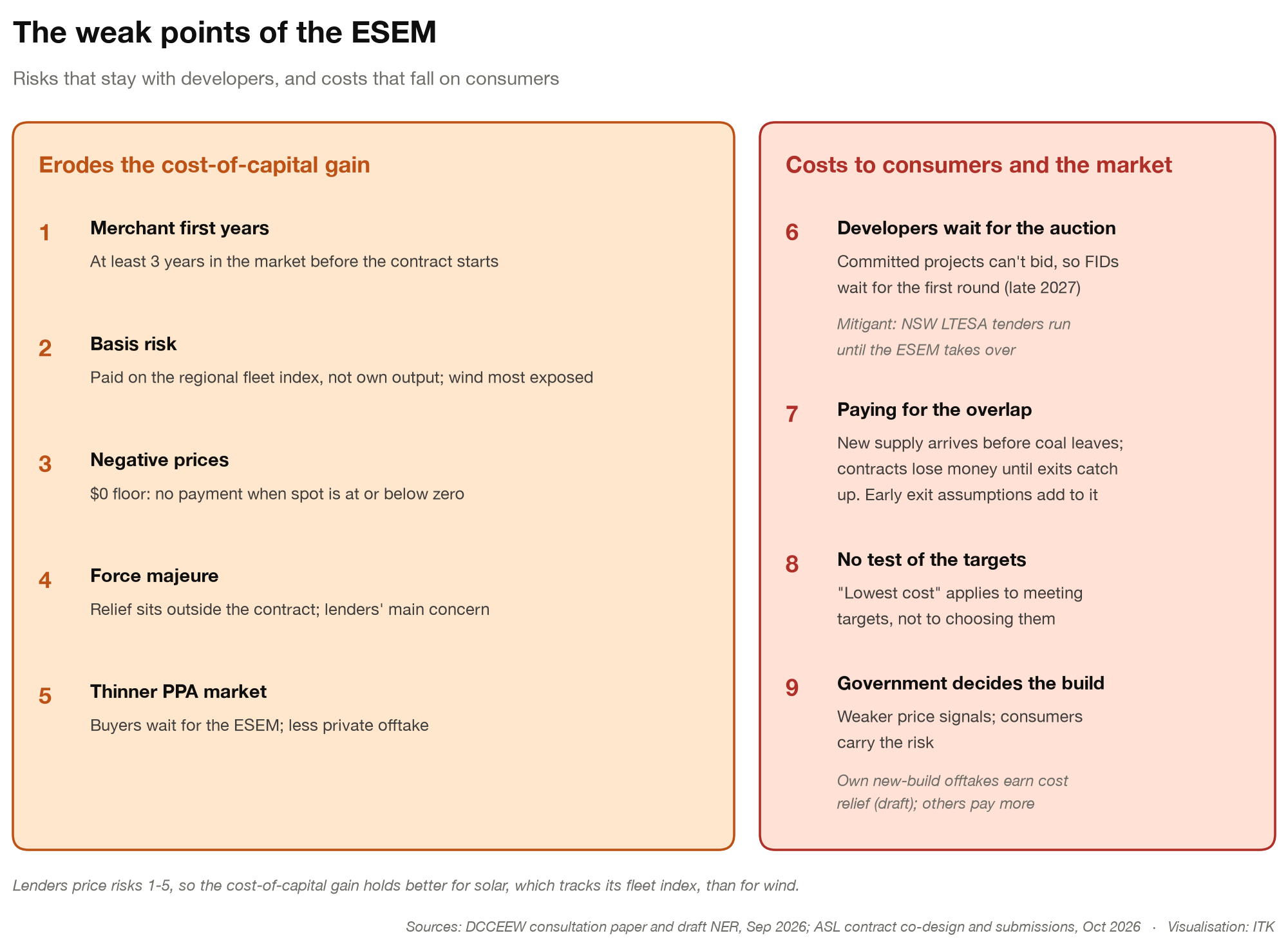
Above all else the scheme is a way to get new capacity built. Projects with 12 years of contracted revenue after their first three years, and by their nature low and predictable costs, are eminently financeable.
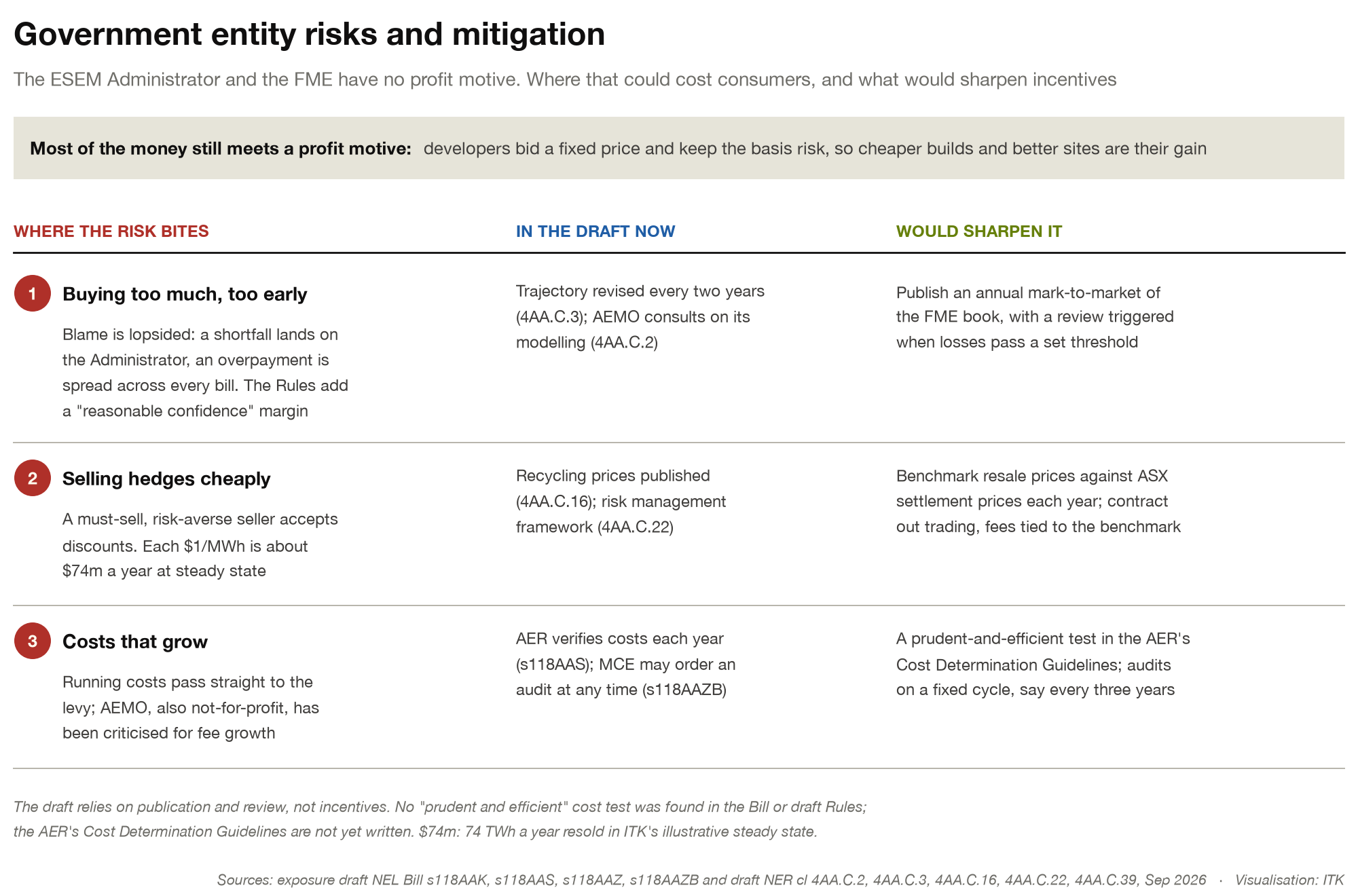
There is also the Government v private sector issue. It’s long been held, and I agree, that risk sits best with those best placed to judge it. Equally the profit incentive for the private sector works. But I think the evidence of a market failure in new investment is reasonably clear at the moment.
Beyond the “T-shirt ideology” there is the execution risk. Personally I would argue that one issue with the CIS is that it over-emphasised protecting the taxpayer purse compared to getting capacity built. I don’t have evidence for that except that not much capacity has been built.
But I do think there are ways that Government appointed entities, quite likely AEMO related, can be pushed towards efficiency.