LTESA - Last chance saloon for NSW wind
On the face of it NSW wind development looks like an epic disaster of NSW public policy. The hosts are ready for the party, the bar is open, the music is playing, the invites have gone out but no-one has shown up. Transmission is everywhere. Communities have battened down the hatches, been softened up and prepared for the worst and then a classic case of “hurry up and do nothing”.
Rye Park reached financial close in September 2021 and Iberdrola committed to 145 MW Flyers Creek in February 2022. Since then only 414 MW Uungula has wandered over the start line, in January 2024, with a Tender 3 LTESA (Long-Term Energy Service Agreement) in its pocket but no announced final investment decision (FID). Otherwise it’s been all talk and no action.
Meanwhile EnergyCo has quietly been restructured: senior executive roles were cut from February on government direction, roadmap architect Chloe Hicks left in May, and chair Paul Binsted resigned in July.
But never fear there is always another party trick up the sleeve, and in this case it’s LTESA and, to a lesser extent, Snowy.
But first the news. Except there isn’t much.
NSW wind news updates
What moved
| Project | Date | Event |
|---|---|---|
| Bullawah (BayWa) | 29 Jul – 8 Sep | The Department of Planning (DPHI) referred it to the Independent Planning Commission (IPC). Panel appointed 30 Jul, public hearing in Deniliquin 1 Sep, submissions closed 8 Sep. It now awaits the panel’s decision; the federal environmental (EPBC) assessment is still under way. |
| Liverpool Range (Tilt) | 9 Sep | DPHI approved Modification 3: fewer turbines, a smaller footprint, and the external transmission line removed. Still no FID or turbine and construction contracts. |
| Uungula (Squadron) | 11–30 Aug | First blade arrived 11 Aug; first complete turbine erected 30 Aug. Reported as more than two-thirds complete. |
| Coppabella (Goldwind) | ~2 Sep | AEMO and Transgrid accepted updated grid-connection performance standards for the wind farm plus batteries at 53 turbine sites (222.6 MW / 1,063 MWh), as reported by esdnews. Goldwind has yet to commit to building the wind farm. |
| Valley of the Winds (ACEN) | Jul – Sep | Neighbouring landholder Marshall Baillieu’s merits appeal against the consent is awaiting judgment, with the hearing listed to finish on 13 August. The ACEN share price is weak (₱2.70 on 28 Sep, down 11% since late July) and ACEN has agreed to sell up to 49% of three Indian projects, with an initial 10% of one closed. A ₱30bn rights issue planned for September 2025 was postponed and is still pending. So my assessment is that financing is difficult especially without a PPA. |
Source: NSW Planning Portal, IPC, Tilt Renewables, esdnews, PSE Edge
Replacing Eraring’s 15 TWh needs $15-$20 bn of capex
I think it’s broadly accepted now that the main problem for NSW is finance. Eraring produces about 15 TWh per year. At 32% capacity factor one GW of wind produces about 2.8 TWh of energy, so 15 TWh is at least 5 GW of wind. Most commentators take the GenCost wind capex numbers with a pinch of salt. It’s around $3 m/MW and so for 5 GW we are at $15 bn. Not all the Eraring replacement comes from new wind but we need to do a lot more than just replace Eraring. Electric trucks, electric cars, data centres. If we want to electrify NSW we need a lot of energy. And as I said the transmission for it is well under way.
So $15 bn of capex is broadly $5 bn of equity. I already wrote extensively that the way to raise this capital is to make the wind energy look like infrastructure. You could do that with full Government ownership which would be an utterly hopeless solution or by having the Government guarantee the revenue via long term PPAs, or by having Gentailers offer the PPAs. Gentailers though have had more than 5 years to come to the party and they have made it abundantly clear in words and deeds that they aren’t going to be there. Gentailers are in fact the market failure. Never mind. We are left with Government.
It’s also been my strong belief that we need an organisation that actually wants to build, own and operate wind farms. The industry is full of get rich quick hopefuls in the form of developers. But getting costs down requires staged building, teams that move from project to project, large portfolios that lower debt and equity costs, strong relationships and countervailing bargaining power with turbine and particularly transformer suppliers. Ability to develop their own vertically integrated concrete companies including cement imports given the oligopolistic behaviour of the existing suppliers. In short a large ($20 bn) business with recognised expertise.
What we have at the moment is a bunch of well-intentioned people but without enough muscle. Anyhow.
The NSW Roadmap LTESA Tender 8 - 7 TWh
This LTESA is essentially what the sector is betting on:
Size and timetable
| Item | Detail |
|---|---|
| Size | 7,000 GWh a year, about 2.5 GW of wind or more if it’s solar. ASL can award more or less than this. |
| Place in the programme | The first of four 2.5 GW generation tenders planned over two years from Q2 2026, under the 2025 Infrastructure Investment Objectives (IIO) Report. More rounds should follow in 2027. |
| Run alongside | Tender 9, for long-duration storage, as a separate process. |
| Opened | 20 May 2026 |
| Registration closed | 22 June 2026 |
| Bids closed | 6 July 2026, 10am |
| Results | November/December 2026. ASL calls this indicative, and its page hasn’t been updated since 22 June. |
Source: ASL, Tender 8 Guidelines (20 May 2026)
Two contracts are on offer:
- Generation LTESA: a series of options, up to 20 years, to enter one-year swaps at a fixed $/MWh price, with no upfront premium. Swaps were two years in Tender 4.
- Exercise: each year the project can exercise in full, in part, or not at all.
- Repayment: in years it doesn’t exercise, 50% of revenue above a threshold price is paid back to the scheme. Repayments are capped at what the scheme has paid the project in total.
- Pricing: bid prices are nominal with no CPI escalation, and can be “sculpted” to vary over the term.
- Negative prices: the floating price is treated as zero in negative-price intervals.
- Certificates: in years the option is exercised, the scheme takes the LGCs and any capacity-type revenues.
- Hybrid Generation LTESA (new): for generation with co-located storage of at least 4 hours, where generation export capacity is larger than storage export capacity. It settles on net exports and splits price risk by a percentage. Its payment cap applies in both directions. In negative-price intervals the contracted quantity is set to zero for both imports and exports. Wind plus BESS qualifies. Coppabella’s new battery layout would fit, but Coppabella already holds a Tender 1 LTESA and can’t bid unless that contract is discontinued. Only the generation MW counts towards the 2.5 GW.
Other points in the guidelines:
They single out wind, saying wind has faced “comparatively greater development and delivery challenges”. The tender therefore “seeks to support progress across both wind and solar”.
A commercial operation date (COD) before 31 December 2029 is preferred, but only with a credible path to it. That favours consented projects such as Pottinger and Liverpool Range, and counts against Bullawah, Winterbourne and Dinawan, whose consents are still undetermined. Arguably Yanco Delta’s need to have aspects of its planning consents re-evaluated might also cost it on score for this tender even if it didn’t already have a Capacity Investment Scheme (CIS) contract. That may be why there is unconfirmed gossip that its route to market comes through a Snowy PPA. But good luck getting a nice price on that.
A project can’t hold an LTESA and a CIS contract at the same time. A signed CIS agreement (CISA) makes a project ineligible. A project that has won a CIS award but not signed it can bid, provided it commits not to sign if it wins an LTESA. The guidelines don’t say CIS status affects the score. Yanco Delta, Baldon and Bullawah Stage 1 won CIS Tender 7, so they could only take an LTESA by not executing their CIS contracts. However, since the CIS contracts are clearly not that favourable they probably won’t be executed.
This LTESA looks in some ways like a PPA, better on tenor and credit, with a few catches:
Latest LTESA compared to PPA
| Feature | LTESA | Typical corporate/retailer PPA |
|---|---|---|
| Commitment | Annual option: notice 6–12 months before each July, irrevocable; 50% clawback of revenue above the threshold in years not exercised | Firm obligation for the whole term |
| Tenor | Options over up to 20 years | Commonly 10–15 years |
| Counterparty | Scheme Financial Vehicle (SFV), rated Aa3, costs recovered from NSW consumers by statute | Retailer or corporate, typically BBB or unrated |
| Negative prices | Spot is floored at zero in the calculation, so the scheme still pays the full Fixed Price. The project earns Fixed + spot, which stays positive until spot falls below −Fixed. | Negative-price clauses commonly stop the fixed payment and push the generator to curtail |
| Payment cap | Scheme payments are capped each year at Fixed × contracted % × P50 annual generation. This only binds if prices collapse towards zero; Tender 4 used 110% × P10. | No cap |
| Volume covered | “Contracted Percentage” is bid, and the project nominates a share each year | Usually a fixed share of output |
| Minimum output | Shortfall payment if generation falls below 75% of P90 | Output or availability guarantees vary by contract |
| Hedge value to a buyer | None: the scheme doesn’t need the energy | The buyer wants it to hedge retail load |
Source: ASL, Tender 8 Guidelines and pro forma Generation LTESA; ITK
Bid price to cover LCOE?
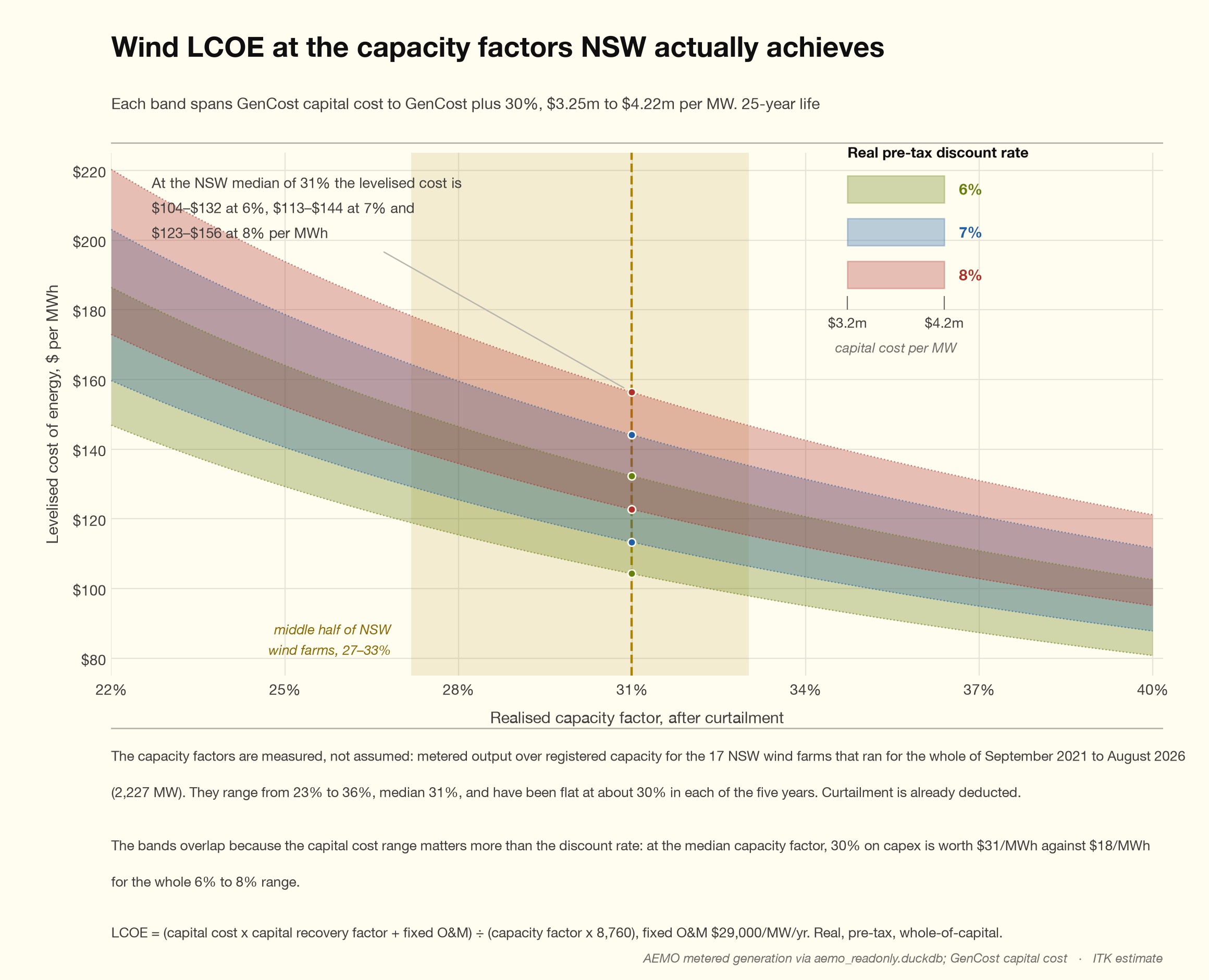
In my opinion, not universally shared, a 20-year LTESA with a highly rated counterparty argues for a relatively low WACC.
That puts the price somewhere around the 6–7% discount-rate points at the NSW median capacity factor in the following exhibit, roughly $110–130/MWh. It’s likely to be higher in Orana and lower in South West REZ, again in my opinion. Orana though has tons of transmission capacity and SW REZ does not. SW REZ could have tons of capacity if a 750 kV VNI West line was built but I’m not opening that can of worms. So Orana and a couple of GW in South West it is, with odds and ends from non REZ projects.
The current quote for FY2030 NSW base load futures is a touch over $100/MWh although I suspect trading is very light.
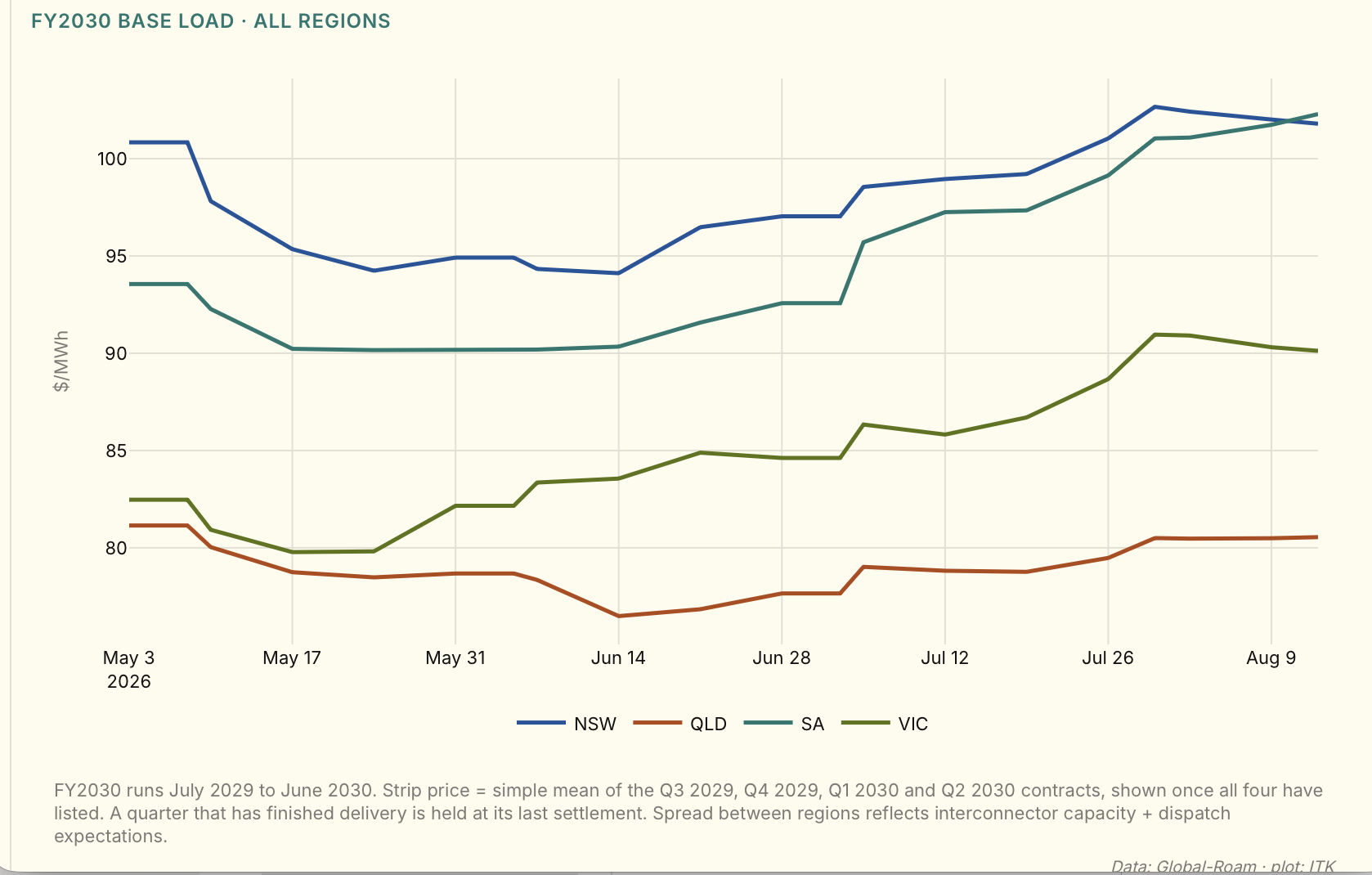
So the gap is perhaps $10–30/MWh, which I think is manageable for NSW electricity consumers even if futures overstate spot expectations.
Suppose the gap between the LTESA price and the spot price wind actually earns (its dispatch-weighted average) is $30/MWh. On 7 TWh that is about $210m a year, or around $3/MWh spread across NSW’s 66 TWh of operational demand, on these assumptions. It is recovered through network bills, presumably as a fixed charge, perhaps $20 per household per year. The net cost would be lower, because the new wind pushes spot prices down.
Eraring’s recent year output is about 14.5 TWh so even if all the LTESA capacity hopefully awarded was available June ’29, which of course it won’t be, it would still only cover half Eraring.
Which is why the NSW Govt will offer more tenders in 2027.
In any event my list of contenders includes:
LTESA Tender 8 contenders
| Project | Existing support | NSW consent / EPBC | Grid | Assessment |
|---|---|---|---|---|
| Pottinger (AGL/Someva, ~831 MW + 400 MW/1,600 MWh BESS) | None found in the DCCEEW lists. One search summary claimed an LTESA; not verified. | ✓ / ✓ | South West REZ access right, 831 MW (Apr 2025) | Consented, AGL looking for a capital partner. |
| Spicers Creek (Squadron, 700 MW) | CIS Tender 1 (Dec 2024) | ✓ / ✓ | Central-West Orana REZ | Possible. Has a signed CISA, which it would need to withdraw from. No news either way. Squadron may not want to fund. |
| Liverpool Range, remaining capacity (Tilt) | Stage 1 (634 MW) has a CIS Tender 4 contract | ✓ / ✓; Modification 3 approved 9 Sep | Central-West Orana access right, 1,332 MW | Must be a strong contender. Foundation of Orana zone |
| Thunderbolt (Neoen, 230 MW) | CIS Tender 1 | Approved | Likely direct 330 kV connection | Could be a strong contender. |
| Hills of Gold (Someva, 372 MW + 100 MW BESS) | None known | ✓ (LEC cleared Mar 2026) / not checked | Needs its own line to the main grid | Possible but second tier. Consented and uncontracted, but the connection and a pre-2030 COD are less proven. Someva is also AGL’s partner in Pottinger. |
| Junction Rivers (Windlab, 585 MW + BESS) | CIS Tender 1 | Not consented | Access for 262.3 MW | Quite unlikely. |
| Valley of the Winds (ACEN, 936 MW) | CIS Tender 1 | Consent under appeal, judgment reserved / ✓ | Central-West Orana | ACEN has had a way of winning tenders and getting projects built. |
| Yanco Delta, Bullawah Stage 1, Baldon | CIS Tender 7 (May 2026) | Yanco ✓ with modifications pending; Bullawah awaiting IPC; Baldon not checked | South West REZ | Possible. Awarded CIS contracts in May and probably not yet signed, so eligible to bid if the CIS terms don’t work. |
| Dinawan wind | Stage 1 CIS Tender 4 | Not determined | South West REZ | Unlikely: no consent. |
Source: DCCEEW, ASL, NSW Planning Portal, company releases; ITK assessment