Australia can win more from eliminating diesel than enabling AI
I am a great supporter of building data centres in Australia fuelled by renewable energy and located in the regions. I wrote about building one next to the Dinawan substation as far back as July 9, 2025. As regular readers would know, I also had a careful look at orbital data centres and I’ve written notes about the buildout around Eastern Creek in Sydney.
But but but the more important imperative for Australia is to get rid of diesel. Replacing diesel is an absolute no brainer, or so it seems to me and yet Australia has ZERO POLICY. Replacing diesel for road transport is a no brainer because it lowers transport costs by over 10%. Thats good for consumers, and for voters, it helps to drive inflation out of the economy.
Its probably unrealistic to expect Government policy to keep up with the real world. What Govt could be expected to take long term policy seriously when all people talk about is the price of diesel this week? Lets talk about non existent data centres while motorists fill up with expensive petrol and pay through the nose at the friendly super market.
Replacing diesel with electricity would:
- Eliminate about $35 bn of diesel imports (year to June 2026), which could be expected to lift the value of the $. This includes replacement of diesel in mining (easy) and agriculture (hard).
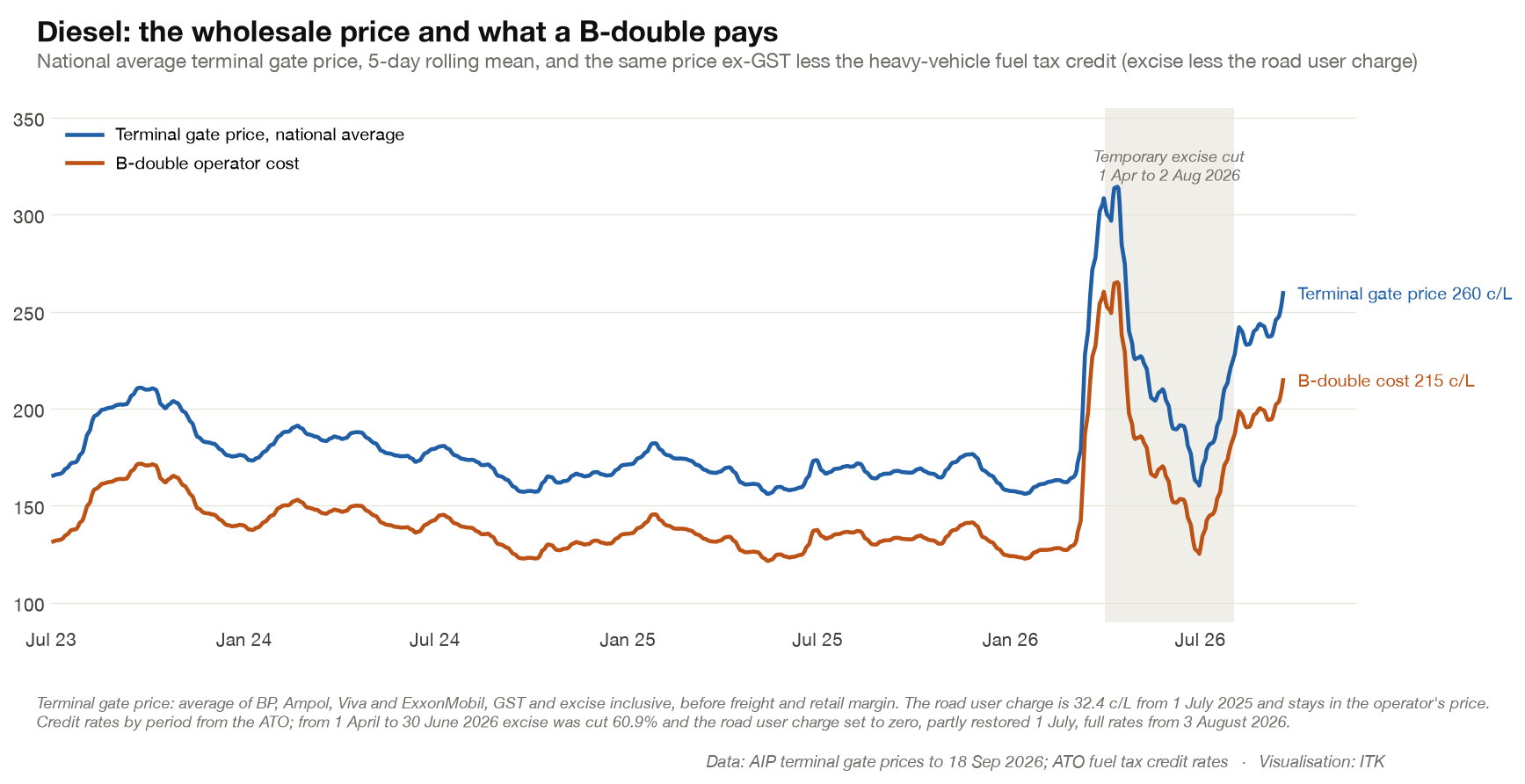
- Cut road transport’s fuel bill by $26 bn a year at this year’s prices, or $16 bn at pre-Hormuz prices. After netting off lost fuel excise and road user charges, the saving is about $9 bn a year on $75 bn of road freight revenue, which LOWERS THE COST OF MOVING GOODS by over 10%.
- Avoid $6 bn a year of health costs
- Improve the productivity of mining
- Improve national security
Freight transport is the priority
Mining is vital to Australia.but as important as mining is, today, transport must be the national electrification priority because it affects every Australian. Lets start with the oil products import bill. That’s the size of the prize. There are few bigger. Oil is from memory about 12% of all traded goods imports.

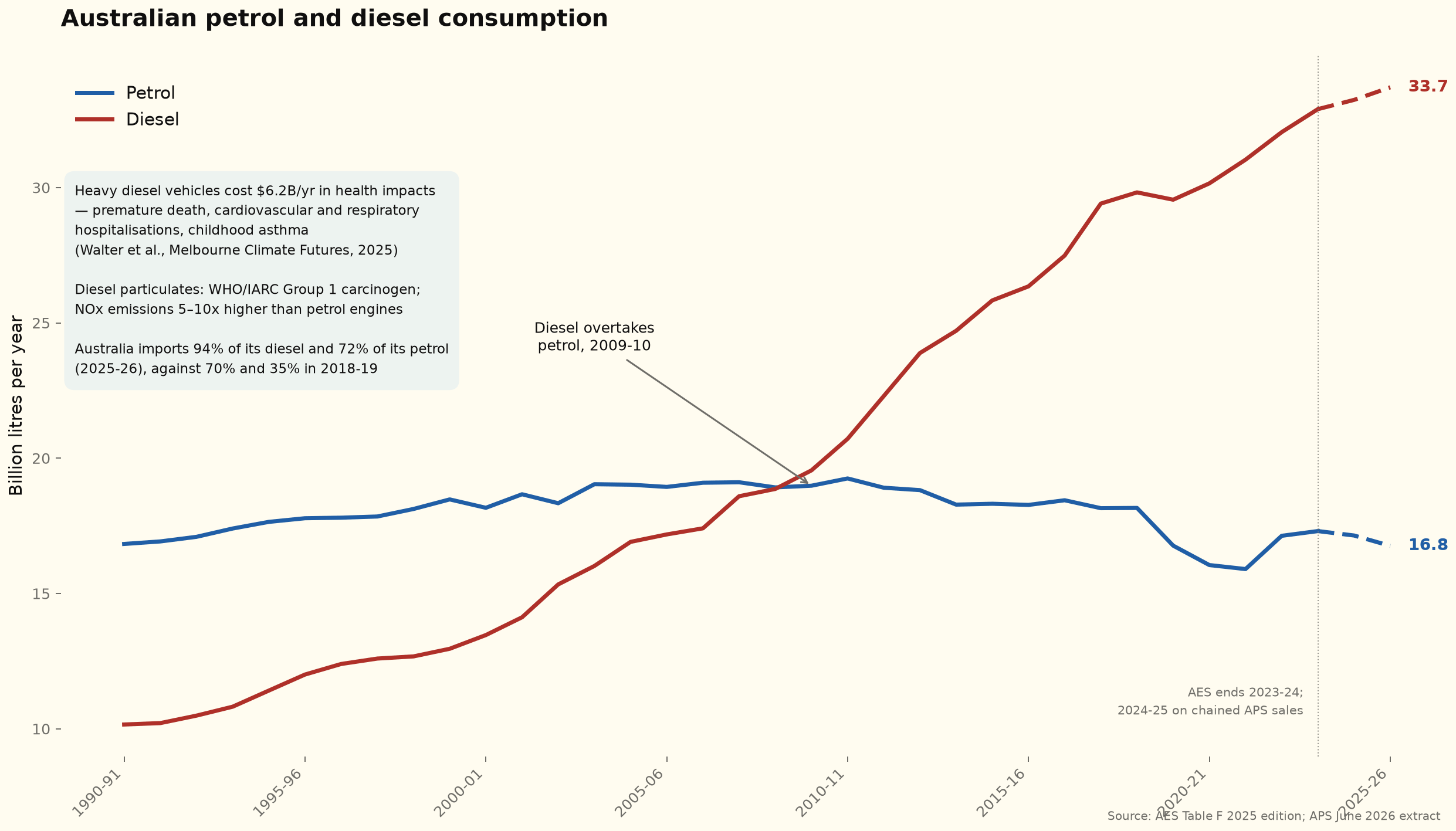
Then the rise of diesel’s share:
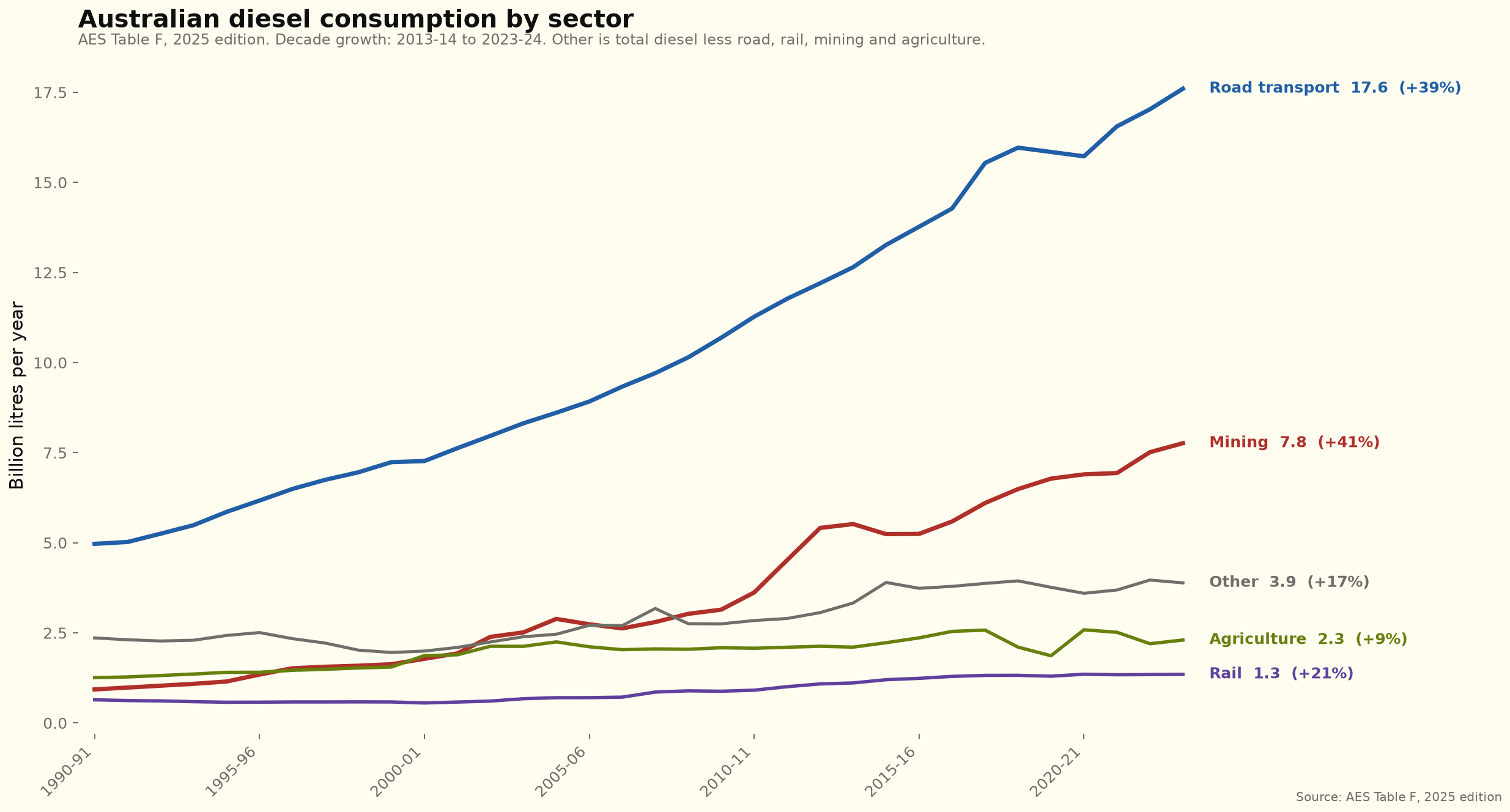
Then where the diesel goes:
So that’s the big picture, now let’s move to electrification.
Electrification of diesel road transport economics
The economics of replacing diesel in road transport is straightforward. Its spending capex to avoid opex.
How much does it cost to go a km on diesel?
How much does it cost to go the same km on electric?
How much more expensive is the electric truck compared to the diesel one?
Sign me up, where can I charge the truck.
The first thing to notice is we save variable cost (fuel per km) by perhaps increasing capital cost. Since the dawn of time when the ancients moved from using people to pull a plough to using horses or oxen that is how productivity has been achieved.
So let’s look at the numbers and the Orange man effect.
Now let’s get all fancy and make a plot that shows the fuel saving/capex premium for various forms of trucking. This plot has to be studied.
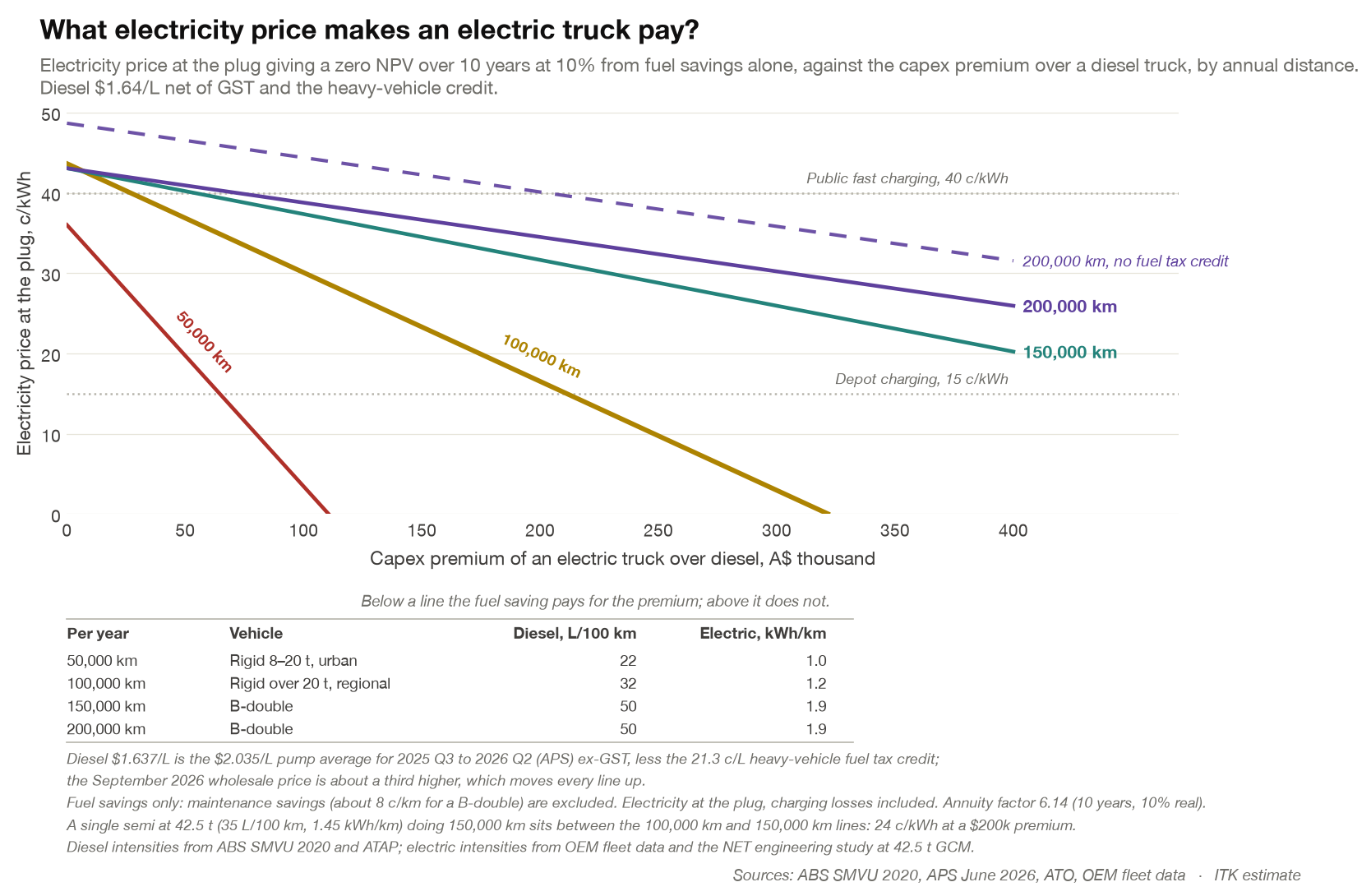
Working through it: The vertical Y axis is the electricity price you pay when you charge your truck. I only run it up to $0.50/kWh. You could imagine higher numbers, but I don’t. The chart marks 40 c/kWh for public fast charging and 15 c/kWh for depot charging.
The horizontal X axis is the premium the electric truck pays over the diesel equivalent. My “bingo” channel sources suggest that for a 3.5 t truck you might pay say $80k for a Japanese diesel and say $110k for a Chinese electric. I expect that differential to reduce (see cars) but it’s where we are right now on gen 1 electric trucks. On the other hand up at the B double area you can find people who will swear blind and blue that a Windrose E700 is about the same as a new Mack and maybe a bit more than a diesel Scania, Man or Volvo. Who knows, my channel sources are not that broad and the numbers are “secret”. The table under the chart shows the other assumptions of diesel and electricity consumption per km. The diesel price is fixed at a conservative $1.64/L reflecting a rebate and ex GST and mostly ignoring Hormuz.
So to read the chart. If the capex premium is zero for electric, ie same cost as diesel, then the electric could pay over $0.40/kWh and break even. If the FTC rebate was eliminated they could afford almost $0.50. If I allowed for lower servicing costs, and these are real, there is a big UK study on cars showing it, then even higher prices could be justified.
The chart basically shows the obvious point that the more km you travel a year the bigger the capex premium you can afford. At 200,000 km a year for a B double you could pay say $200k extra capex if the charge cost was no more than $0.35/kWh, or $300k at $0.30/kWh.
But what about the charging?
The trucks exist. Here’s a post from LinkedIn from Ross Linton.
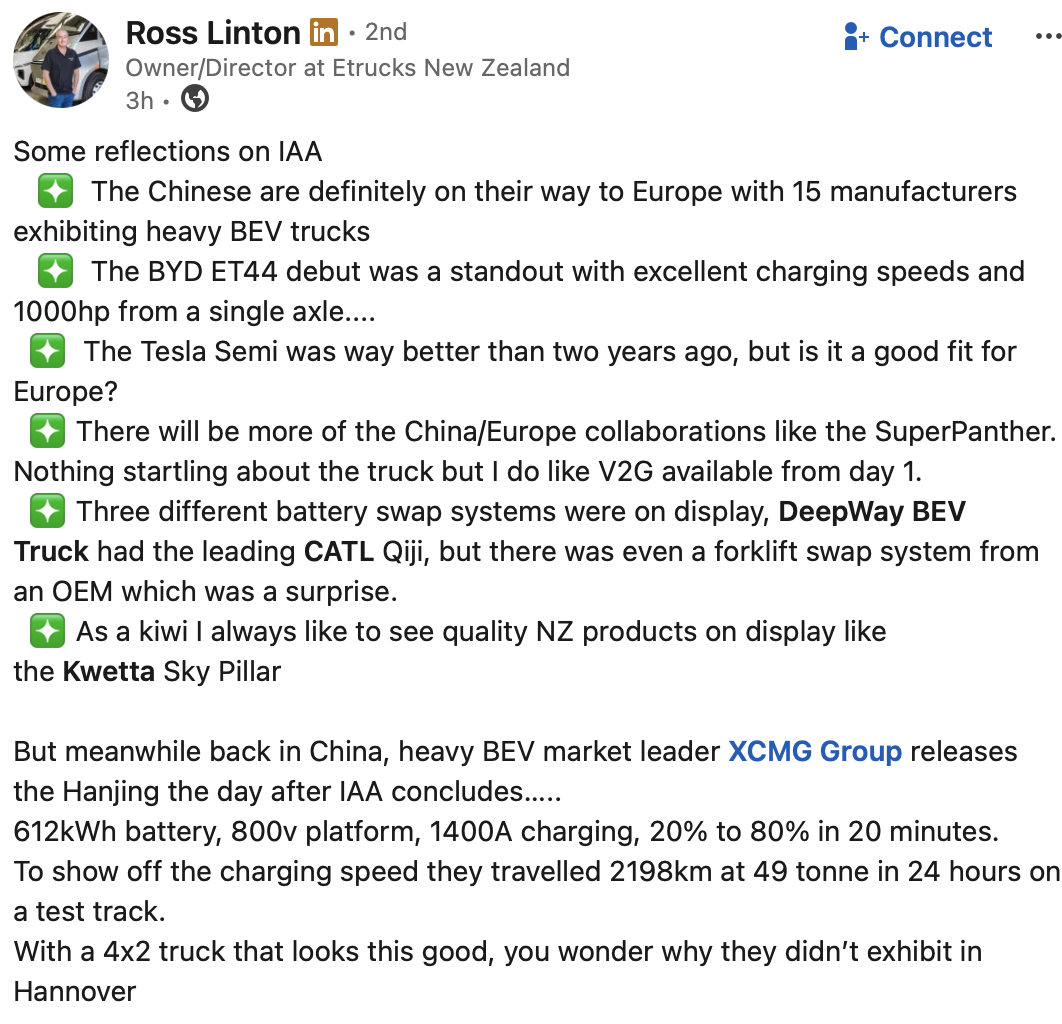
That’s only the Chinese manufacturers and Tesla. Tesla signed a 2,500-truck single order in the USA. Let’s get real. There are also the European traditional manufacturers who once they have changed their undies are getting on with meeting the competition. Normally in Europe this means moving the goalposts but we can come back to that.
Like I said the trucks exist. What doesn’t exist is the charging infrastructure. It would be easy to blame the Government for this. After all if something is wrong it is obviously the Government’s fault. Except in my house where it is always my fault.
But really, the Government hardly knows what day of the week it is, and it is almost humorous to see Albanese holding hands and talking climate change in the Pacific or at the United Nations whilst having very little policy and certainly a diesel supporting rather than diesel reducing policy for fuel. That should not blind us to the opportunity this opens up for the private sector.
We can live in hope that even an Australian Prime Minister can eventually realise that actions speak louder than words. Much louder. As does a lack of action. But when faced with the political alternatives to our current prime minister most of us will just put up with what we’ve got and restrict ourselves to ever-increasing cynicism. And then observe that nature abhors a vacuum and there is an opportunity.
The opportunity is to build chargers. Quickly.
Around the world there are basically three truck charging models:
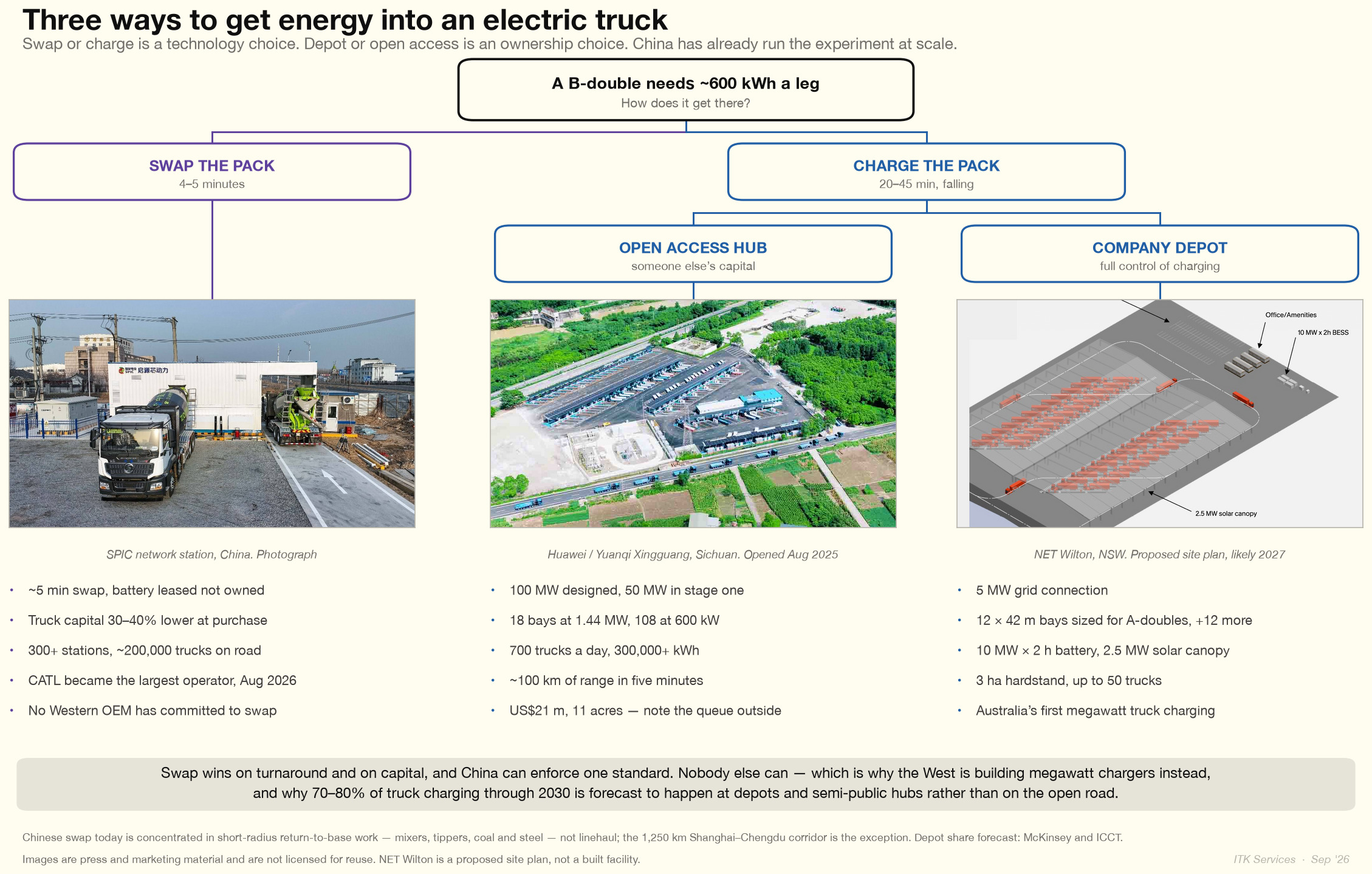
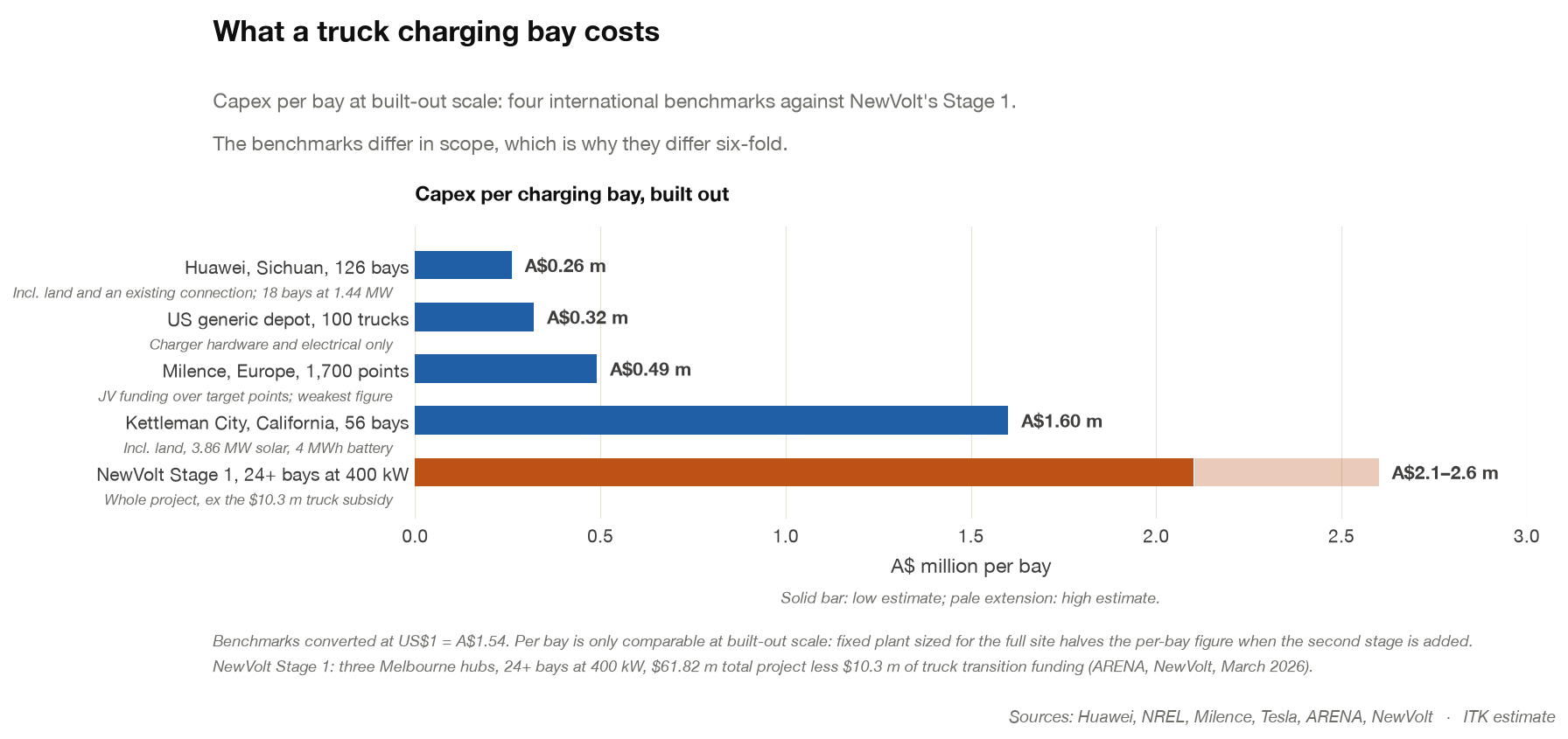
Look at all the trucks lined up at the Huawei hub. What would a charging station cost? Based on internet searches you can get a range between $1 m a bay and $2 m a bay. If we used the NewVolt numbers you are looking at a spread of about 12–17 c/kWh over the energy cost at 20–30% utilisation.
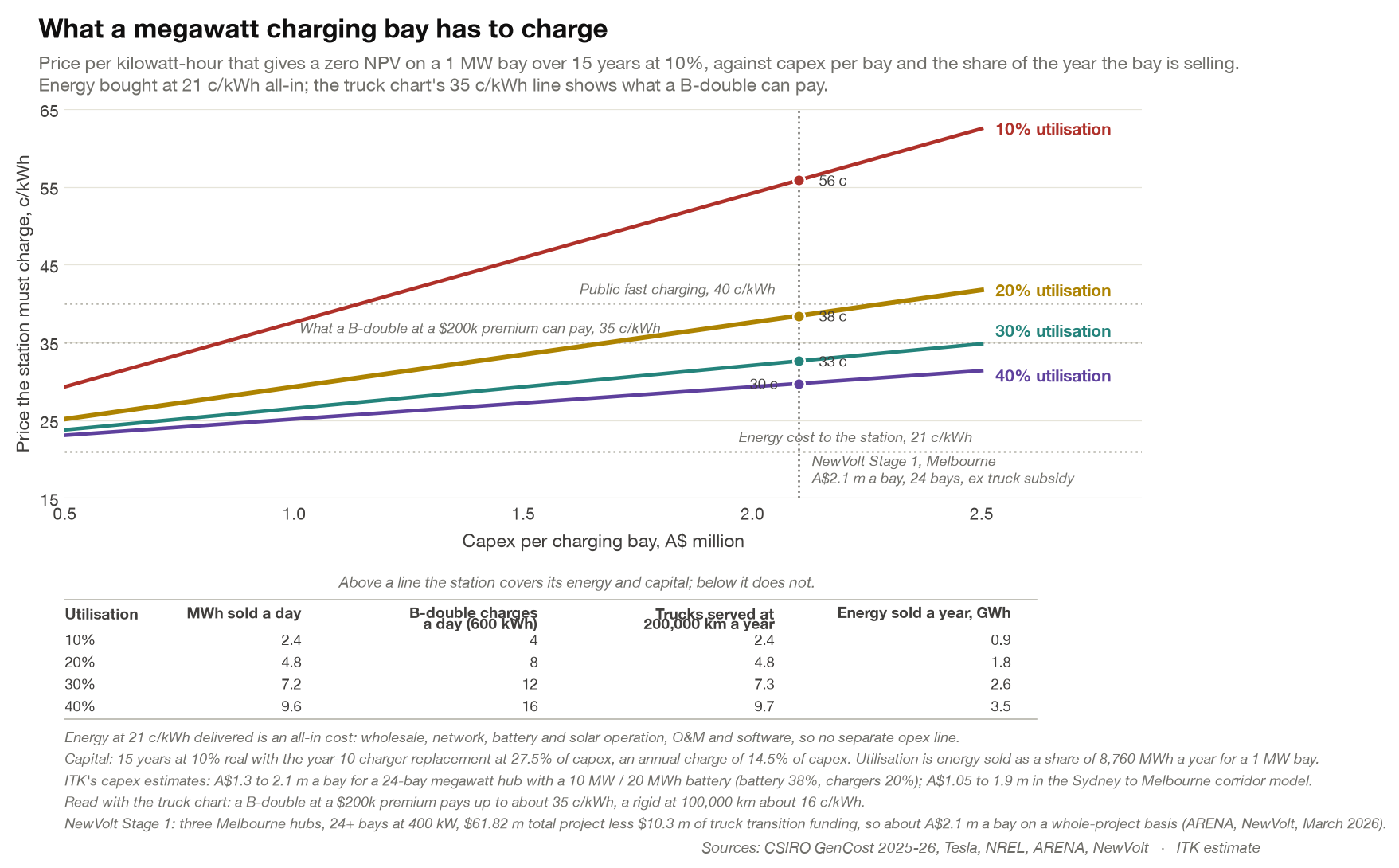
There are a lot of factors to think about in relation to charger cost. Alternative use of the land, grid access, grid dependency, self generation, learning rates and so on. However there are reasons to think that with care and under competitive pressure costs could come down.
The company depot suits a business that can keep its own chargers busy: size the fleet and the chargers together, push utilisation up and the power cost down.
Equally if you could be first to market with the Open Access Hub you might get good capacity utilisation and as with other technology grid access might be a scarce resource. No doubt there are lots of factors.
As with solar and wind farms working out where the locations should be, optioning the site, organising your on or near site generation could end up with a semi competitive moat. If you have all the best sites maybe you have a cost advantage.
In any event my feeling is that NewVolt cost is ok for a first attempt but looks quite expensive by global standards and costs should come down as the network is built. Land costs have to be considered of course. Charging station BOS costs vary widely I expect depending on location and other design choices.
I argue that the FTC rebate could be used to invest in transport electrification.
Repurposing the FTC - lots of support to eliminate the FTC
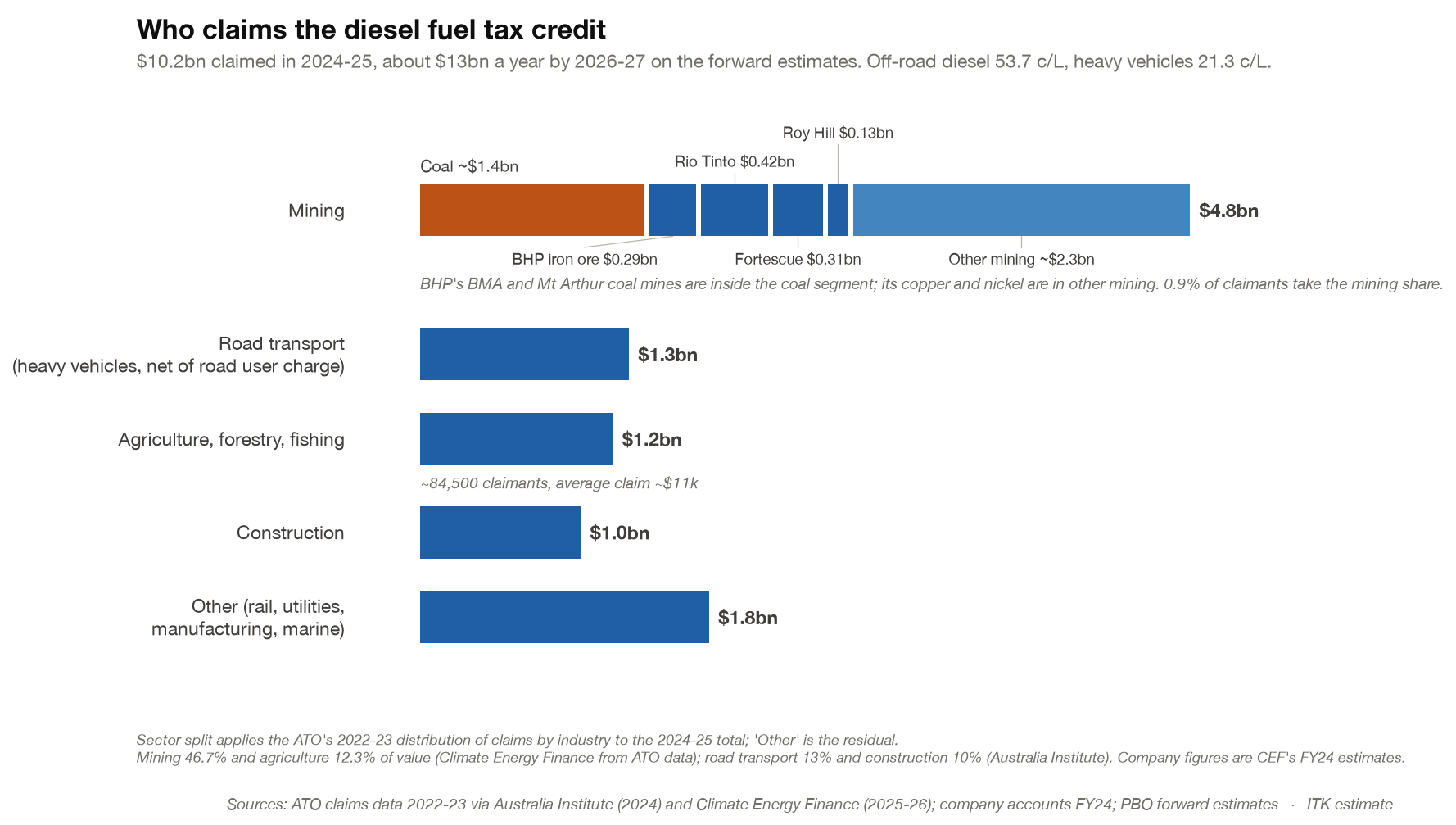
Most of the diesel fuel tax credit goes to the mining industry but about $1.3 bn goes to reducing diesel costs for heavy vehicles. I cannot understand why coal miners, BHP and Rio Tinto should get a tax rebate for burning diesel and as you can see from Figure 3 mining’s consumption of diesel is up 41% in the decade to 2023-24.
By my estimate, over 10 years one 240 t haul truck claims about $6–7 m of FTC and that would easily pay for an electric truck replacement all by itself.
Most reform proposals have been aimed at the big miners. The Greens naturally favour abolition for fossil fuel companies.
Climate Energy Finance proposed a $50 m annual rebate cap with credits above only available if the credit money was used for decarbonisation capex. Most companies fall below the $50 m cap, so the policy would only impact big miners. A version of this was endorsed by Fortescue, and the ACTU proposed a $20 m cap.
There is reported to be significant support within the ALP rank and file for a cap. But any discussion has been put on hold thanks to Hormuz. The Government priority is short term. Keep diesel prices down.
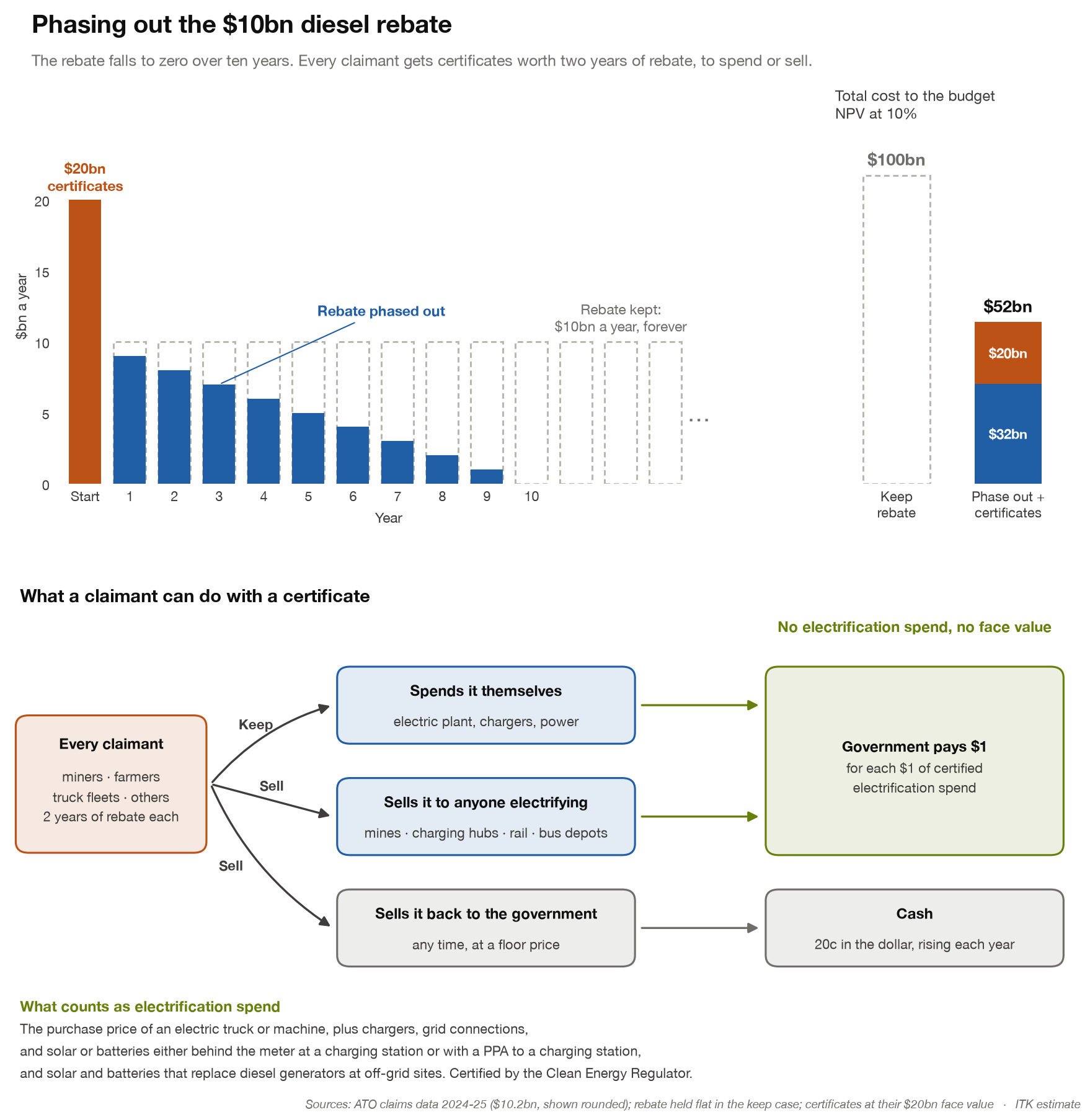
My proposal: phase out the rebate and give claimants tradeable certificates
Rather than write 1,000 words, here is the proposal in one graphic.
The rebate falls to zero over ten years. Every claimant gets certificates worth two years of its past claims. A certificate pays its face value only against spending on electrification, as defined on the chart. A claimant who can’t electrify, a farmer say, sells it to someone who can, or back to the government at a floor price. Measured in today’s dollars, the long term cost to the budget roughly halves and funding is provided for electrification. As I said just another thought bubble.