Anthropic IPO scan - building a better HAL?
The thesis I have been running with this year is that there are only a couple of places to be in the AI Lab space. One space is to be the “best”, the other is “good enough and cheap enough”. Anthropic aims to be the best. It is also my preferred AI, indeed the only one I use other than Google search. The Anthropic thesis is:
- Inference is likely very profitable
- You have to invest in training to stay on the inference frontier and be able to charge a premium
- In 2027 Anthropic, like other labs, will have a huge increase in available compute. If it cancelled its cancellable contracts, profitability would go up a lot. So the question is how much future growth and advantage the optional training compute buys, over and above the committed compute.
Anthropic investment is really a bet on how much better AI will get The dominant question people should ask is will the models keep improving? And how much? That drives the use cases, and the pricing power. Many people get hung up on data centres and power and ethics and job losses and many other important issues without really devoting enough time to understand (A() what the labs can do now and (B) what they will be able to do in a year or two. An investor needs to take a deep dive on capability if they are to have a hope of forecasting revenue.
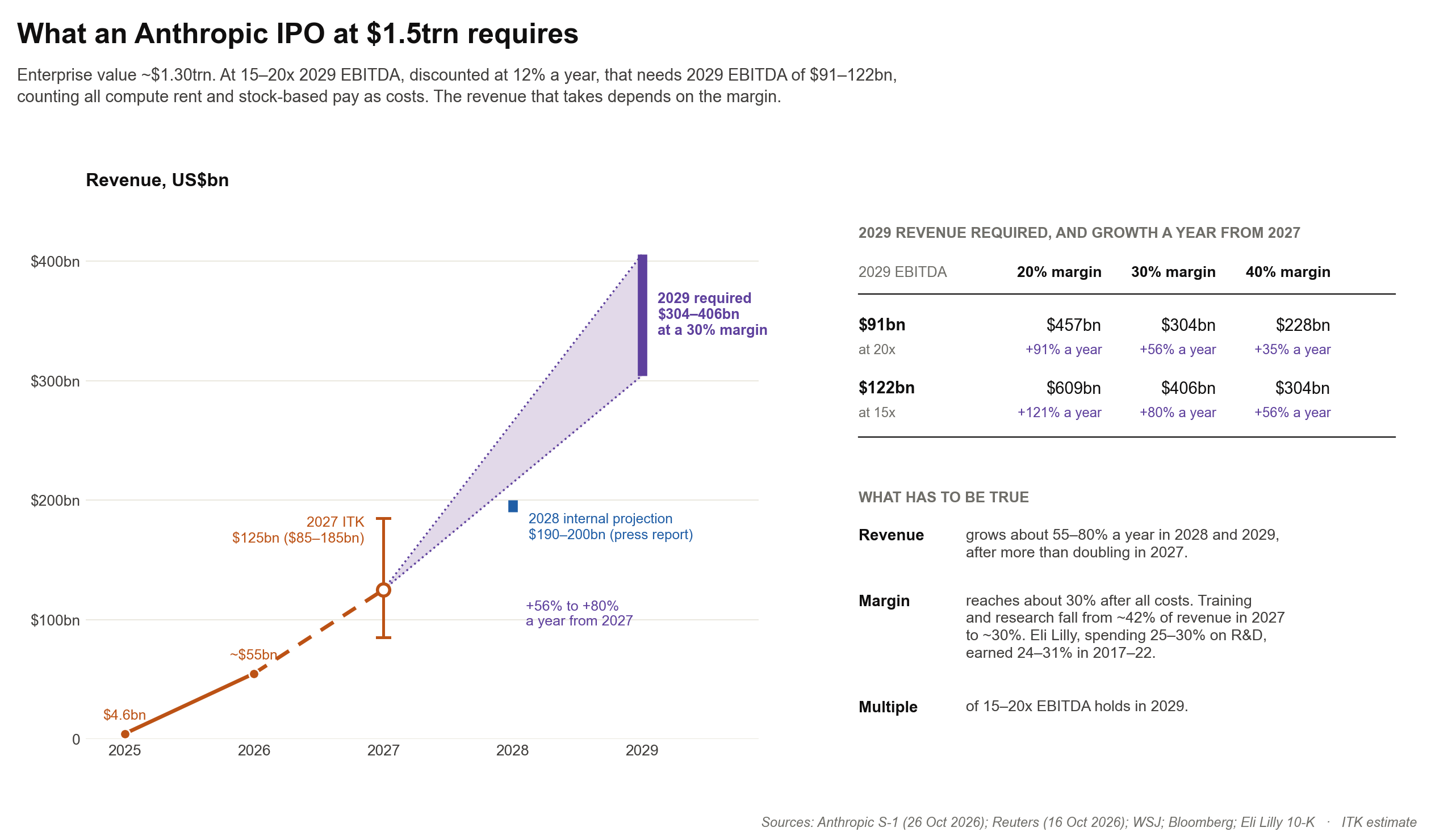
The IPO is reported at $1.5–2 trillion. In my view something like US$300 bn of 2029 revenue is required to justify thatt.
In my opinion Anthropic has been the market leader for most of this year, on two criteria: (i) it has been at the top of the AI task leaderboard, and (ii) its management espouses values and a culture that I can somewhat support. Beyond the AI you have to look at the people pushing the buttons.
For me it is beyond any doubt that AI is very useful. It’s lifted my capabilities very significantly. I was an average Python coder; now I produce dashboards in a morning. I was a good but flawed writer; now my notes have far fewer grammar, spelling and other errors. I was a proven investment banking analyst; now I can research any topic at will, including reading and summarising reports written in most other languages. I could produce good graphs and knew what better ones looked like; now I can produce magazine-quality graphs as often as I need them. It’s not far off fantasy capabilities and yet as an analyst of more than 40 years’ experience I’m well aware it’s a tool and I am less smart (cognifitve ability declines with age) than I was two years ago.
Obviously my new super powers must be used with restraint. It’s always been a problem for an investment banking analyst to get a “share of voice”. To get someone to read. Now there is way more content, but tine is constant.
I digress because:
- Sceptics doubt if AI adds value;
- Sceptics doubt if AI labs are profitable.
- Sceptics doubt if it’s worth building all the data centres required;
- Humans don’t trust machines and trust AI and its proponents less;
- “Big tech” is a target, as big business has always been, and in Australia the tall poppy must be cut down.
To the IPO
Let’s start with the P&L. Based on the latest six months’ data my presentation is:
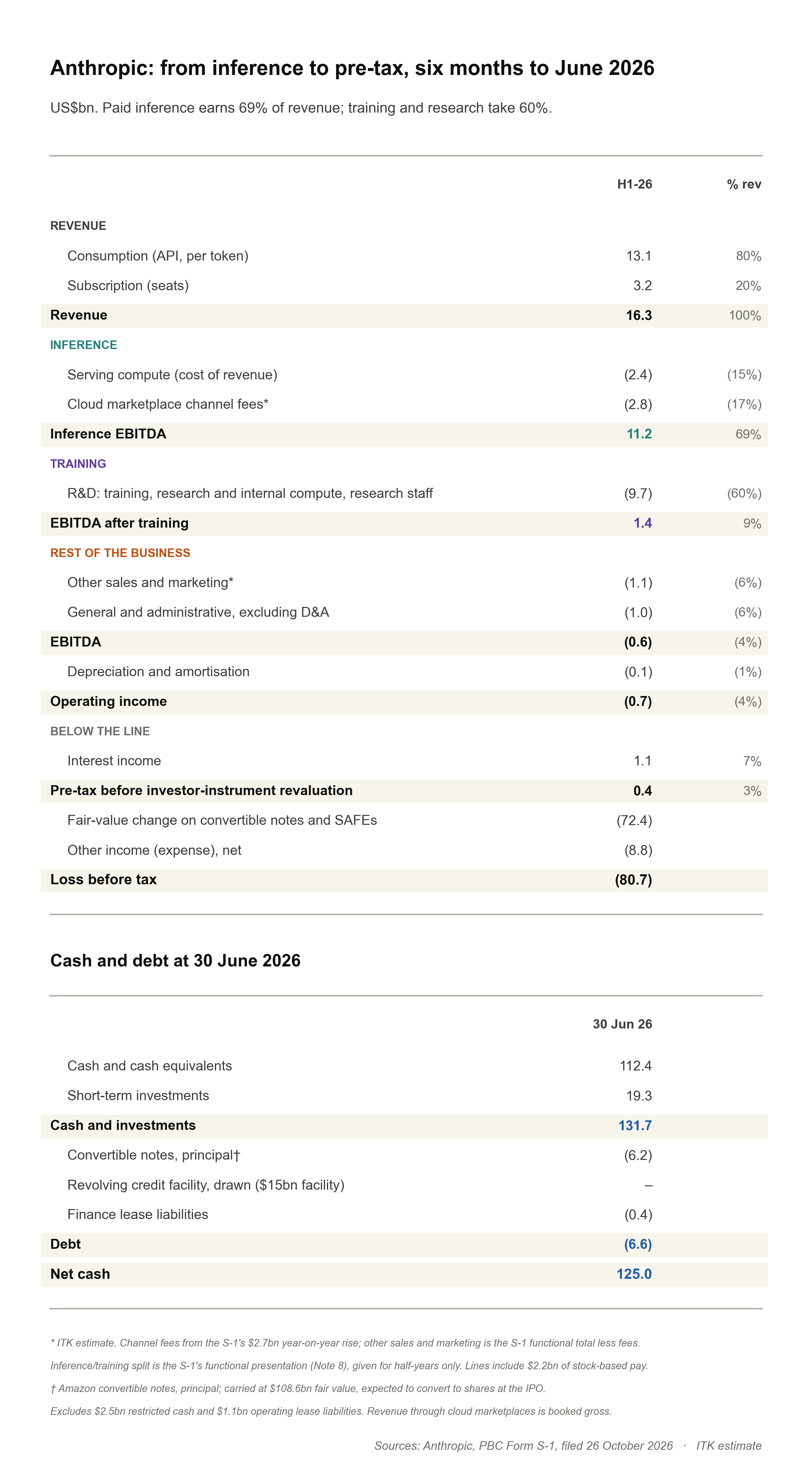
This table purports to show that inference is profitable for Anthropic. After training the business roughly breaks even, and overheads push it into losses.
Although the business is very compute intensive, depreciation at present is negligible. The compute is rented, so all of its cost, for inference and training, sits in operating expenses. But that is going to change from 2027. The Broadcom equipment leases come onto the balance sheet as finance leases, so their cost moves out of operating expenses into depreciation and interest. Operating expenses fall and EBITDA looks better than the cash flow. The cloud contracts with Google, Amazon and Microsoft stay in operating expenses.
Let’s have a look at these nosebebleed inducing forward agreements.
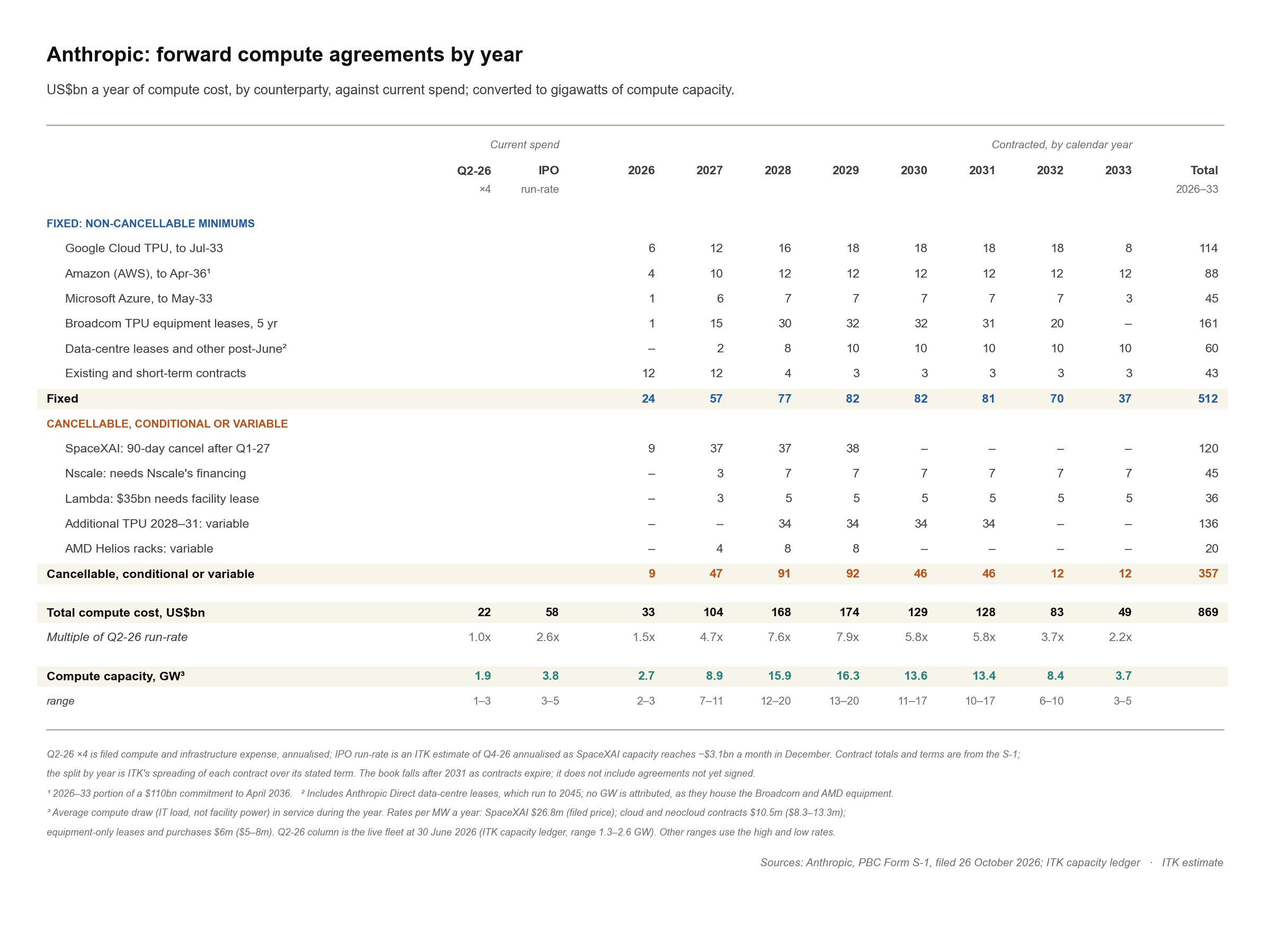
Half a trillion US$ of non-cancellable compute commitments to 2033 is any way you look at it a lot of money. You might think Anthropic with $132 bn of cash and investments is well capitalised, but that covers only about a quarter of the fixed commitments.
Model usefulness remains the key
Having enough compute is one of the keys to model capabilities continuing to increase.
Eighteen months ago Anthropic was way behind in terms of its access to compute but it’s catching up.
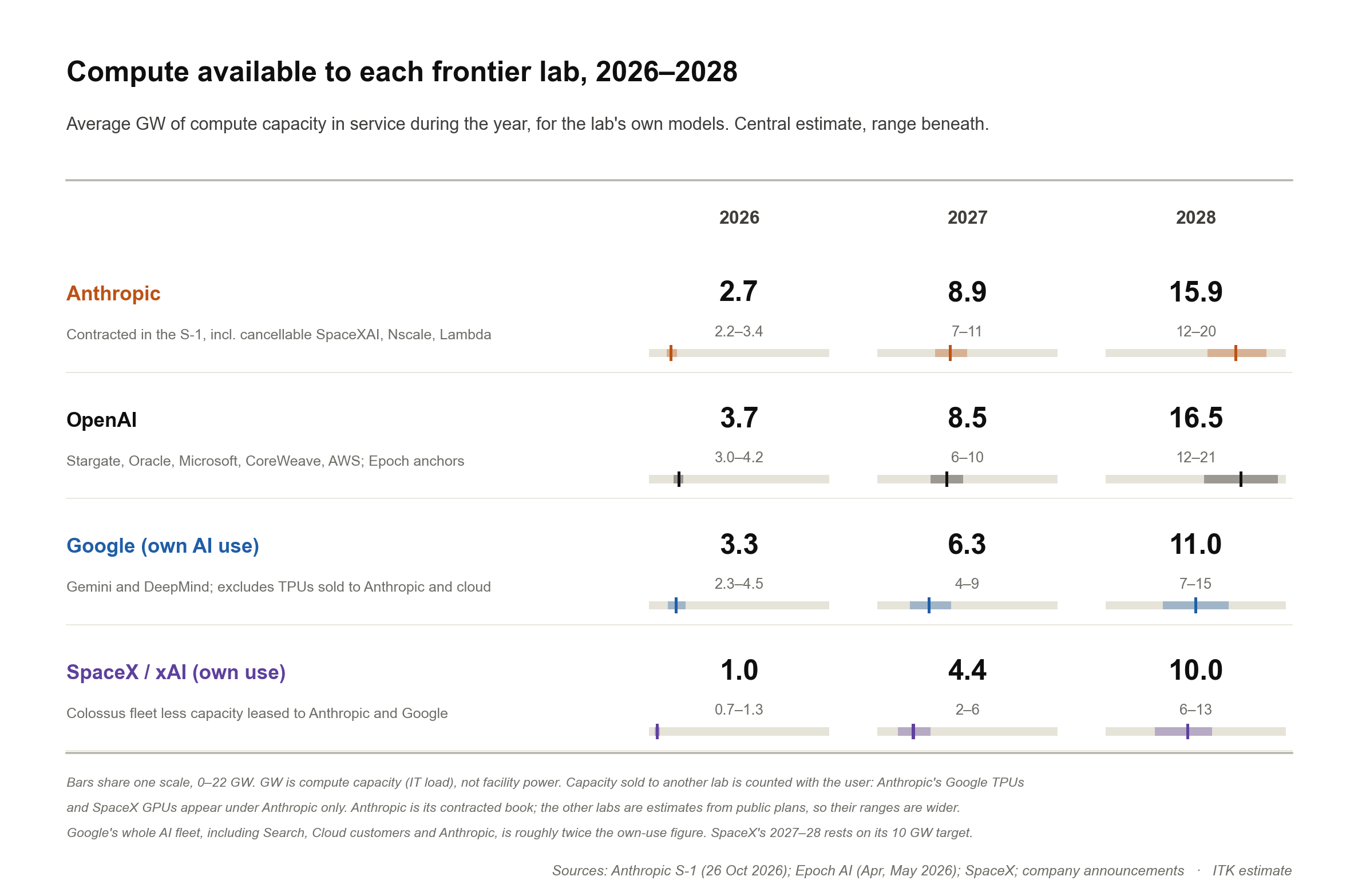
On the above chart every major provider will have access to way more compute in 2028 than they had in 2027. The question is what this will mean for model capabilities. Model capability is the dominant question.
I hesitate to project capability beyond 2027. My historic bias is to underestimate growth. However it still seems reasonable based on recent rates of progress, and the vast amounts of new computing power that will be applied, to forecast “lots” of capability growth in 2027.
Fundamentally this means that demand will grow. People, and businesses in particular, will want access to tools that rapidly increase productivity. Big business will find ways to harness and apply this new “intellectual workforce”.
Behind that is a second wave as robots are developed. How far away can brick laying robots be? Autonomous driving? Health care robots doing room cleaning, resident transfers, food delivery and pick up? The point for the Anthropic IPO is that increasing model capabilities will drive demand growth at least over the next 12 months.
The chart below shows the capability record to date and my projection for 2027.
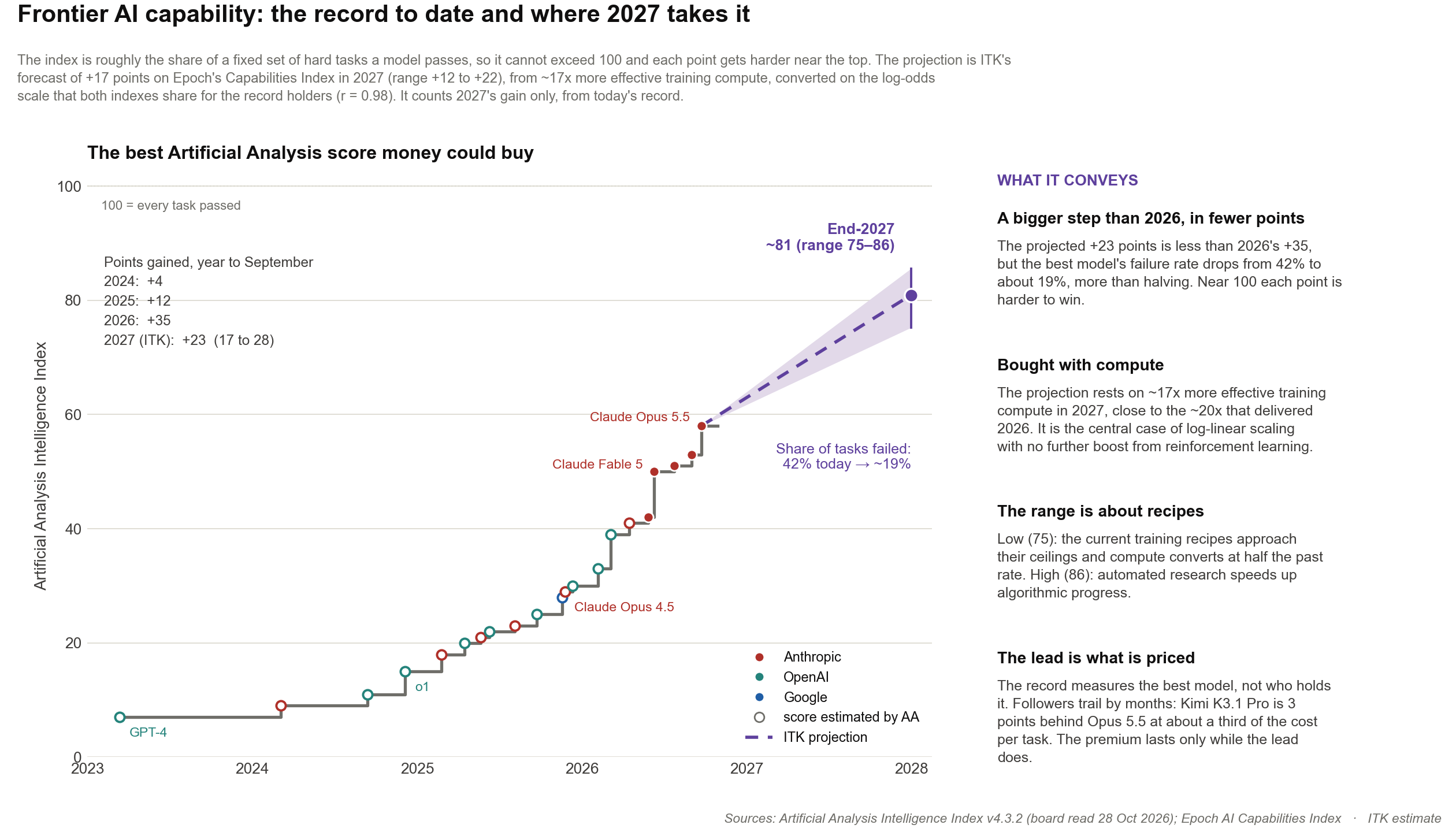
If like me you use AI every day, as a research and technical increasingly senior partner, you will come to appreciate that one of the more subtle benefits is a reduction in the mistakes newer top level models make. Facts and research are generally correct. Calculations, even complex calculations are more likely to be correct and the AI can do more on its own without losing track. It’s very analogous to a new graduate gradually getting ready for more senior roles. Below I show how this translates to pricing power.
The other point to be drawn from the compute and capability charts is that Anthropic’s lead in the AI capabilities index did not come from more compute but from better training “recipes”: in 2026 Anthropic had less compute than OpenAI or Google (Figure 3), yet holds the capability record (Figure 4). Designer and trainer human skill, to this point, has been the key to success. Understanding the use case for AI and building models that fulfil customer needs is where success is built. And it was ever thus. This goes to “culture”.
As the models become ever more capable (powerful?) the question is whether human skill remains a differentiating factor? Or will having the most capable model become a self perpetuating advantage as models find their own ways of improving capabilities? You can get worried about this as Clarke and Kubrick postulated in the 1968 “2001 a space odysse” but with that worry comes the dream. That dream is a material advance in productivity that means better lives for the majority of people.
Pricing power is questionable but commodification is not inevitable yet
It’s obvious that any respectable AI “model” will be able to do many tasks and as such basic AI will be a commodity and commodities by definition do not have pricing power.
However there are many soccer players in the world but some get paid a lot more than most. Anthropic has so far shown that it can charge a premium. I personally would find it difficult to switch model providers although I’m sure I could if Anthropic gives me a reason. Some professionals switch models all the time. I suspect though that businesses big and small will pick a product and then that product will get embedded in the culture. You only have to see the success of Microsoft in the business world for an example. And the more you let AI learn about you and your business the more useful it becomes. No doubt there are limits.
More analytically even a small reduction in mistakes over a long task can justify a higher price. The table blow compares two models with Artificial Analysis Intelligence Index scores of 58 and 55. The 58 model charges twice as much per token, and the task takes 40 steps.
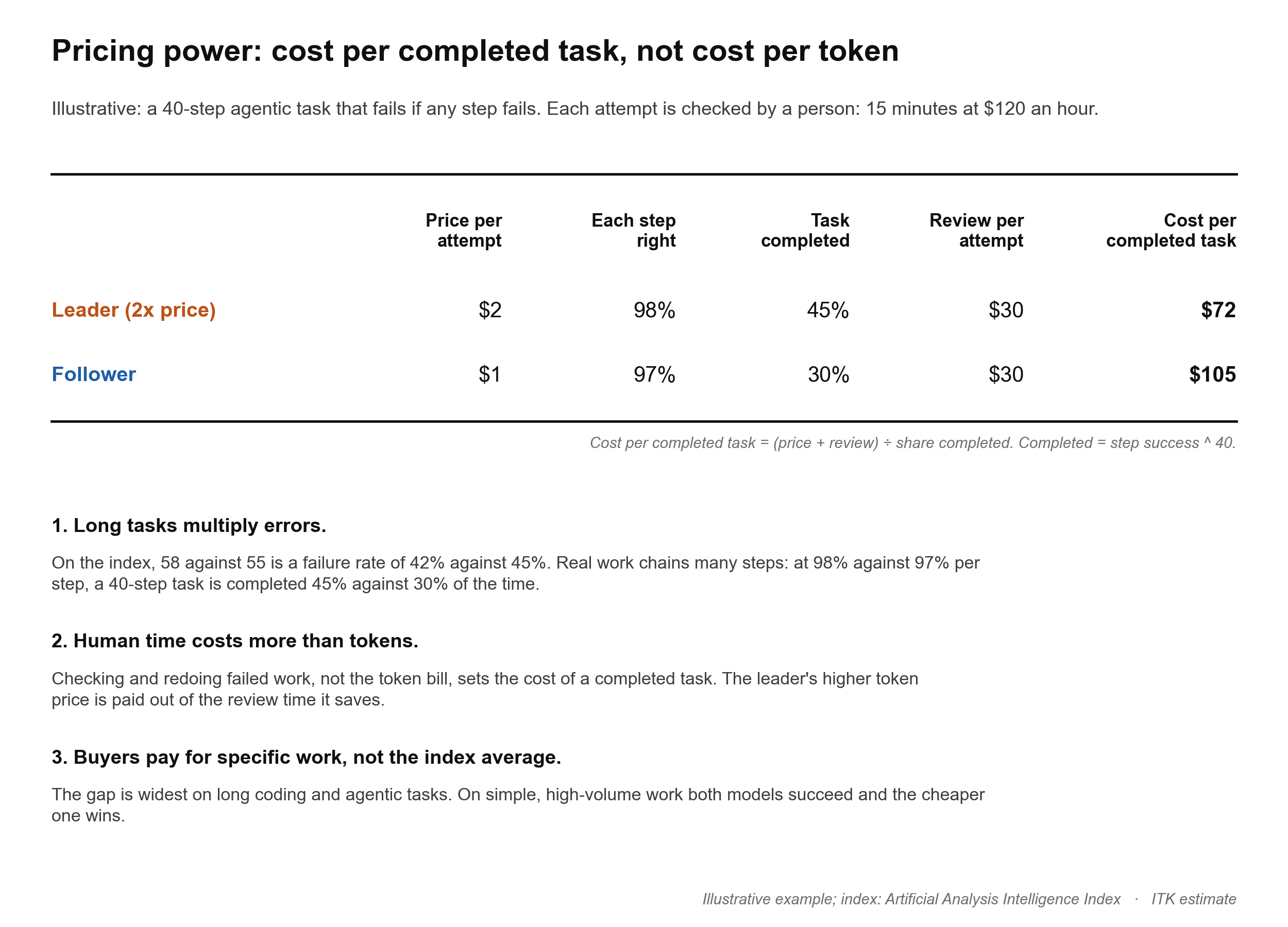
So my view is that there is likely to always be space for a premium model or two.
A stab at the 2027 P&L
Forecasting Anthropic’s financials is a fool’s errand. In about 1983, as the only analyst at the now defunct stockbroker Norths, I wrote a four-page report on BHP after three days’ study, printed on light brown paper to stop photocopying. The day after it came out the AFR rang to ask what I thought of the BHP result: I had the most accurate profit forecast. I hadn’t even known the result was out. I have never had much respect for forecasting skill since; these days I would call it confusing luck with skill. As Albert King sings, “as for luck I ain’t had no luck at all”.
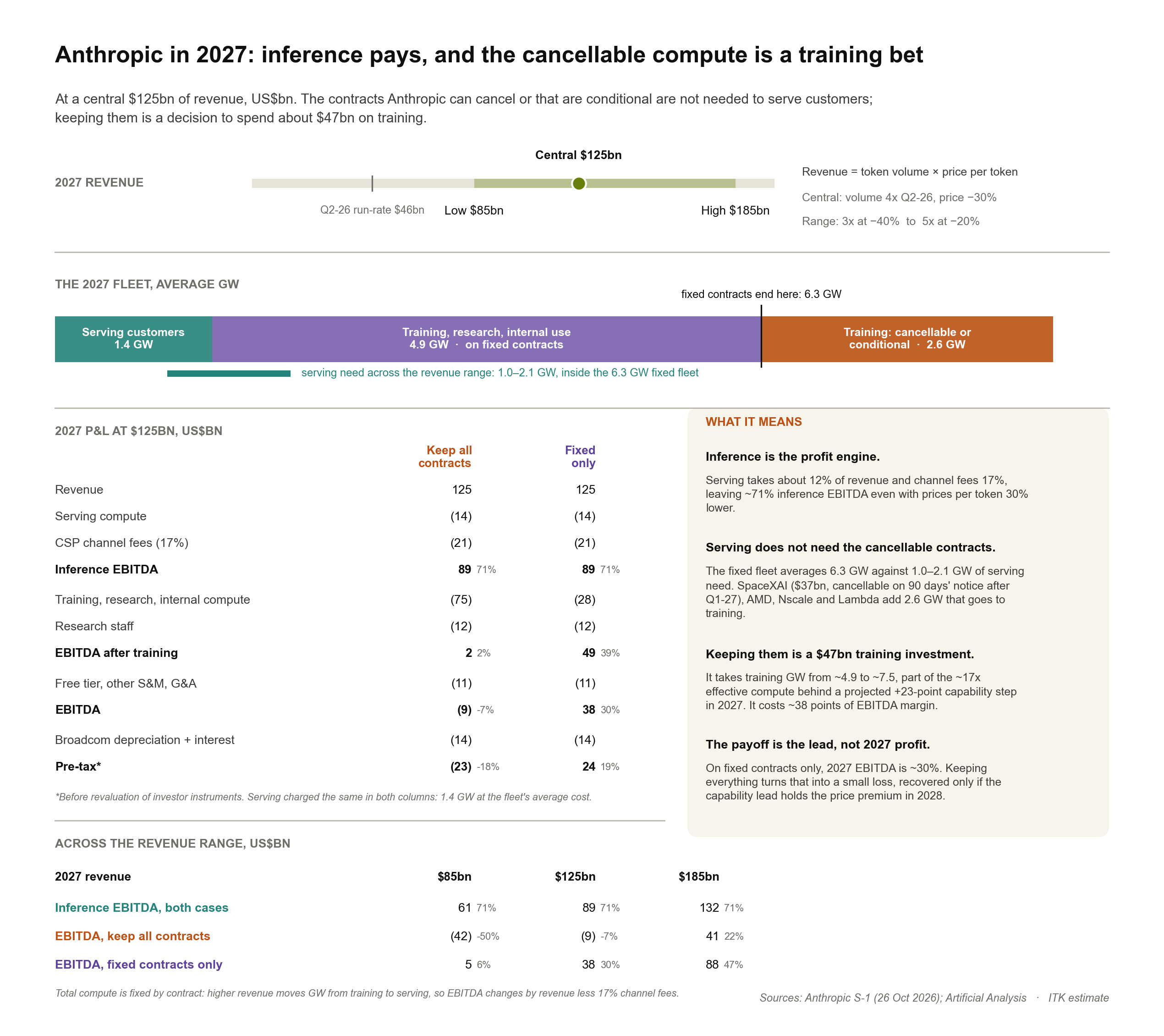
Plausibly there is a huge range possible for 2027 Anthropic revenue, something like $85 bn to $185 bn. My estimate today is around $125 bn.
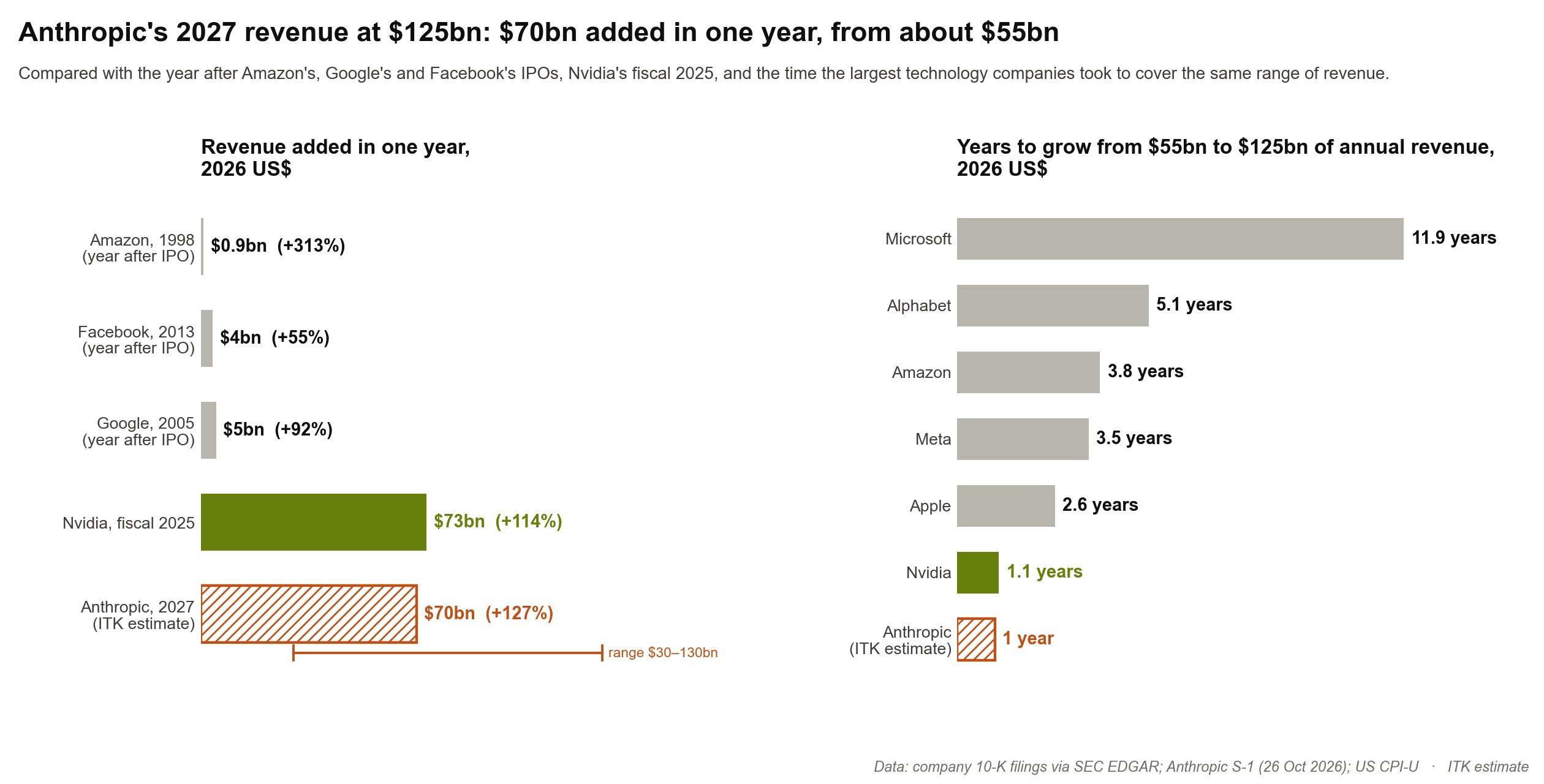
For context, the chart below asks two questions: how much revenue did other companies add in the year after their IPO, and how long did they take to grow from $55 bn to $125 bn?
Although Anthropic would have to do better than any previous IPO in absolute dollars it is comparable with Nvidia and even Apple. And in percentage terms Amazon did better and Nvidia is similar.
Then we can build a P&L. Of the many versions possible, I show two.
- Inference earns about 70% of revenue in both.
- Training is where the money goes: about $75 bn if Anthropic keeps every contract, $28 bn on fixed contracts only.
- Keeping the cancellable contracts turns EBITDA of about +$38 bn into about −$9 bn. That $47 bn is the price of the optional training compute.
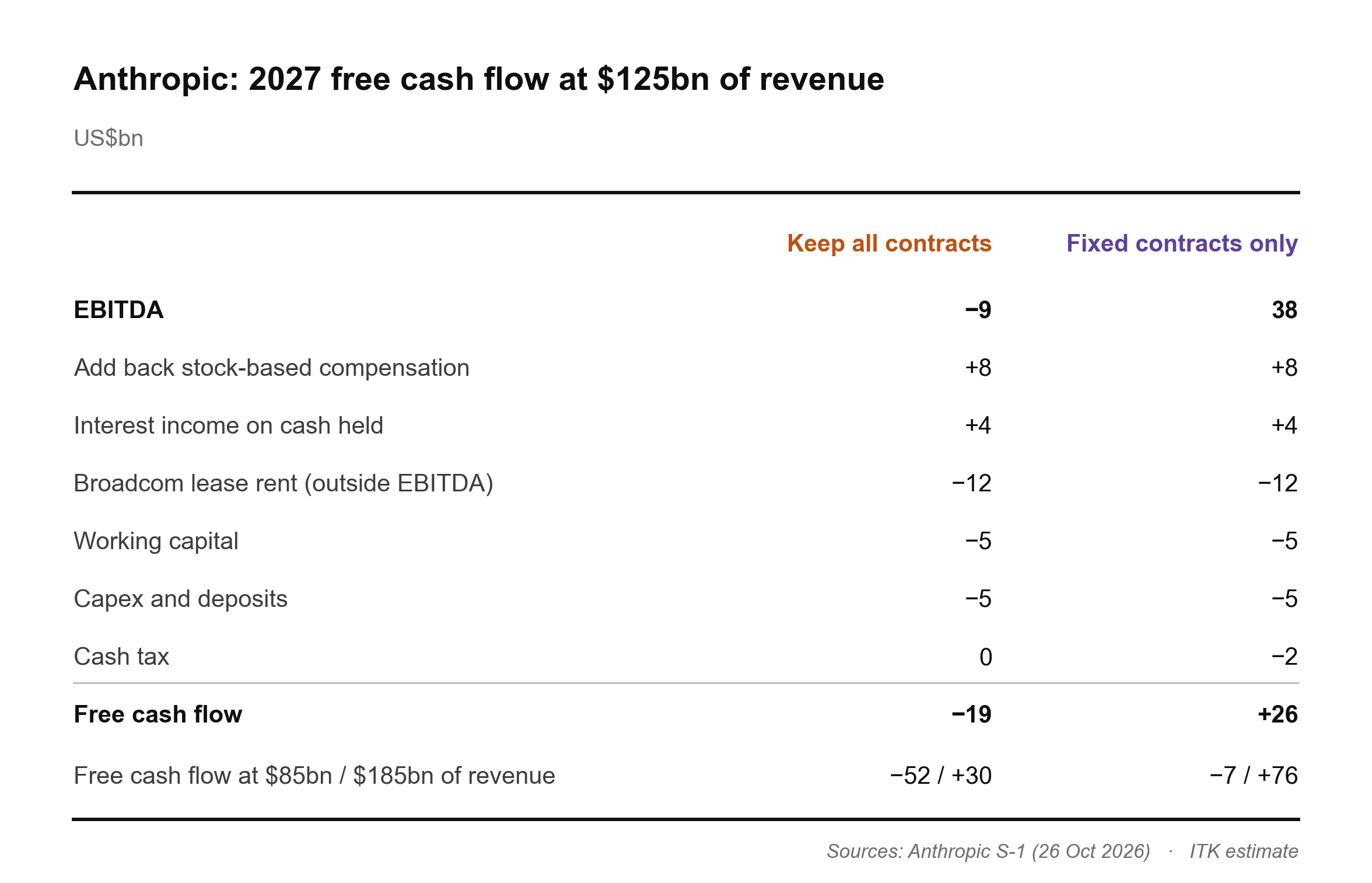
On these numbers Anthropic won’t run out of cash in 2027. Even keeping every contract, the $19 bn outflow uses about a seventh of its cash.
Conclusion: what do you have to believe?
The press talks about the IPO raising money at a valuation of $1.5 to $2 trillion. I have worked on $1.5 trillion.
Once upon a time I used to talk about PE multiples. Then EBITDA became a proxy for cash flow; an even better measure is a free cash flow multiple. For tech companies revenue multiples are common, because margins on incremental revenue are very high. But for labs like Anthropic every $ of revenue carries compute costs, so I prefer EBITDA.
The method is to look out a few years, to when growth settles, forecast revenue and an EBITDA margin, and discount back to today. My EBITDA counts all compute as a cost, including the leased Broadcom chips, and treats stock-based pay as a cost too. I’ve used an EBITDA multiple of 15–20x.
So for Anthropic to be fair value at a market capitalisation of $1.5 trillion, it needs about $91–122 bn of EBITDA in 2029. At a 30% EBITDA margin that means something like $300 bn of revenue. That’s a heck of an ask but not impossible.
In my long-standing analytical method, a standard approach is to compare and contrast. A good example is a business whose high margins are reduced by the R&D needed to stay ahead, and which has had a growth spurt of its own: big pharma, and specifically Eli Lilly.
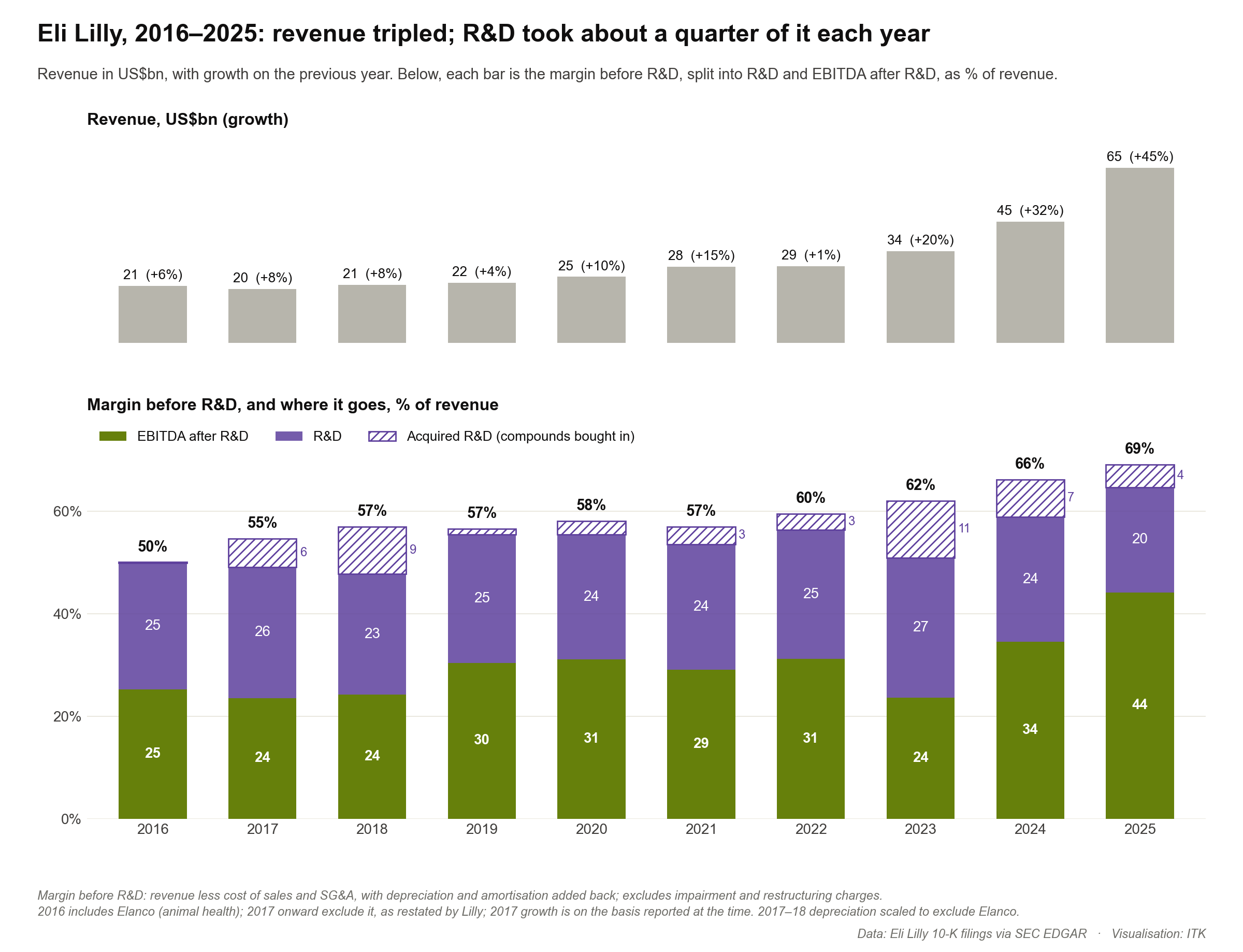
So what do you have to believe? That revenue grows something like 55–80% a year for two more years after more than doubling in 2027, and that training spending then grows more slowly than revenue. The first is a bet on demand. The second is a decision, arguably the biggest win for us al is if the optional investment in training continues to be seen by skilled management as the NPV maximising outcome.